Merkel cell carcinoma is a rare, aggressive skin cancer that tends to affect older White people. Diagnosis is by biopsy. Treatment typically is determined by staging.
(See also Overview of Skin Cancer.)
It is most common in adults over 70 years (1). Merkel cell carcinoma also affects younger patients who are immunosuppressed. Other risk factors include cumulative exposure to ultraviolet light, exposure to the Merkel cell polyomavirus, and having another cancer (eg, multiple myeloma, chronic lymphocytic leukemia, melanoma).
Lymphatic spread is common.
General reference
1. American Cancer Society. Merkel Cell Carcinoma (MCC) Risk Factors. January 10, 2025. Accessed November 10, 2025.
Symptoms and Signs of Merkel Cell Carcinoma
Skin lesions are typically firm, shiny, flesh-colored or bluish-red, and nodular. The most characteristic clinical findings of Merkel cell carcinoma lesions are rapid growth and absence of pain and tenderness.
Although Merkel cell carcinoma can affect any part of the skin, it is most common on sun-exposed areas (eg, face, upper extremities).

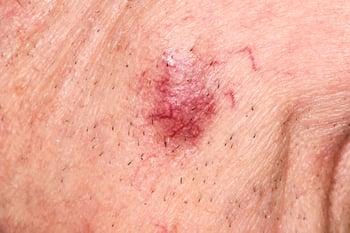
This photo shows a Merkel cell carcinoma manifesting as an erythematous and highly vascular nodule on the sun-exposed cheek of a 90-year-old patient.
Diagnosis of Merkel Cell Carcinoma
Biopsy
The diagnosis of Merkel cell carcinoma is based on a high index of clinical suspicion and confirmed by biopsy (1).
At the time of initial diagnosis, 20 to 26% patients show local or regional metastases and approximately 8 to 14% show distant metastases (2).
Diagnosis references
1. National Comprehensive Cancer Network. NCCN Clinical Practice Guidelines in Oncology (NCCN Guidelines). Merkel Cell Carcinoma, version 2.2026. https://www.nccn.org/professionals/physician_gls/pdf/mcc.pdf. Accessed November 13, 2025.
2. Weilandt J, Peitsch WK. Modern diagnostics and treatment of Merkel cell carcinoma. J Dtsch Dermatol Ges. 2023 Dec;21(12):1524-1546. doi: 10.1111/ddg.15214. Epub 2023 Oct 24. PMID: 37875785.
Treatment of Merkel Cell Carcinoma
Determined by staging
The treatment of Merkel cell carcinoma is determined by cancer staging and typically includes wide local excision, often followed by radiation therapy, lymph node dissection, or both (1).
Systemic immunotherapy (eg, avelumab, pembrolizumab, retifanlimab, or another programmed death receptor 1 [PD-1] inhibitor) or conventional chemotherapy may be indicated for metastatic or recurrent cancer (2).
The prognosis is variable and based on clinical staging, but it is generally poor (2). The 5-year survival for metastatic disease is < 15%.
Treatment references
1. National Comprehensive Cancer Network. NCCN Clinical Practice Guidelines in Oncology (NCCN Guidelines). Merkel Cell Carcinoma, version 2.2026. https://www.nccn.org/professionals/physician_gls/pdf/mcc.pdf. Accessed November 13, 2025.
2. Pan K, Vromans AM, Cheng L, et al. Merkel Cell Carcinoma: Current Treatment Landscape and Emerging Therapeutic Targets. Curr Oncol Rep. 2025 Jul;27(7):822-832. doi: 10.1007/s11912-025-01693-z. Epub 2025 Jun 3. PMID: 40459726
Prevention of Merkel Cell Carcinoma
Because Merkel cell carcinoma is associated with ultraviolet (UV) radiation exposure, a number of measures are recommended to limit exposure (eg, sun avoidance measures, use of protective clothing, use of sunscreen). For more detailed information, see Prevention of Effects of Sun Exposure.
Drug Information for the Topic