Tinea capitis is a dermatophyte infection of the scalp. Diagnosis is based on clinical appearance and by examination of plucked hairs or hairs and scale on potassium hydroxide wet mount. Treatment involves oral antifungals.
Tinea capitis is a dermatophytosis that mainly affects children, is contagious, and can be epidemic.
Trichophyton tonsurans is the most common cause in the United States, followed by Microsporum canis and M. audouinii; other Trichophyton species (eg, T. schoenleinii, T. violaceum) are common elsewhere. Transmission occurs via direct contact with infected persons, animals, or fomites, and is facilitated by environmental factors (ie, crowded living conditions, poor hygiene) (1).
Tinea capitis causes the gradual appearance of round patches of dry scale, alopecia, or both. T. tonsurans infection causes black dot ringworm, in which hair shafts break at the scalp surface; M. audouinii infection causes gray patch ringworm, in which hair shafts break above the surface, leaving short stubs. Tinea capitis less commonly manifests as diffuse scaling, like dandruff, or in a diffuse pustular pattern. It is frequently associated with regional lymphadenopathy, particularly involving the posterior cervical and occipital lymph nodes (2).

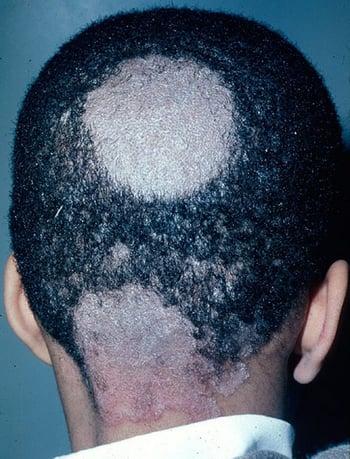
Scales are heaped-up accumulations of horny epithelium. Scaling is a characteristic feature of many dermatophytoses, including tinea capitis, resulting in the large bald patches. In this image, scale is especially noticeable at the nape of the neck.

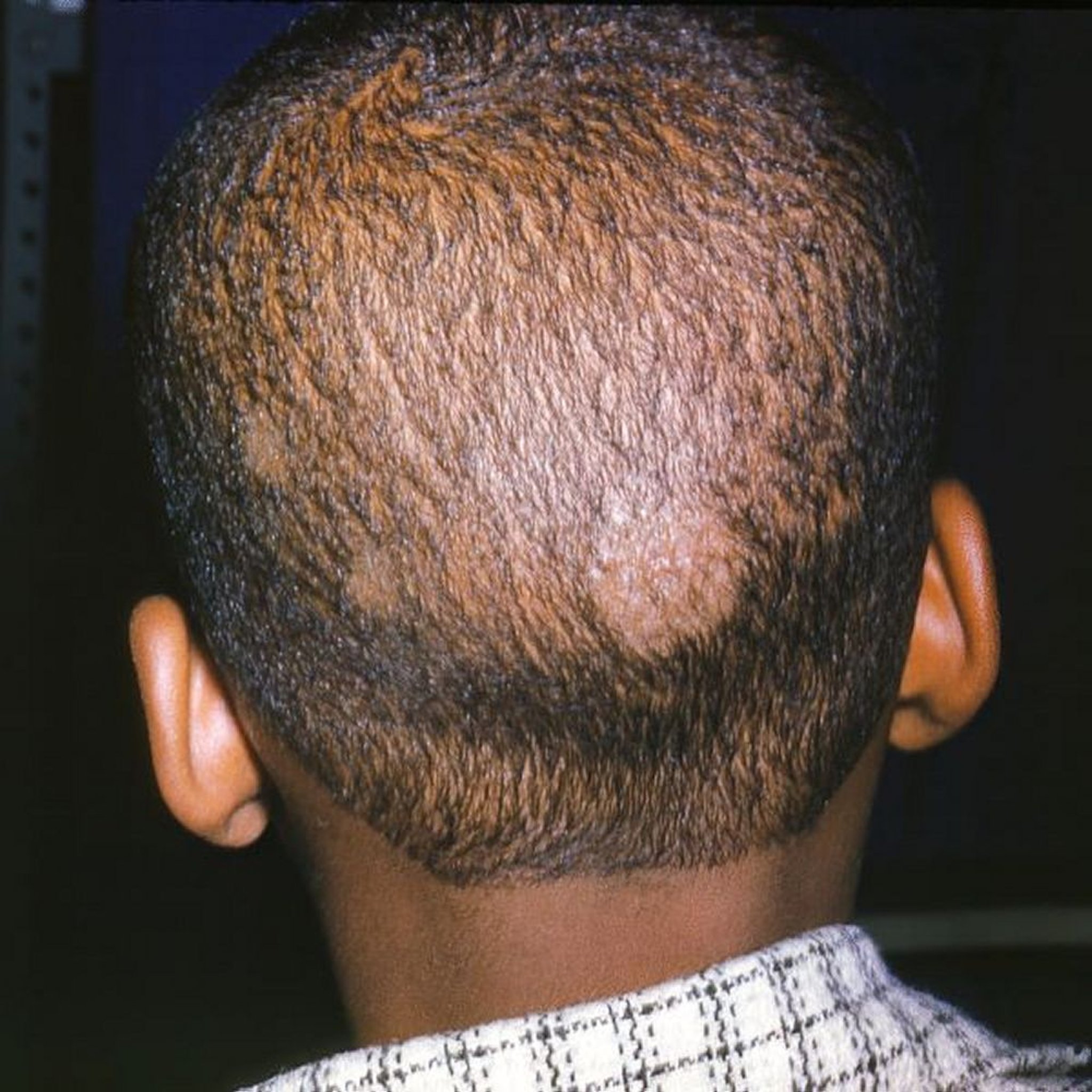
This photo shows round, boggy plaques of tinea capitis. The erythema can be very subtle in dark skin tones.
Image courtesy of Karen McKoy, MD.
Dermatophyte infection occasionally leads to formation of a kerion, which is a large, boggy, inflammatory scalp mass caused by a severe inflammatory reaction to the dermatophyte. A kerion may have pustules and crusting and can be mistaken for an abscess. A kerion may result in scarring hair loss.

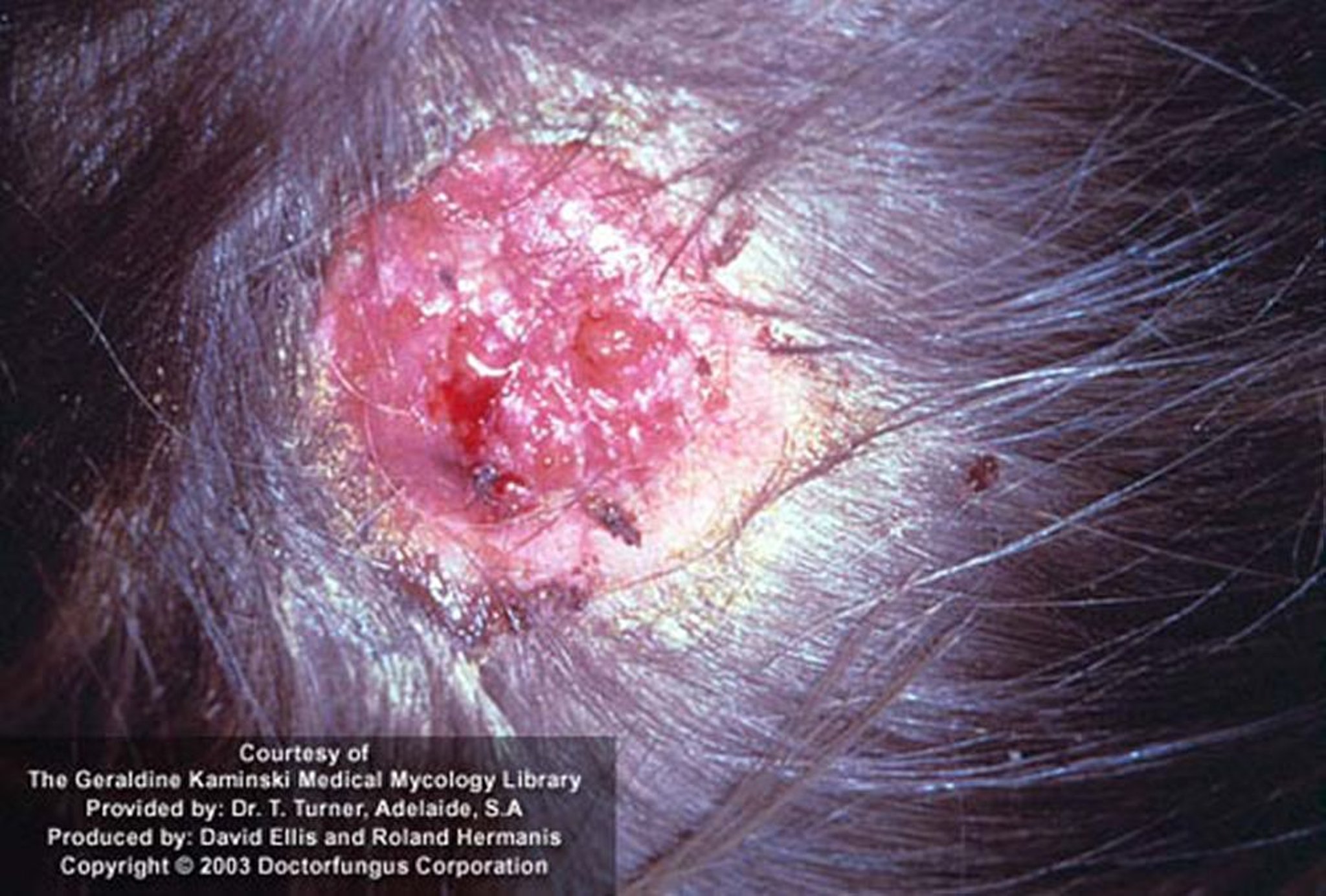
This photo shows a kerion, which is a large, boggy scalp mass caused by a severe inflammatory reaction to a scalp dermatophyte infection. Pustules and crusting are visible.
Image courtesy of www.doctorfungus.org © 2005.

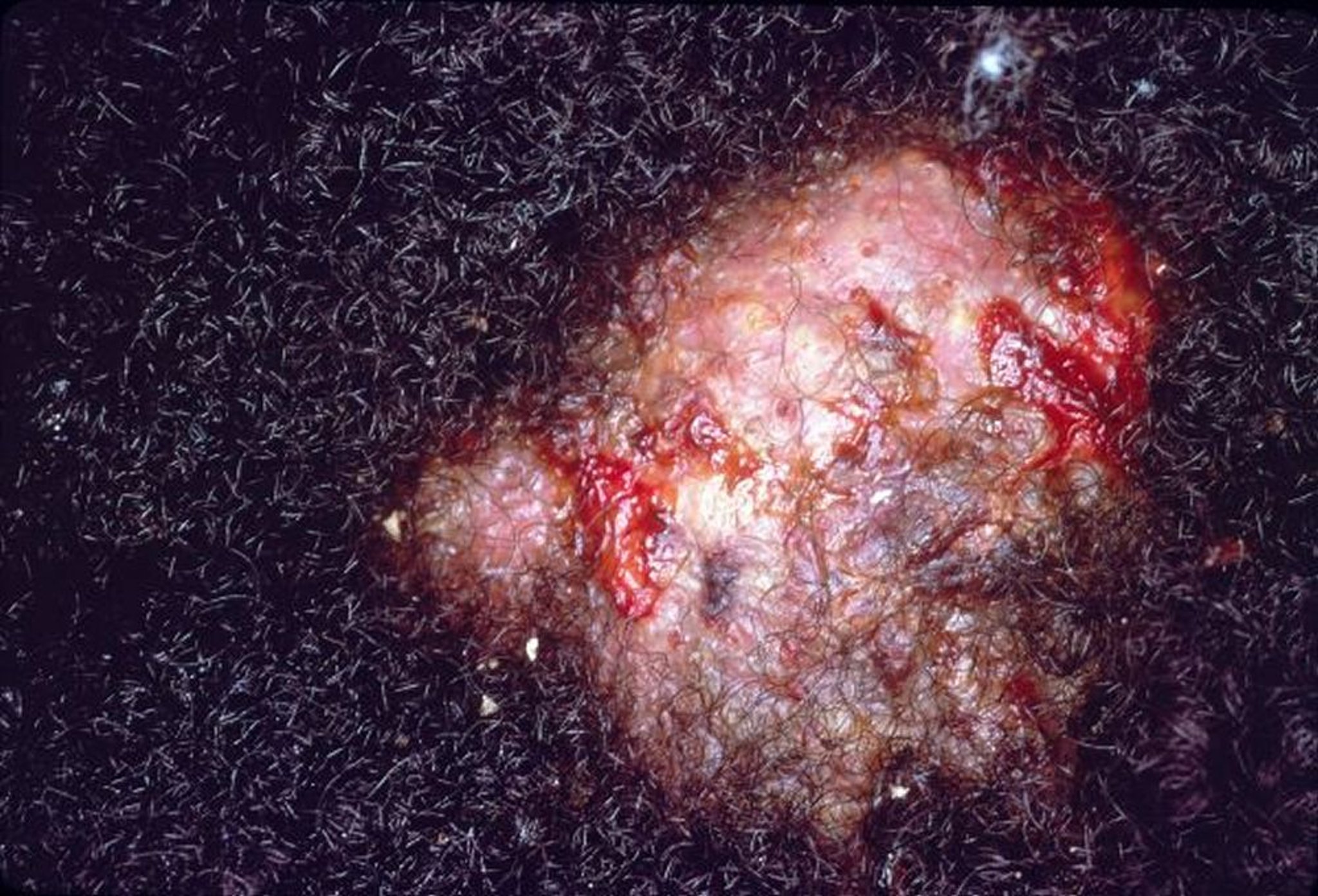
This photo shows a kerion, which is a large, boggy scalp mass caused by a severe inflammatory reaction to a scalp dermatophyte infection. Pustules and crusting are visible.
Image courtesy of Karen McKoy, MD.
General references
1. Gupta AK, Polla Ravi S, Wang T, et al. An update on tinea capitis in children. Pediatr Dermatol. 2024;41(6):1030-1039. doi:10.1111/pde.15708
2. Hubbard TW. The predictive value of symptoms in diagnosing childhood tinea capitis. Arch Pediatr Adolesc Med. 1999;153(11):1150-1153. doi:10.1001/archpedi.153.11.1150
Diagnosis of Tinea Capitis
Primarily physical examination
Potassium hydroxide wet mount (KOH)
Sometimes a Wood light examination and sometimes culture
Tinea capitis is suspected based on its characteristic clinical appearance. The diagnosis is established by potassium hydroxide wet mount of plucked hairs or of hairs and scale obtained by scraping or brushing. Spore size and appearance inside (endothrix) or outside (ectothrix) the hair shaft distinguish organisms and can help guide treatment.
Blue-green fluorescence during a Wood light examination is also diagnostic for infection with M. canis and M. audouinii and can distinguish tinea from erythrasma. T. tonsurans infections do not fluoresce on Wood light examination.
Fungal culture of plucked hairs can be performed when necessary. In a child, a scalp lesion that appears similar to an abscess may be a kerion; if necessary, cultures can help make the distinction.
Pearls & Pitfalls
|
Differential diagnosis of tinea capitis includes:
Folliculitis decalvans
Scalp lesions of discoid lupus erythematosus
Dissecting cellulitis of the scalp
Treatment of Tinea Capitis
Oral antifungals
Topical agents such as imidazoles or ciclopirox cream, selenium sulfide shampoo
Sometimes oral glucocorticoids
Oral terbinafine is a first-line treatment for infections due to Trichophyton species in children because of its efficacy and shorter treatment duration (1). Alternatively, oral griseofulvin is preferred for Microsporum species in children because it is more efficacious. (See table .)
Adjunctive topical agents may help reduce transmission but are not sufficient as monotherapy. An imidazole or ciclopirox cream can be applied to the scalp to prevent spread, especially to other children, until tinea capitis is cured; selenium sulfide 2.5% shampoo should also be used at least twice a week. Children may attend school during treatment.
Adults are treated with terbinafine, which is more effective for endothrix infections, or itraconazole. Treatment can also include selenium sulfide 2.5% shampoo.
For severely inflamed lesions and/or for kerion, a short course of prednisone should be added (to lessen symptoms and potentially reduce the chance of scarring) and tapered over 2 weeks.
Treatment reference
1. El-Gohary M, van Zuuren EJ, Fedorowicz Z, et al. Topical antifungal treatments for tinea cruris and tinea corporis. Cochrane Database Syst Rev. 2014;2014(8):CD009992. Published 2014 Aug 4. doi:10.1002/14651858.CD009992.pub2
Key Points
Tinea capitis affects mostly children and can be contagious and epidemic.
Confirm tinea capitis by potassium hydroxide wet mount, fungal culture, or sometimes Wood light examination.
Treat with oral terbinafine or griseofulvin in addition to a topical antifungal.
Topical agents such as ciclopirox, imidazole, and selenium sulfide shampoos may be used as adjunctive therapy to help prevent transmission.
Add a short course of oral prednisone for a kerion and/or severe inflammation.
Drug Information for the Topic