Fingernails and toenails can be damaged by injuries. Diagnosis is clinical. Treatment varies by cause.
Nail trauma is common. Resulting disorders can include:
Activity-related toenail injury
Acute activity-related toenail injuries are common among athletes and are typically caused by repetitive microtrauma, such as the nail plate striking footwear. Long-term complications include secondary fungal infections and nail plate deformities, including retronychia.
Nail-biting
Nail-biting (onychophagia) may occur in both adults and children and may cause complications including the following (1):
Dystrophy
Infections (bacterial, viral, and/or fungal), typically resulting from small areas of nail trauma and damage
Dental complications
Dystrophy can develop if chronic nail-biting disrupts the nail unit, which often inflames the nail matrix. The nails can develop horizontal ridging, depressions, and raised areas. Nails can become shortened permanently because the distal nail bed becomes keratinized. The cuticles are almost always damaged, disrupting the nails' waterproof "seal," causing them to thin and peel, and increasing the risk of infection. Eventually, scarring can affect the cuticles and matrix, making dystrophy irreversible. Nail biting can also stimulate melanocytes, causing melanocytic activation and eventually melanin production.
Viral infections commonly include human papillomavirus, causing warts. Small areas of trauma all around the nail facilitate viral entry to the nails. These infections are difficult to eradicate and spread easily between fingers, and also from the fingers to the mouth and lips. Warts can be unsightly and distressing. Subungual warts are challenging to treat.
Bacterial infections are often due to staphylococcal and streptococcal species but may involve anaerobic bacteria, including Pseudomonas aeruginosa. Abscesses can develop that could lead to permanent nail loss without timely surgical drainage. Permanent dystrophy may develop even with surgical drainage.
Fungal infections are common among nail biters, but they usually also have accompanying toenail onychomycosis. Treatment of Candida is controversial; it sometimes may be a colonizer rather than a pathogen.
Dental complications may include tooth disfigurement or shifts in position. The risks of gingival disease and infection are also increased.
Patients, particularly adults, are often embarrassed to disclose nail biting to the clinician. Clinicians may observe short and uneven nails on physical examination and discuss nail biting with the patient. Patients are often grateful that the clinician mentions the nail biting and that there can be a treatment. Habit-breaking techniques may include applying over-the-counter nail polish that is foul-tasting or a long-wearing manicure that obstructs the person's ability to bite the nail, such as a dip-powder manicure. Substituting the habit with squeezing a ball can be helpful, as can treatment with the supplement N-acetyl-cysteine (2). Nail biting is often associated with comorbid psychiatric conditions including anxiety and depression (3). Referral to psychiatry may be necessary for treatment.
Onychogryphosis
Onychogryphosis is a nail dystrophy in which the nail, most often on the hallux (big toe), becomes thickened and curved (sometimes also called "ram's horn nail"). It may be caused by ill-fitting shoes. It is common among older adults. It often occurs with neglect and can be associated with vascular disorders (4). Treatment consists of trimming the deformed nails.

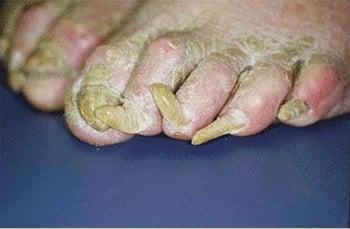
Onychogryphosis is thickening and curving of the nails.
Onychotillomania
In this disorder, patients pick at their nails, which can lead to skin erosions, missing cuticles, and parallel transverse grooves and ridges (washboard deformity or habit-tic nail deformity). It most commonly manifests in patients who habitually push back the cuticle on one finger, causing dystrophy of the nail plate as it grows. Splinter hemorrhages and subungual hemorrhages can also develop in onychotillomania.
Subungual hematoma
Subungual hematoma occurs when blood becomes trapped between the nail plate and nail bed, usually as a result of trauma. Subungual hematoma may cause significant and throbbing pain, bluish black discoloration, and, unless small, eventual separation and temporary loss of the nail plate. When the cause is a crush injury, underlying fracture and nail bed or matrix damage may occur. Nail bed or matrix damage may result in permanent nail deformity.

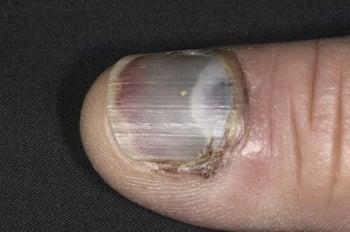
This photo shows bleeding under the fingernail.


If the injury is acute, nail trephination (eg, creating a hole in the nail plate using a cautery device, 18-gauge needle, or red-hot paperclip) can help relieve pain by draining accumulated blood; after 24 hours, blood is coagulated, thus trephination offers no benefit. It is not clear whether removing the nail and repairing any nail bed damage reduces risk of permanent nail deformity. Because the hematoma is incorporated into the nail plate and must grow out distally, clearance time is determined by the distance from the proximal nail fold to the free edge. For chronic injuries that have blood near the cuticle, patients can be counseled that, on average, it takes 6 months for blood to clear from the fingernail, and 1 year for the toenail.
White spots
White spots (punctate leukonychia) on fingernails are generally of no concern. They usually occur as a result of a minor injury to the nail.

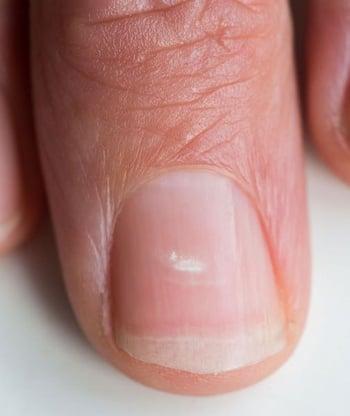
This image shows punctate leukonychia due to minor injury to the nail.
Nail trauma references
1. Halteh P, Scher RK, Lipner SR. Onychotillomania: Diagnosis and Management. Am J Clin Dermatol. 2017;18(6):763-770. doi:10.1007/s40257-017-0289-6
2. Lee DK, Lipner SR. The Potential of N-Acetylcysteine for Treatment of Trichotillomania, Excoriation Disorder, Onychophagia, and Onychotillomania: An Updated Literature Review. Int J Environ Res Public Health. 2022;19(11):6370. Published 2022 May 24. doi:10.3390/ijerph19116370
3. Lee DK, Lipner SR. Update on Diagnosis and Management of Onychophagia and Onychotillomania. Int J Environ Res Public Health. 2022;19(6):3392. Published 2022 Mar 13. doi:10.3390/ijerph19063392
4. Choo ZN, Lipner SR. Onychogryphosis Is Associated with Dermatologic and Vascular Disease: A Case-Control Study of the All of Us Research Program. Skin Appendage Disord. 2023;9(4):252-257. doi:10.1159/000530096
Drug Information for the Topic