Chronic effects of sunlight include photoaging, actinic keratoses, and skin cancer. (See also Overview of Effects of Sunlight.)

Photoaging
Photoaging refers to premature aging of the skin caused by chronic exposure to solar radiation, primarily due to UV radiation, but also visible and infrared wavelengths (1). Chronic exposure can cause photoaging, dermatoheliosis, and extrinsic aging (ie, aging caused by exposure to other environmental factors). Photoaging involves destruction of skin collagen due to various biochemical and DNA disruptions. Skin changes include both fine and coarse wrinkles, rough leathery texture, mottled pigmentation, lentigines (large frecklelike spots), sallowness, and telangiectasia. By reducing exposure to sunlight, photoaging is largely preventable.

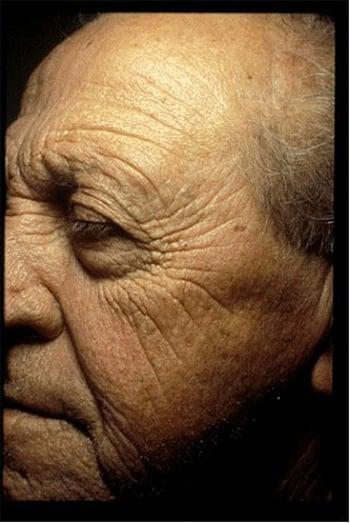
Photoaged skin is characterized by fine and coarse wrinkling, irregular mottled pigmentation, lentigines (large frecklelike spots), roughness, and sallowness.
Actinic keratoses
Actinic keratoses are precancerous changes in skin cells (keratinocytes) that are a frequent consequence of many years of sun exposure. Actinic keratoses may be pink, red, or, less commonly, gray or brown, and may feel rough and scaly.
Seborrheic keratoses may look similar to actinic keratoses. However, they appear on areas of the skin that are not exposed to sunlight and are not precancerous.
Skin cancers
The incidence of squamous cell carcinoma and basal cell carcinoma in adults with lightly pigmented skin is directly proportional to the total annual sunlight in the area. Such lesions are especially common among people who were extensively exposed to sunlight as children and adolescents and among those who are chronically exposed to the sun as part of their profession or recreational activities (eg, athletes, farmers, ranchers, sailors, frequent sunbathers). Chronic sun exposure also substantially increases the risk of malignant melanoma.
General reference
1. Kaltchenko MV, Chien AL. Photoaging: Current Concepts on Molecular Mechanisms, Prevention, and Treatment. Am J Clin Dermatol. 2025 May;26(3):321-344. doi: 10.1007/s40257-025-00933-z
Treating Chronic Effects of Sunlight
Minimization of UV radiation exposure
Topical treatments for photoaged skin
Treatment begins with preventive efforts to minimize UV radiation exposure—avoiding the sun and tanning beds and wearing protective clothing and sunscreen.
Photoaging
Various combination therapies, including chemical peels, 5-fluorouracil (5-FU), topical alpha-hydroxy acids, imiquimod, photodynamic therapy, and topical retinoids (such as isotretinoin, tretinoin, retinol, and tazarotene), have been used to reduce precancerous changes and improve the cosmetic appearance of chronically sun-damaged skin (1). These therapies are often effective in ameliorating superficial skin changes (eg, fine wrinkles, irregular pigmentation, sallowness, roughness, minor laxity) but have a much less pronounced effect on deeper changes (eg, telangiectasias).
Sun protection (eg, avoidance, use of sunscreen) is the cornerstone of preventive approaches. However, many ingredients are used in over-the-counter cosmetic products without significant evidence that they improve chronic changes of the skin caused by sunlight.
Actinic keratoses
For treatment of actinic keratoses, see Actinic Keratoses.
Skin cancers
For treatment of skin cancers, see Cancers of the Skin.
Treatment reference
1. Lin L, Chen X, Liu C, et al. Comparative efficacy of topical interventions for facial photoaging: a network meta-analysis. Sci Rep. 2025;15(1):26889. Published 2025 Jul 24. doi:10.1038/s41598-025-12597-0
Drug Information for the Topic