The ear canal may be obstructed by cerumen (earwax), scar tissue, a tumor, a foreign body, or an insect. Itching, pain, and temporary conductive hearing loss may result. Most causes of obstruction are readily apparent during otoscopic examination. Treatment is careful manual removal using adequate lighting and appropriate instruments.
External ear obstructions encompass a range of conditions or precipitating factors that block the external auditory canal. Besides cerumen (earwax) impaction, other obstructions include foreign bodies (including insects and hearing aid domes), scar tissue, and tumors.
Cerumen (earwax) impaction is the most common cause of external ear obstruction (1). It can cause hearing loss, tinnitus, fullness, itching, otalgia, or rarely, ear discharge. Cerumen may be pushed farther into the ear canal and accumulate during a patient's attempts to clean the ear canal with cotton swabs, resulting in obstruction or impaction.
Foreign bodies are common, particularly among children, who often insert objects, particularly beads, erasers, and beans, into the ear canal (2). Foreign bodies may remain unnoticed until they provoke an inflammatory response, causing pain, itching, infection, and foul-smelling, purulent drainage. In adults, hearing aid domes and insects are the most likely foreign objects.

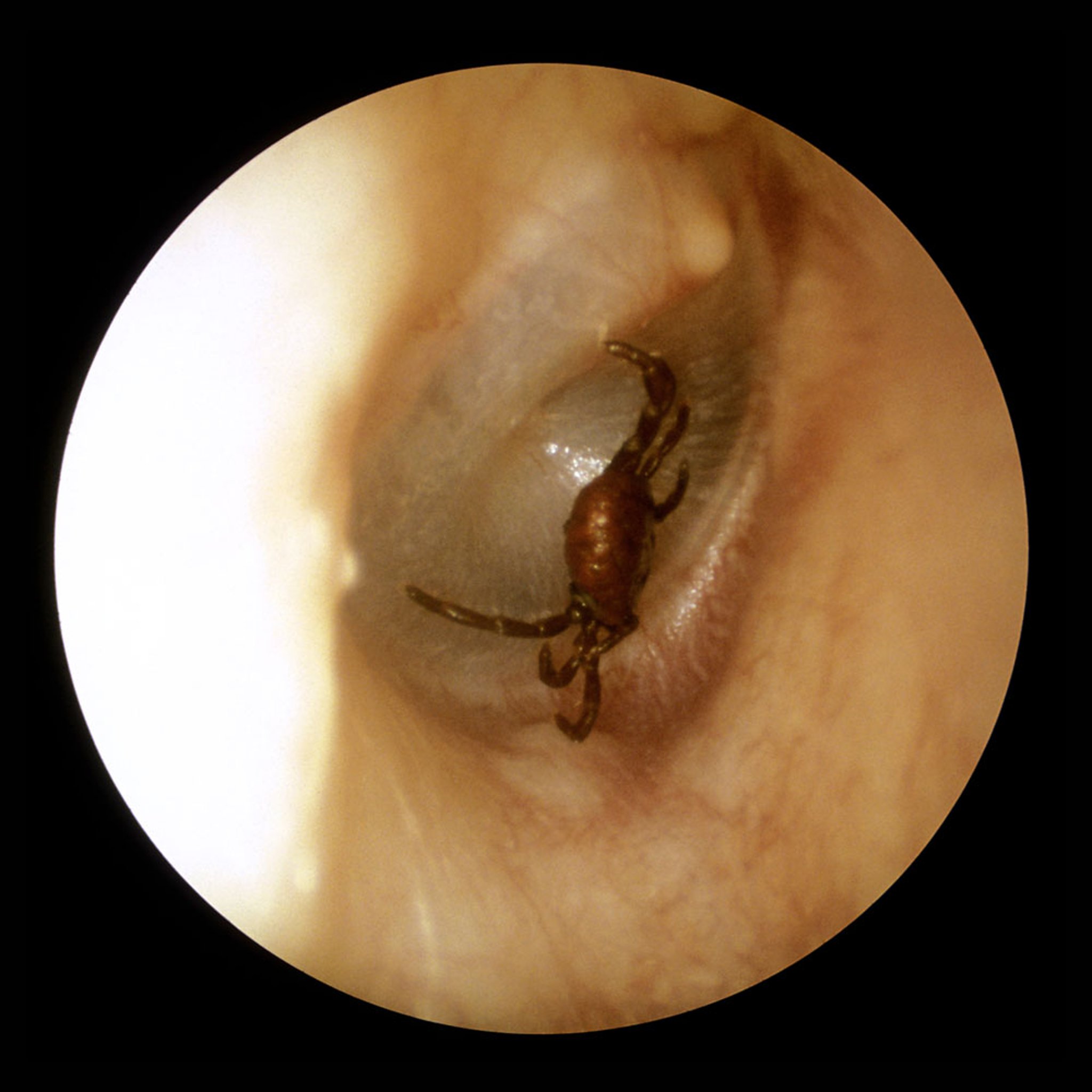
This photo shows an arthropod in the external auditory canal next to the tympanic membrane.
CLINICA CLAROS/SCIENCE PHOTO LIBRARY
Ear obstruction may also result from keratinaceous lesions, including external auditory canal cholesteatomas (EACC) and keratosis obturans (3). EACC is different from the cholesteatoma that occurs in infancy (arising from the middle ear) or acquired cholesteatoma that originates from the tympanic membrane. It is a rare keratinaceous, erosive lesion characterized by squamous epithelial invasion into localized areas of periosteitis in the ear canal wall, causing bony erosion (4). It typically presents in older patients with chronic dull pain and otorrhea (or with hearing loss secondary to obstruction of the ear canal), occurs unilaterally, and most commonly affects the inferior canal wall without superior wall involvement. See Cholesteatoma for related disease.
General references
1. Schwartz SR, Magit AE, Rosenfeld RM, et al. Clinical Practice Guideline (Update): Earwax (Cerumen Impaction) Executive Summary. Otolaryngol Head Neck Surg. 2017;156(1):14-29. doi:10.1177/0194599816678832
2. Lane Wilson J. Foreign Bodies in the Ear, Nose, and Throat. Am Fam Physician. 2025;112(1):27-33.
3. Piepergerdes MC, Kramer BM, Behnke EE. Keratosis obturans and external auditory canal cholesteatoma. Laryngoscope. 1980;90(3):383-391. doi:10.1002/lary.5540900303
4. Munjal T, Kullar PJ, Alyono J. External Ear Disease: Keratinaceous Lesions of the External Auditory Canal. Otolaryngol Clin North Am. 2023;56(5):897-908. doi:10.1016/j.otc.2023.06.013
Diagnosis of External Ear Obstructions
The diagnosis of external ear canal obstructions is usually evident based on physical examination.
Before and after attempting to remove cerumen or a foreign body from the ear canal, clinicians should consider doing a hearing assessment if they have the necessary equipment readily available. Hearing loss (compared with the unaffected ear) that does not improve after removal of the obstruction could indicate that the foreign body (or prior attempts to remove it) has damaged the middle or inner ear. Hearing that worsens after removal of the obstruction could indicate damage caused by the removal process. However, clinicians who cannot formally assess hearing need not defer removal of common, easily removable obstructions. An in-office tuning fork test can also document hearing status.
Treatment of External Ear Obstructions
The treatment of external ear obstructions is directed at the underlying cause. Approaches typically prioritize removal of the obstruction. For cerumen, approaches include cerumenolysis, irrigation, and manual removal. For foreign objects (including insects), irrigation with various materials and instrumental (ie, manual) removal are performed. Irrigation is not recommended for organic obstructions such as beans or seeds. Water irrigation will cause the organic material to swell making removal more difficult. Debridement may be required for scar tissue or other keratinaceous material. For tumors, biopsy is indicated, and for more aggressive keratinaceous lesions (eg, external auditory canal cholesteatomas), more aggressive surgical interventions may be required. For any obstruction that does not resolve (or one that is complicated), referral to an otorhinolaryngologist should be done wherever feasible.
Cerumen
See also How To Remove Cerumen Manually and With Irrigation.
Cerumenolytics, also called cerumen solvents (hydrogen peroxide, carbamide peroxide, glycerin, triethanolamine, liquid docusate sodium, or mineral oil), may be used to soften very hard wax before direct removal. However, the prolonged use of these agents may lead to canal skin irritation or allergic reactions. There is a paucity of high-quality evidence to support the administration of one agent over another, or for the optimal duration of outpatient treatment with such agents (1).
In general, cerumen impaction that is severe enough to prevent visualization of the eardrum should be managed by an otolaryngologist, when practical.
Manual techniques may also aid in the removal of cerumen. Cerumen can be removed by rolling it out of the ear canal with a blunt "Buck" curette or loop or a small, blunt right angle hook, or by removing it with a suction tip (eg, Baron, size 5 French). Adequate lighting is essential. These methods, particularly when performed by an experienced clinician, can be quicker and safer than irrigation.
Irrigation is another technique and is often performed in the emergency department, urgent care setting, or primary care setting and should be performed carefully to avoid complications. Irrigation may also be combined with cerumenolytic agents, such as liquid docusate sodium. It is contraindicated in patients with a known tympanic membrane perforation or with a suspected infection. Water entering the middle ear through a tympanic membrane perforation may exacerbate chronic otitis media and cause an acute otitis media. Irrigation is also not performed if patients have diabetes mellitus, immunocompromise, certain ear canal abnormalities, have had radiation therapy to the head and neck, or if patients are taking anticoagulants.

Foreign bodies in the ear
See also How To Remove a Foreign Body From the External Ear.
In general, foreign bodies that appear easy to grasp and remove (eg, paper, an insect wing) can be removed with alligator forceps by most clinicians (2). However, forceps may push round, smooth objects (eg, beads, beans) deeper into the canal.
If a smooth, round foreign body is lateral to the isthmus (bony-cartilaginous junction), it should be removed by reaching behind the object with a small right-angle instrument and rolling it out. For foreign bodies medial to the isthmus, an otolaryngologist should remove the object using a microscope for guidance. Unless a microscope is used, a foreign body lying at or medial to the bony cartilaginous junction of the external auditory canal is difficult to remove without injuring the delicate canal skin, tympanic membrane, or ossicular chain.
Irrigation is not usually recommended for removing a foreign body; hygroscopic foreign bodies (eg, beans or other organic matter) swell when water is added, complicating removal. Irrigation may be appropriate if there is certainty that the material is nonabsorbent (eg, small plastic fragments).
Pearls & Pitfalls
|
When a patient cannot remain still or removal is difficult, a general anesthetic or deep sedation may be needed to prevent injury to the ear canal, tympanic membrane or ossicles. Bleeding may indicate that the canal skin is lacerated or that the foreign body is actually a middle ear polyp.
Insects in the canal may be bothersome for patients and challenging to remove while alive for clinicians. Filling the canal with viscous lidocaine (or alcohol if the eardrum is intact) kills the insect, which provides immediate relief and allows the immobilized insect to be removed with forceps by grasping a wing or leg.
Referral to an otorhinolaryngologist may be required. Patients with round, smooth foreign objects or organic matter that cannot be easily removed with irrigation should be referred to an otorhinolaryngologist if the object cannot be easily removed with a curette or alligator forceps. Referral is also indicated when a child with a foreign body is uncooperative and may require sedation, or when attempts at removal are otherwise unsuccessful. If manipulating a presumed foreign body results in bleeding, further attempts at removal should stop and referral must be sought immediately.
Keratinaceous lesions
External auditory canal cholesteatoma requires more aggressive management due to characteristic bony erosion (3). Limited disease can often be managed on an outpatient basis with serial debridement and emollients like mineral oil; however, surgery may be required for definitive management when disease extends beyond the canal. Treatment selection depends on staging, with minimally invasive procedures preferred when complete lesion resection is achievable.
Referral to an otorhinolaryngology specialist for further evaluation and treatment of external auditory canal cholesteatoma.
Treatment references
1. Aaron K, Cooper TE, Warner L, Burton MJ. Ear drops for the removal of ear wax. Cochrane Database Syst Rev. 2018;7(7):CD012171. Published 2018 Jul 25. doi:10.1002/14651858.CD012171.pub2
2. Curry SD, Maxwell AK. Management of foreign bodies in the ear canal. Otolaryngol Clin North Am. 2023;56 (5):881–889. doi: 10.1016/j.otc.2023.06.002
3. He G, Lin C, Zhu Z, et al. External auditory canal cholesteatoma: staging and treatment strategies. Front Neurol. 2024;15:1505108. Published 2024 Dec 19. doi:10.3389/fneur.2024.1505108
Drug Information for the Topic