


Third window syndrome is a group of vestibular and auditory symptoms caused by the presence of an abnormal communication within the inner ear. This can arise from different anatomic locations, but is most commonly from dehiscence of the superior semicircular canal. Symptoms include autophony, aural pressure or sound-induced dizziness, and mixed hearing loss.
Third window syndrome refers to a set of vestibular and auditory symptoms caused by the presence of an abnormal third mobile window in the bony labyrinth of the inner ear (1). This pathological opening ("third window") disrupts the normal biomechanics of the inner ear, which typically has only 2 mobile windows: the oval and round windows. Third window syndrome is most commonly due to abnormalities that cause dehiscence (absence) or near-dehiscence (thinning) of bony sections lying superior to the canal.

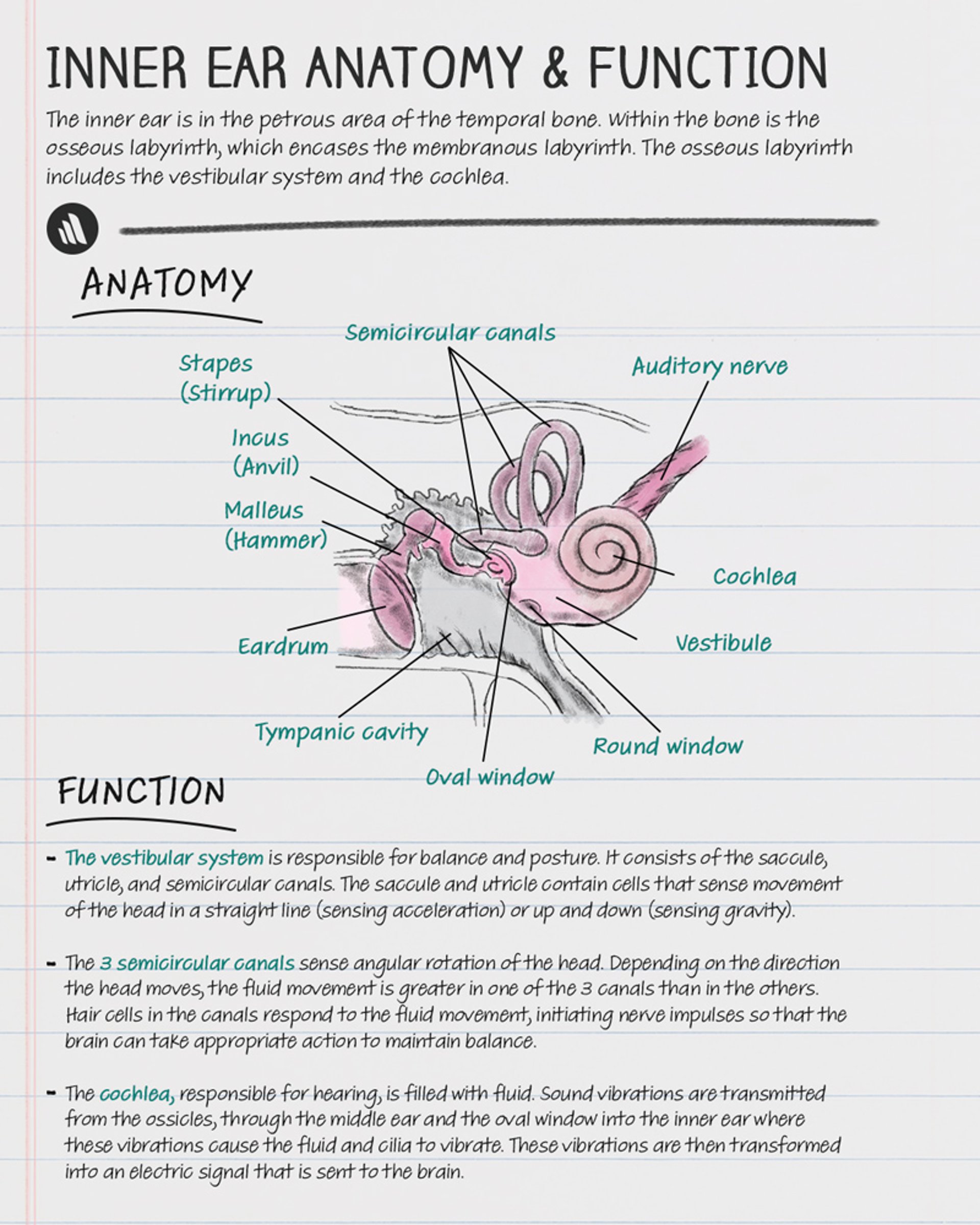
Copyright © 2023 Merck & Co., Inc., Rahway, NJ, USA and its affiliates. All rights reserved.
Reference
1. Iversen MM, Rabbitt RD. Biomechanics of Third Window Syndrome. Front Neurol. 2020;11:891. Published 2020 Aug 25. doi:10.3389/fneur.2020.00891
Symptoms and Signs of Third Window Syndrome
Patients present with symptoms of hearing loss, autophony (increased loudness in hearing one's own voice, footsteps, or other body sounds, including eye movement or blood flow), pressure- or sound-induced dizziness, and trouble focusing.
Diagnosis of Third Window Syndrome
History and physical examination
Audiogram
Sometimes high-resolution CT
Sometimes vestibular-evoked myogenic potential testing
The diagnosis of third window syndrome is supported by patients with the characteristic clinical symptoms. On physical examination, there can be pressure-induced nystagmus with pneumatic otoscopy and abnormal tuning fork testing, indicating improved bone conduction in the affected ear (ie, Weber test showing increased hearing in the abnormal ear, Rinne test showing bone conduction greater than air conduction). Patients may also be able to hear a tuning fork placed on the ankle.
Audiogram will typically show mixed hearing loss or suprathreshold hearing (ie, better than normal hearing) on bone conduction.
High-resolution CT scan of the temporal bone is then used to confirm an abnormal opening, with dehiscence of the superior semicircular canal being the most common site. Superior semicircular canal dehiscence can also be found incidentally in patients with no symptoms. Conditions that lead to increased intracranial pressure and head trauma can increase the likelihood of developing dehiscence; other cases are thought to be congenital. If no abnormality is identified radiologically, patients may have a perilymphatic fistula (leakage of fluid from an inner defect). This is most commonly caused by surgery involving the oval or round window (stapes surgery, cochlear implant) or barotrauma (scuba diving, flying).
Vestibular evoked myogenic potential testing evaluates reflexive responses to sound of the eye (oVEMP) and neck (cVEMP); in patients with third window syndrome, this response is more sensitive, resulting in a decreased threshold and increased amplitude.
Treatment of Third Window Syndrome
Conservative management
Sometimes surgical repair
The treatment of third window syndrome is tailored to the degree of the patient's symptoms. Many patients with mild symptoms can be treated conservatively (ie, with observation), treating any coexisting or exacerbating conditions (eg, migraine or vestibular migraine). Surgical repair of the defect can be effective in patients with more severe symptoms.
Key Points
Third window syndrome is caused by an abnormal opening in the inner ear.
It causes symptoms of hearing loss, autophony, pressure- and sound-induced dizziness.
The diagnosis is made with a combination of history, physical examination hearing assessments, and high-resolution CT scan; vestibular evoked myogenic potential testing can also be helpful.
Treatment is based on the degree of symptoms and can range from observation to surgical repair.







