Hiatus hernia (also called hiatal hernia) is a protrusion of the stomach through the diaphragmatic hiatus into the thorax. Most hernias are asymptomatic, but an increased incidence of acid reflux may lead to symptoms of gastroesophageal reflux disease. Diagnosis is by barium swallow. Treatment is directed at symptoms of gastroesophageal reflux disease if present.
Etiology of Hiatus Hernia
Etiology of hiatus hernia is usually unknown, but a hiatus hernia is thought to be acquired through stretching of the fascial attachments between the esophagus and diaphragm at the hiatus (the opening through which the esophagus traverses the diaphragm).
Pathophysiology of Hiatus Hernia
There are 2 main types of hiatus hernia:
Sliding hiatus hernia (most common): Gastroesophageal junction and a portion of the stomach are above the diaphragm.
Paraesophageal hiatus hernia: Gastroesophageal junction is in the normal location, but a portion of the stomach is adjacent to the esophagus in the diaphragmatic hiatus.
Less commonly, hiatus hernias have both sliding and paraesophageal components, or involve other organs (1). Hernias may also occur through other parts of the diaphragm (see also Diaphragmatic Hernia).
Understanding Hiatus Hernia
A hiatus hernia is an abnormal bulging of a portion of the stomach through the diaphragm. |

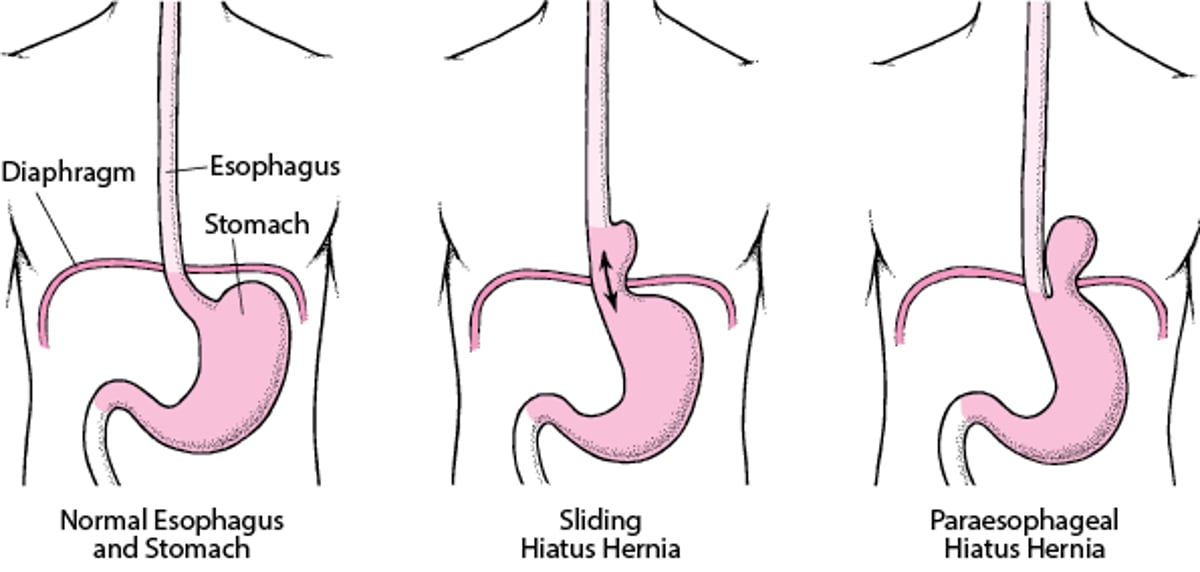
Up to approximately 94% of patients with gastroesophageal reflux disease (GERD) have some degree of hiatus hernia and up to approximately 67% of patients with hiatus hernia have GERD (2, 3); however, a sliding hiatus hernia is a common incidental finding on imaging (4, 5), therefore the relationship of hernia to symptoms is unclear.
Pathophysiology references
1. Daly S, Kumar SS, Collings AT, et al. SAGES guidelines for the surgical treatment of hiatal hernias. Surg Endosc. 2024;38(9):4765-4775. doi:10.1007/s00464-024-11092-3
2. Savas N, Dagli U, Sahin B. The effect of hiatal hernia on gastroesophageal reflux disease and influence on proximal and distal esophageal reflux. Dig Dis Sci. 2008;53(9):2380-2386. doi:10.1007/s10620-007-0158-x
3. Shahsavari D, Smith MS, Malik Z, Parkman HP. Hiatal hernias associated with acid reflux: size larger than 2 cm matters. Dis Esophagus. 2022;35(8):doac001. doi:10.1093/dote/doac001
4. Kim J, Hiura GT, Oelsner EC, et al. Hiatal hernia prevalence and natural history on non-contrast CT in the Multi-Ethnic Study of Atherosclerosis (MESA). BMJ Open Gastroenterol. 2021;8(1):e000565. doi:10.1136/bmjgast-2020-000565
5. Pickhardt PJ, Boyce CJ, Kim DH, Hinshaw LJ, Taylor AJ, Winter TC. Should small sliding hiatal hernias be reported at CT colonography? AJR Am J Roentgenol. 2011;196(4):W400-W404. doi:10.2214/AJR.10.5392
Symptoms and Signs of Hiatus Hernia
Most patients with a sliding hiatus hernia are asymptomatic (1), but chest pain and other reflux symptoms can occur. A paraesophageal hiatus hernia is generally asymptomatic but, unlike a sliding hiatus hernia, may incarcerate and strangulate. Occult or massive gastrointestinal hemorrhage may occur rarely with either type.
Symptoms and signs reference
1. Wallner B, Björ O, Andreasson A, et al. Identifying clinically relevant sliding hiatal hernias: a population-based endoscopy study. Scand J Gastroenterol. 2018;53(6):657-660. doi:10.1080/00365521.2018.1458896
Diagnosis of Hiatus Hernia
Barium swallow
Sometimes upper endoscopy
Sometimes high-resolution esophageal manometry
Barium swallow is the diagnostic test of choice for hiatus hernia; endoscopy may also be used but is less sensitive than a barium swallow (1, 2). High-resolution esophageal manometry may be used as a complementary test to improve sensitivity of either barium swallow or endoscopy. Hiatus hernia is also often discovered incidentally on chest radiograph or chest or abdominal CT scan.

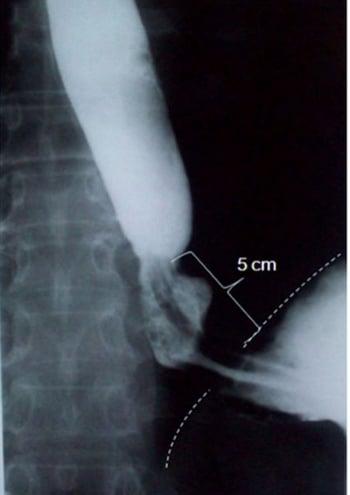
This image shows a sliding hiatus hernia measuring 5 centimeters (5 cm) in axial length (dashed line indicates the diaphragmatic border).
Hernias can also be seen with upper endoscopy.

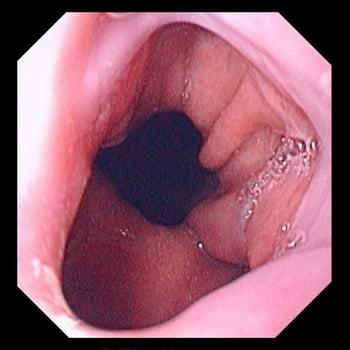
This endoscopic photo shows a small sliding hiatal hernia.
Diagnosis references
1. Expert Panel on Gastrointestinal Imaging, Vij A, Zaheer A, et al. ACR Appropriateness Criteria® Epigastric Pain. J Am Coll Radiol. 2021;18(11S):S330-S339. doi:10.1016/j.jacr.2021.08.006
2. Gyawali CP, Carlson DA, Chen JW, Patel A, Wong RJ, Yadlapati RH. ACG Clinical Guidelines: Clinical Use of Esophageal Physiologic Testing. Am J Gastroenterol. 2020;115(9):1412-1428. doi:10.14309/ajg.0000000000000734
Treatment of Hiatus Hernia
Sometimes surgical repair
Sometimes a proton pump inhibitor
An asymptomatic sliding hiatus hernia requires no specific therapy (1). For patients with accompanying GERD, therapy with a proton pump inhibitor should be considered.
Surgical repair of a sliding hiatus hernia should be considered if GERD is present (1); surgery consists of relieving the hernia and a fundoplication. Symptomatic paraesophageal hernias should generally be surgically repaired. Evidence is lacking regarding the appropriateness of surgery in asymptomatic paraesophageal or more complex hernias (2).
Treatment references
1. Kohn GP, Price RR, DeMeester SR, et al. Guidelines for the management of hiatal hernia. Surg Endosc. 2013;27(12):4409-4428. doi: 10.1007/s00464-013-3173-3
2. Daly S, Kumar SS, Collings AT, et al. SAGES guidelines for the surgical treatment of hiatal hernias. Surg Endosc. 2024;38(9):4765-4775. doi:10.1007/s00464-024-11092-3