Immune thrombocytopenia (ITP) is a bleeding disorder usually without anemia or leukopenia. Typically, it is chronic in adults, but it is usually acute and self-limited in children. Spleen size is normal in the absence of another underlying condition. Diagnosis is usually clinical, based on exclusion of other causes of thrombocytopenia (eg, HIV infection, hepatitis C infection). Chronic treatment includes glucocorticoids, splenectomy, immunosuppressants, thrombopoietin receptor agonists, the BTK inhibitor rilzabrutinib, or the spleen tyrosine kinase inhibitor fostamatinib. For life-threatening bleeding, platelet transfusions, IV glucocorticoids, IV anti-D immune globulin, or IV immune globulin may be used individually or in combination.
Immune thrombocytopenia (ITP) usually results from development of an autoantibody directed against a structural platelet antigen (1). These antiplatelet antibodies lead to increased platelet destruction, usually in the spleen, and inhibition of platelet production and release from megakaryocytes. (See also Overview of Platelet Disorders.)
In childhood ITP, the autoantibody may be triggered by viral antigens. The trigger in adults is unknown, although in some countries (eg, Japan, Italy), ITP has been associated with Helicobacter pylori infection, and treatment of the infection has been followed by remission of the ITP (2).
COVID-19 infection rarely causes ITP, but COVID-19 vaccination may worsen thrombocytopenia in patients with ITP, with some studies reporting a decrease in platelet count in approximately 6% (3). ITP tends to worsen during pregnancy but with adequate treatment is not associated with increased maternal or fetal mortality.
General references
1. Al-Samkari H, Rosovsky RP, Karp Leaf RS, et al. A modern reassessment of glycoprotein-specific direct platelet autoantibody testing in immune thrombocytopenia. Blood Adv. 2020;4(1):9-18. doi:10.1182/bloodadvances.2019000868
2. Kuter DJ. The treatment of immune thrombocytopenia (ITP)—focus on thrombopoietin receptor agonists. Annals of Blood. Volume 6 March 31, 2021. doi: 10.21037/aob-21-23
3. Visser C, Swinkels M, van Werkhoven ED, et al. COVID-19 vaccination in patients with immune thrombocytopenia. Blood Adv. 2022;6(6):1637-1644. doi:10.1182/bloodadvances.2021006379
Symptoms and Signs of ITP
Although often asymptomatic and identified only by a low platelet count on a routine assay, when present the symptoms and signs of immune thrombocytopenia include the following (1):
Petechiae
Purpura and/or ecchymoses
Mucosal bleeding
Increased menstrual bleeding
Fatigue
Cognitive dysfunction
Gross gastrointestinal (GI) bleeding and hematuria are less common. The spleen is of normal size unless it is enlarged by a coexisting viral infection or autoimmune hemolytic anemia (Evans syndrome). Like the other disorders of increased platelet destruction, ITP is also associated with an increased risk of thrombosis.


Petechiae are characterized by small red spots as seen here on the palate of this patient.
Petechiae are characterized by small red spots as seen here on the palate of this patient.
DR P. MARAZZI/SCIENCE PHOTO LIBRARY


By permission of the publisher. From Deitcher S. In Atlas of Clinical Hematology. Edited by JO Armitage. Philadelphia, Current Medicine, 2004.

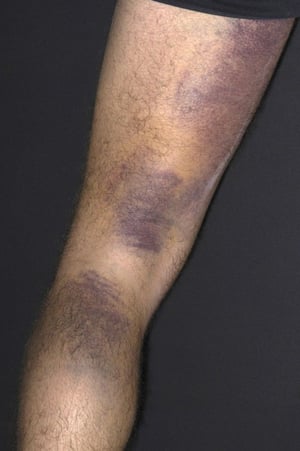
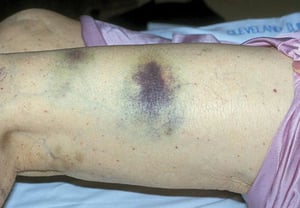
Ecchymoses are the large purple bruises seen on the leg of this patient.
Ecchymoses are the large purple bruises seen on the leg of this patient.
DR P. MARAZZI/SCIENCE PHOTO LIBRARY

By permission of the publisher. From Deitcher S. In Atlas of Clinical Hematology. Edited by JO Armitage. Philadelphia, Current Medicine, 2004.
Petechiae are characterized by small red spots as seen here on the palate of this patient.
Petechiae are characterized by small red spots as seen here on the palate of this patient.
DR P. MARAZZI/SCIENCE PHOTO LIBRARY
By permission of the publisher. From Deitcher S. In Atlas of Clinical Hematology. Edited by JO Armitage. Philadelphia, Current Medicine, 2004.
Ecchymoses are the large purple bruises seen on the leg of this patient.
Ecchymoses are the large purple bruises seen on the leg of this patient.
DR P. MARAZZI/SCIENCE PHOTO LIBRARY
By permission of the publisher. From Deitcher S. In Atlas of Clinical Hematology. Edited by JO Armitage. Philadelphia, Current Medicine, 2004.
Symptoms and signs reference
1. Cooper N, Ghanima W. Immune Thrombocytopenia. N Engl J Med. 2019;381(10):945-955. doi:10.1056/NEJMcp1810479
Diagnosis of ITP
Complete blood count (CBC) with platelets and examination of the peripheral blood smear
Rarely bone marrow aspiration
Exclusion of other thrombocytopenic disorders
Immune thrombocytopenia is suspected in patients with isolated thrombocytopenia (ie, otherwise normal CBC and peripheral blood smear). Because manifestations of ITP are nonspecific, other reversible causes of isolated thrombocytopenia (eg, medications, some illicit substances, alcohol, lymphoproliferative disorders, other autoimmune diseases, viral infections) need to be excluded by clinical evaluation and appropriate testing. Typically, patients have coagulation studies, liver tests, and tests for infection with hepatitis C and HIV. Peripheral blood smear must be reviewed to assess platelet size and granularity and to help exclude other major causes of thrombocytopenia such as thrombotic thrombocytopenic purpura (TTP), inherited thrombocytopenia, and leukemia. Testing for antiplatelet antibody (1) and thrombopoietin (TPO) testing (2) may aid the diagnosis in some cases. The immature platelet fraction may be elevated in ITP when the platelet count is < 50,000/mcL (< 50 × 109/L); large platelets are seen on blood smear examination, and the mean platelet volume (MPV) is increased (3).
Bone marrow examination is not required to make the diagnosis but is done if blood counts or blood smear reveals abnormalities in addition to thrombocytopenia, when clinical features are not typical, or if patients fail to respond to standard therapies (eg, glucocorticoids). In patients with ITP, bone marrow examination, if performed, reveals normal or possibly increased numbers of megakaryocytes in an otherwise normal bone marrow sample.
Diagnosis references
1. Al-Samkari H, Rosovsky RP, Karp Leaf RS, Smith DB, Goodarzi K, Fogerty AE, Sykes DB, Kuter DJ. A modern reassessment of glycoprotein-specific direct platelet autoantibody testing in immune thrombocytopenia. Blood Adv. 2020;4(1):9-18. doi: 10.1182/bloodadvances.2019000868
2. Makar RS, Zhukov OS, Sahud MA, Kuter DJ. Thrombopoietin levels in patients with disorders of platelet production: diagnostic potential and utility in predicting response to TPO receptor agonists. Am J Hematol. 2013;88(12):1041-1044. doi:10.1002/ajh.23562
3. Cooper N, Ghanima W. Immune Thrombocytopenia. N Engl J Med. 2019;381(10):945-955. doi:10.1056/NEJMcp1810479
Treatment of ITP
Oral glucocorticoids
IV immune globulin (IVIG)
IV anti-D immune globulin
Rarely splenectomy
Thrombopoietin receptor agonists (TPO-RA)
Rituximab
Fostamatinib
Rilzabrutinib
Other immunosuppressants (eg, mycophenolate, azathioprine, sirolimus, cyclosporine)
For severe bleeding, IVIG, IV anti-D immune globulin, IV glucocorticoids, and/or platelet transfusions
Patients who have no symptoms, a platelet count > 30,000/mcL (> 30 × 109/L), no other bleeding risks (eg, anticoagulants) and no bleeding usually do not require treatment and can be monitored.
Adults with newly diagnosed ITP with bleeding and a platelet count < 30,000/mcL (< 30 × 109/L) are usually given an oral glucocorticoid (eg, prednisone 1 mg/kg orally once a day). An alternative, probably equally effective, glucocorticoid regimen is dexamethasone 40 mg orally once a day for 4 days. In most patients, the platelet count increases within 2 to 5 days. However, in some patients, a response may take 2 to 4 weeks. When the glucocorticoid is tapered after response, most adult patients relapse. Repeated glucocorticoid treatments may be effective but increase the risk of adverse effects. Glucocorticoids should not usually be continued beyond the first 6 weeks; other medications may be tried in an attempt to avoid splenectomy. If medical therapy is effective, most guidelines recommend continuing it for at least 1 year before considering splenectomy.
Oral glucocorticoids, IVIG, or IV anti-D immune globulin may also be given when a transient increase of the platelet count is required for tooth extractions, childbirth, surgery, or other invasive procedures. Thrombopoietin receptor agonists (TPO-RA, eg, romiplostim, eltrombopag, avatrombopag) can also be used (as second-line therapy) before invasive procedures but should be used cautiously during pregnancy. IVIG and IV anti-D immune globulin are also useful for life-threatening bleeding in immune thrombocytopenia (ITP) but are rarely used for chronic treatment because their response may last for only a few days to weeks.
Splenectomy can achieve a complete remission in approximately two-thirds of patients who relapse after initial glucocorticoid therapy. Splenectomy is usually reserved for patients with severe thrombocytopenia (eg, < 15,000/mcL [< 15 × 109/L]) in whom bleeding risk cannot be controlled with medical therapy or those whose disease persists after 12 months. Since thrombocytopenia can usually be controlled with second-line medical therapies, splenectomy is often not necessary (1, 2). Splenectomy results in an increased risk of thrombosis and infection (particularly with encapsulated bacteria such as pneumococcus); patients require vaccination against Streptococcus pneumoniae, Haemophilus influenzae, and Neisseria meningitidis (ideally > 2 weeks before the procedure). The role of post-splenectomy antibiotic use is unclear in healthy adults but generally established in patients with immunodeficiencies.
Second-line medical therapies
Second-line medical therapies are available for patients with immune thrombocytopenia:
Who are seeking to defer splenectomy in hope of a spontaneous remission
Who are not candidates for or refuse splenectomy
In whom splenectomy has not been effective
Such patients usually have platelet counts < 10,000 to 20,000/mcL (< 10 to 20 × 109/L), and thus are at risk for bleeding. Second-line medical therapies include thrombopoietin receptor agonists (TPO-RAs), rituximab, rilzabrutinib, fostamatinib, or other immunosuppressive medications.
Thrombopoietin receptor agonists, such as romiplostim 1 to 10 mcg/kg subcutaneously once a week, eltrombopag 25 to 75 mg orally once a day, and avatrombopag 20 to 40 mg orally once a day have response rates > 85%. TPO-RAs often need to be administered continuously to maintain the platelet count > 50,000/mcL (> 50 × 109/L), but data suggest that one-third of adults will undergo a treatment-free remission after 1 year and > 50% after 2 years (3, 4).
Rituximab (375 mg/m2 IV once a week for 4 weeks) has a response rate of 57%, but only 21% of adult patients remain in remission after 5 years (5). Alternate dosing schemes are also effective (eg, doses of 1000 mg IV given 2 weeks apart).
Fostamatinib, a spleen tyrosine kinase inhibitor, has a reported response rate of 18%. The dose is 100 mg orally twice a day, increasing to 150 mg twice a day after 1 month if the platelet count has not increased to > 50,000/mcL (> 50 × 109/L) (6). Its use is often limited by increased rates of diarrhea and hypertension.
Rilzabrutinib, a BTK inhibitor, lacks the inhibitory effects on platelet function and increased risk of arrhythmias that occur with other BTK inhibitors. It is given at a fixed dose of 400 mg every 12 hours. In studies of patients with highly refractory ITP, response rates of 23% occurred with rilzabrutinib versus 0% for patients receiving a placebo; much higher rates of response occurred when rilzabrutinib was used as second-line therapy and for longer periods of time (7, 8).
More intensive immunosuppression may be required with medications such as cyclophosphamide, cyclosporine, sirolimus, mycophenolate, or azathioprine in patients who are unresponsive to other medications and have severe, symptomatic thrombocytopenia.
Life-threatening bleeding in ITP
In children or adults with immune thrombocytopenia and life-threatening bleeding, rapid phagocytic blockade is attempted by giving IVIG 1 g/kg once a day for 1 to 2 days or, in Rh-positive patients, a single dose of IV anti-D immune globulin 75 mcg/kg. IV anti-D immunoglobulin is only effective in patients who have not had a splenectomy, and it may be associated with severe complications such as severe hemolysis and disseminated intravascular coagulation. IVIG treatment usually causes the platelet count to rise within 2 to 4 days, but the count remains high for only 2 to 4 weeks (9).
High-dose methylprednisolone (1 g IV once a day for 3 days) is easier to administer than IVIG or IV anti-D immune globulin but may not be as effective.
Patients with ITP and life-threatening bleeding are also given platelet transfusions. Platelet transfusions are not used prophylactically.
Vincristine (1.4 mg/m2; maximum dose of 2 mg) has also been used in emergency situations but may produce neuropathy with repeated administration.
Early use of thrombopoietin receptor agonists (TPO-RA) may also be effective in combination with the therapies above (10, 11).
Treatment of children with ITP
Treatment of children with immune thrombocytopenia is usually supportive because most children spontaneously recover (12). Even after months or years of thrombocytopenia, most children have spontaneous remissions. If mucosal bleeding occurs, glucocorticoids or IVIG may be given. Glucocorticoid and IVIG use is controversial because the increased platelet count may not improve clinical outcome. However, if thrombocytopenia is severe and symptomatic for > 6 months, then TPO-RA (eg, romiplostim, eltrombopag, avatrombopag) should be considered. Splenectomy is rarely done in children.
Treatment references
1. Ghanima W, Cuker A, Michel M. Insights on treatment of adult ITP: algorithm for management and role of multimodal therapy. Hematology Am Soc Hematol Educ Program. 2024;2024(1):678-684. doi:10.1182/hematology.2024000594
2. Chowdhury SR, Sirotich E, Guyatt GH, et al. Guideline on the emergency management of critical bleeding in patients with immune thrombocytopenia. Blood Adv. Published online February 4, 2026. doi:10.1182/bloodadvances.2025018818
3. Guillet S, Crickx E, Azzaoui I, et al. Prolonged response after TPO-RA discontinuation in primary ITP: results of a prospective multicenter study. Blood. 2023;141(23):2867-2877. doi:10.1182/blood.2022018665
4. Marshall AL, Scarpone R, De Greef M, Bird R, Kuter DJ. Remissions after long-term use of romiplostim for immune thrombocytopenia. Haematologica. 2016;101(12):e476-e478. doi:10.3324/haematol.2016.151886
5. Patel VL, Mahevas M, Lee SY, et al. Outcomes 5 years after response to rituximab therapy in children and adults with immune thrombocytopenia. Blood. 2012;119(25):5989-5995. doi: 10.1182/blood-2011-11-393975
6. Bussel J, Arnold DM, Grossbard E, et al. Fostamatinib for the treatment of adult persistent and chronic immune thrombocytopenia: Results of two phase 3, randomized, placebo‐controlled trials. Am J Hematol. 2018;93(7): 921-930. doi: 10.1002/ajh.25125
7. Kuter DJ, Efraim M, Mayer J, et al. Rilzabrutinib, an Oral BTK Inhibitor, in Immune Thrombocytopenia. N Engl J Med. 2022;386(15):1421-1431. doi:10.1056/NEJMoa2110297
8. Kuter DJ, Ghanima W, Cooper N, et al. Safety and efficacy of rilzabrutinib vs placebo in adults with immune thrombocytopenia: the phase 3 LUNA3 study. Blood. 2025;145(24):2914-2926. doi:10.1182/blood.2024027336
9. Arbach O, Taumberger AB, Wietek S, Cervinek L, Salama A. Efficacy and safety of a new intravenous immunoglobulin (Panzyga® ) in chronic immune thrombocytopenia. Transfus Med. 2019;29(1):48-54. doi:10.1111/tme.12573
10. Kuter DJ, Tarantino MD, Lawrence T. Clinical overview and practical considerations for optimizing romiplostim therapy in patients with immune thrombocytopenia. Blood Rev. 2021;49:100811. doi: 10.1016/j.blre.2021.100811
11. Lozano ML, Godeau B, Grainger J, et al. Romiplostim in adults with newly diagnosed or persistent immune thrombocytopenia. Expert Rev Hematol. 2020;13(12):1319-1332. doi: 10.1080/17474086.2020.1850253
12. Neunert CE, Buchanan GR, Imbach P, et al. Bleeding manifestations and management of children with persistent and chronic immune thrombocytopenia: data from the Intercontinental Cooperative ITP Study Group (ICIS). Blood. 2013;121(22):4457-4462. doi:10.1182/blood-2012-12-466375
Prognosis for ITP
Children typically recover spontaneously, even from severe thrombocytopenia, in several weeks to months.
In adults, spontaneous remission occurs in less than 10%. With completion of initial treatment, approximately one-third of patients undergo remission. Up to 75% of patients improve within 5 years (1). However, many patients have mild and stable disease (ie, platelet counts > 30,000/mcL [> 30 × 109/L]) with minimal or no bleeding; they are often discovered by the automated platelet counting now routinely done with a complete blood count.
Prognosis reference
1. Sailer T, Lechner K, Panzer S, et al. The course of severe autoimmune thrombocytopenia in patients not undergoing splenectomy. Haematologica. 2006;1(8):1041-1045.
Key Points
In immune thrombocytopenia (ITP), the immune system destroys platelets in the circulation and at the same time may attack bone marrow megakaryocytes, thereby reducing platelet production.
Other causes of isolated thrombocytopenia (eg, medications, alcohol, lymphoproliferative disorders, other autoimmune diseases, viral infections) need to be excluded.
Children usually have spontaneous remission; in adults, spontaneous remission may occur during the first year but is less common (about 33%) than in children.
Glucocorticoids (and sometimes intravenous immune globulin [IVIG] or IV anti-D immune globulin) are first-line treatments for bleeding or severe thrombocytopenia.
Bone marrow biopsy is typically not needed unless there are other concerning red or white blood cell abnormalities or in patients being considered for splenectomy who have not responded to standard treatment with glucocorticoids or IVIG.
Thrombopoietin receptor agonists are highly effective in maintaining a safe platelet count in > 85% of adults.
COVID-19 infection rarely causes ITP, but COVID-19 vaccination may worsen thrombocytopenia in 2 to 12% of patients with ITP.
Splenectomy is often effective but is reserved for patients in whom medical therapy is ineffective.
Platelet transfusion is given only for life-threatening bleeding.
Drug Information for the Topic