Chronic mucocutaneous candidiasis is persistent or recurrent candidal infection due to inherited T-cell defects. When the disease is inherited as a recessive trait, autoimmune and endocrine disorders may develop. Diagnosis is based on recurrent, unexplained Candida infections. Treatment includes antifungals and treatment of any endocrine and autoimmune disorders.
Chronic mucocutaneous candidiasis is a primary immunodeficiency disorder that involves T cell defects (1). Some patients also have deficient humoral immunity (sometimes called antibody deficiency) that is characterized by abnormal antibody responses to polysaccharide antigens despite normal immunoglobulin levels. (See also Approach to the Patient With an Immunodeficiency Disorder.)
Inheritance may be:
Autosomal dominant (most common): Involving a mutation in the signal transducer and activator of transcription 1 gene (STAT1)
Autosomal recessive: Involving a mutation in the autoimmune regulator gene (AIRE)
In the recessive form (autoimmune polyendocrinopathy–candidosis-ectodermal dystrophy, also called APECED syndrome), autoimmune manifestations typically develop; they include endocrine disorders (eg, hypoparathyroidism, adrenal insufficiency, hypogonadism, thyroid disorders, diabetes), alopecia areata, pernicious anemia, and hepatitis (2).
Mutations may also occur in genes that encode various proteins involved in the innate immune response to fungi—notably, the following:
PTPN22 (protein tyrosine phosphatase, non-receptor type 22 [also called LYP, or lymphoid tyrosine phosphatase], which is involved in T-cell–receptor signalling)
Dectin-1 (an innate pattern recognition receptor essential for the control of fungal infections)
CARD9 (caspase recruitment domain-containing protein 9, which is an adaptor molecule important in the production of interleukin (IL)-17 and for protection against fungal invasion)
Mucocutaneous candidiasis recurs or persists, usually beginning during infancy but sometimes not until early adulthood. Life span is not affected.
Infections due to organisms other than Candida species (eg, Staphylococcus, Trichophyton) may occur.
General references
1. Egri N, Esteve-Solé A, Deyà-Martínez À, et al. Primary immunodeficiency and chronic mucocutaneous candidiasis: pathophysiological, diagnostic, and therapeutic approaches. Allergol Immunopathol (Madr). 2021;49(1):118-127. doi:10.15586/aei.v49i1.20
2. Capalbo D, De Martino L, Giardino G, et al. Autoimmune polyendocrinopathy candidiasis ectodermal dystrophy: insights into genotype-phenotype correlation. Int J Endocrinol. 2012;2012:353250. doi:10.1155/2012/353250
Symptoms and Signs of Chronic Mucocutaneous Candidiasis
Thrush is common, as are candidal infections of the scalp, skin, nails, and gastrointestinal and vaginal mucosa. Severity varies depending on the causative mutation. Nails may be thickened, cracked, and discolored, with edema and erythema of the surrounding periungual tissue, resembling clubbing. Skin lesions are crusted, pustular, erythematous, and hyperkeratotic. Scalp lesions may result in scarring alopecia.
Infants often present with refractory thrush, candidal diaper rash, or both.

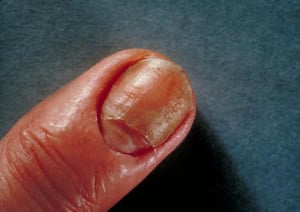
Candidal nail infections can involve the full thickness of the nail plate (onychomycosis), the edges of the nail (paronychia), or both.
Candidal nail infections can involve the full thickness of the nail plate (onychomycosis), the edges of the nail (paron
Image courtesy of CDC/Sherry Brinkman via the Public Health Image Library of the Centers for Disease Control and Prevention.

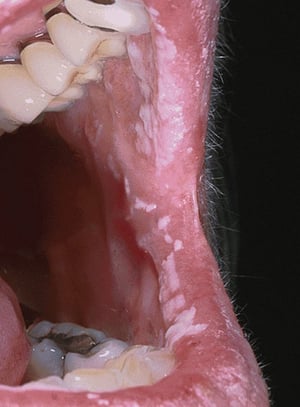
Creamy white patches are seen inside the mouth and may bleed when scraped off. This finding is typical of thrush, which is caused by infection with Candida.
Creamy white patches are seen inside the mouth and may bleed when scraped off. This finding is typical of thrush, which
Image provided by Thomas Habif, MD.

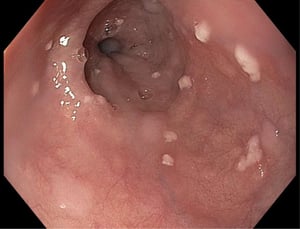
Diffuse whitish plaques are typical of Candida esophagitis.
Diffuse whitish plaques are typical of Candida esophagitis.
Image provided by Kristle Lynch, MD.
Candidal nail infections can involve the full thickness of the nail plate (onychomycosis), the edges of the nail (paronychia), or both.
Candidal nail infections can involve the full thickness of the nail plate (onychomycosis), the edges of the nail (paron
Image courtesy of CDC/Sherry Brinkman via the Public Health Image Library of the Centers for Disease Control and Prevention.
Creamy white patches are seen inside the mouth and may bleed when scraped off. This finding is typical of thrush, which is caused by infection with Candida.
Creamy white patches are seen inside the mouth and may bleed when scraped off. This finding is typical of thrush, which
Image provided by Thomas Habif, MD.
Diffuse whitish plaques are typical of Candida esophagitis.
Diffuse whitish plaques are typical of Candida esophagitis.
Image provided by Kristle Lynch, MD.
Diagnosis of Chronic Mucocutaneous Candidiasis
History and physical examination
Flow cytometry
Sometimes genetic testing
Testing for delayed type skin hypersensitivity, mitogen, and antibody responses to Candida
Chronic mucocutaneous candidiasis should be suspected in patients with persistent, recurrent, or treatment-refractory Candida species infection of the skin, nails, or mucous membranes (1). The presence of Candida in the lesions is confirmed by standard mycologic tests (eg, potassium hydroxide [KOH] wet mount of scrapings or fungal culture).
Diagnosis of chronic mucocutaneous candidiasis is based on the presence of recurrent candidal skin or mucosal lesions when no other known predisposing causes of candidal infection (eg, diabetes, immunosuppressive therapy, prolonged antibiotic use) are present.
Flow cytometric evaluation for lymphocyte subsets that include Th17 cells, natural killer (NK) cells, and functional cytotoxicity assays are typically performed as initial tests.
Candida-specific defects in cell-mediated immunity can be demonstrated by:
Absent proliferative responses to the Candida antigen (more commonly performed)
Negative delayed-type hypersensitivity skin testing (less commonly performed)
Because defects in chronic mucocutaneous candidiasis are Candida-specific; global immune function remains intact. Mitogen-induced proliferation to non-Candida antigens is typically normal, indicating competent overall T-cell function, and antibody responses to Candida and to other antigens are preserved, indicating competent B-cell function.
Patients should be tested for endocrine disorders based on clinical suspicion (eg, in patients with APECED syndrome).
Genetic testing is performed if clinical suspicion is high and other common causes of the patient's clinical symptoms have been eliminated. If an AIRE mutation is detected, screening can be offered to the patient's siblings and children.
Diagnosis reference
1. Bonilla FA, Khan DA, Ballas ZK, et al. Practice parameter for the diagnosis and management of primary immunodeficiency. J Allergy Clin Immunol. 2015;136(5):1186-205.e2078. doi:10.1016/j.jaci.2015.04.049
Treatment of Chronic Mucocutaneous Candidiasis
Antifungals
Immunomodulatory treatments (eg, IVIG, JAK inhibitors)
Treatment of endocrine and autoimmune manifestations
Sometimes, hematopoietic stem cell transplantation
Antifungal agents are the mainstay of treatment in chronic mucocutaneous candidiasis (1) (see table ). Usually, infections can be controlled with a topical antifungal. If patients have a poor response to topical antifungals, long-term or even lifelong treatment with a systemic antifungal (eg, amphotericin B, fluconazole, ketoconazole) may be needed. Antifungal agents such as ibrexafungerp and oteseconazole have been used for superficial disease, and rezafungin has been helpful for invasive disease (2). The use of oral JAK inhibitors (eg, ruxolitinib, baricitinib) has led to complete remission in some patients with STAT1 mutations; however, remission is contingent on continued therapy (3, 4).
Immune globulin should be considered if patients have antibody deficiency.
Autoimmune (including endocrine) manifestations should be treated aggressively. Interferon-gamma and granulocyte-macrophage colony-stimulating factor (GM-CSF) can sometimes help treat these complications (5).
Hematopoietic stem cell transplantation is not routinely performed for patients with chronic mucocutaneous candidiasis because outcomes have been poor in patients with STAT1 gain-of-function mutations (the most common genetic etiology) and is associated with a high treatment-related mortality. However, transplantation has been successful in some patients with CARD9 mutations and may be considered in severe, refractory cases (6).
(See also Treatment of Candidiasis and Treatment of Mucocutaneous Candidiasis.)
Treatment references
1. Bonilla FA, Khan DA, Ballas ZK, et al. Practice parameter for the diagnosis and management of primary immunodeficiency. J Allergy Clin Immunol. 2015;136(5):1186-205.e2078. doi:10.1016/j.jaci.2015.04.049
2. Cornely OA, Sprute R, Bassetti M, et al. Global guideline for the diagnosis and management of candidiasis: an initiative of the ECMM in cooperation with ISHAM and ASM. Lancet Infect Dis. 2025;25(5):e280-e293. doi:10.1016/S1473-3099(24)00749-7
3. Carey B, Lambourne J, Porter S, Hodgson T. Chronic mucocutaneous candidiasis due to gain-of-function mutation in STAT1. Oral Dis. 2019;25(3):684-692. doi:10.1111/odi.12881
4. Jing D, Liang G, Li X, Liu W. Progress in molecular diagnosis and treatment of chronic mucocutaneous candidiasis. Front Immunol. 2024;15:1343138. doi:10.3389/fimmu.2024.1343138
5. Pappas PG, Kauffman CA, Andes DR, et al. Clinical Practice Guideline for the Management of Candidiasis: 2016 Update by the Infectious Diseases Society of America. Clin Infect Dis. 2016;62(4):e1-e50. doi:10.1093/cid/civ933
6. Queiroz-Telles F, Mercier T, Maertens J, et al. Successful Allogenic Stem Cell Transplantation in Patients with Inherited CARD9 Deficiency. J Clin Immunol. 2019;39(5):462-469. doi:10.1007/s10875-019-00662-z
Key Points
Inheritance of chronic mucocutaneous candidiasis is autosomal dominant or recessive.
Patients with the recessive form can have autoimmune (including endocrine) manifestations.
Diagnosis is by confirming mucocutaneous Candida infection, excluding other causes, and genetic testing.
Treatment of candidiasis is with antifungals (using a systemic medication if needed), autoimmune manifestations are also treated.
JAK inhibitors and stem cell transplantation may be considered in severe cases.
Drug Information for the Topic