Erysipelas is a type of superficial cellulitis with dermal lymphatic involvement. Diagnosis is clinical. Treatment is with oral or parenteral antibiotics.
(See also Overview of Bacterial Skin Infections.)
Erysipelas should not be confused with erysipeloid, a skin infection caused by Erysipelothrix rhusiopathiae. In some regions of the world (notably, Europe), the terms erysipelas and cellulitis are used synonymously (1). Erysipelas is more likely to develop in patients with immunosuppression.
Erysipelas is most often caused by group A (or rarely group C or G) beta-hemolytic streptococci and occurs most frequently on the legs and face (2). The infection occurs when bacteria enter the skin through a break in the cutaneous barrier (such as those frequently caused by insect or animal bites, trauma, immersion injuries, or surgical wounds). It can affect children as well as adults.
Other causes include Staphylococcus aureus, Klebsiella pneumoniae, Haemophilus influenzae, Escherichia coli, Staphylococcus warneri, Streptococcus pneumoniae, Streptococcus pyogenes, and Moraxella species.
Erysipelas may be recurrent and may result in chronic lymphedema.
Complications of erysipelas commonly include thrombophlebitis, abscesses, and gangrene.
General references
1. Hirschmann JV, Raugi GJ. Lower limb cellulitis and its mimics: part I. Lower limb cellulitis. J Am Acad Dermatol. 2012;67(2):163.e1-176. doi:10.1016/j.jaad.2012.03.024
2. Bläckberg A, Trell K, Rasmussen M. Erysipelas, a large retrospective study of aetiology and clinical presentation. BMC Infect Dis. 2015;15:402. Published 2015 Sep 30. doi:10.1186/s12879-015-1134-2
Symptoms and Signs of Erysipelas
Erysipelas is characterized clinically by shiny, raised, indurated, and tender plaques with distinct margins. Compared to cellulitis, erysipelas is considered by some experts to have more clearly delineated borders and involve more superficial planes (ie, upper dermis and above, including the lymphatics) (1).
High fever, chills, and malaise more frequently accompany erysipelas compared to cellulitis.
There is also a bullous form of erysipelas.

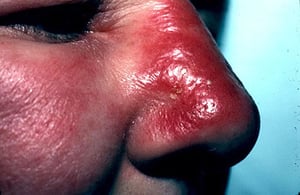
Erysipelas is characterized by shiny, raised, indurated, and tender plaque-like lesions with distinct margins.
Erysipelas is characterized by shiny, raised, indurated, and tender plaque-like lesions with distinct margins.
Image provided by Thomas Habif, MD.

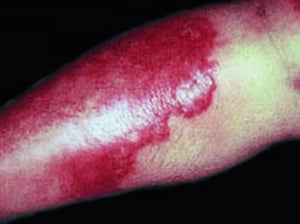
Note the sharp line of demarcation and bright red color, features that distinguish erysipelas from cellulitis.
Note the sharp line of demarcation and bright red color, features that distinguish erysipelas from cellulitis.
© Springer Science+Business Media

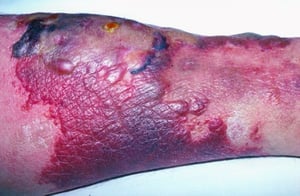
This image shows the bullous form of erysipelas.
This image shows the bullous form of erysipelas.
Image courtesy of Karen McKoy, MD.
Erysipelas is characterized by shiny, raised, indurated, and tender plaque-like lesions with distinct margins.
Erysipelas is characterized by shiny, raised, indurated, and tender plaque-like lesions with distinct margins.
Image provided by Thomas Habif, MD.
Note the sharp line of demarcation and bright red color, features that distinguish erysipelas from cellulitis.
Note the sharp line of demarcation and bright red color, features that distinguish erysipelas from cellulitis.
© Springer Science+Business Media
This image shows the bullous form of erysipelas.
This image shows the bullous form of erysipelas.
Image courtesy of Karen McKoy, MD.
Diagnosis of Erysipelas
Primarily history and physical examination
Sometimes culture
The diagnosis of erysipelas is based on its characteristic clinical appearance and on the exclusion of other causes that may present similarly.
Cultures of blood or cutaneous aspirates, biopsies, or swabs are not routinely recommended but should be done in toxic-appearing patients and should be considered in patients with immunosuppression, immersion injuries, or animal bites (1).
Erysipelas of the face must be differentiated from herpes zoster, angioedema, and contact dermatitis. Diffuse inflammatory breast cancer may also be mistaken for erysipelas.
Diagnosis reference
1. Stevens DL, Bisno AL, Chambers HF, et al. Practice guidelines for the diagnosis and management of skin and soft tissue infections: 2014 update by the Infectious Diseases Society of America. Clin Infect Dis. 2014;59(2):e10-e52. doi:10.1093/cid/ciu444
Treatment of Erysipelas
Oral or parenteral antibiotics
Antibiotics active against streptococci are the primary treatment for patients with erysipelas but no systemic signs of infection.
First-line oral antibiotics include one of the following (1):
Penicillin Vs
Amoxicillin or amoxicillin/clavulanic acid
Cephalexin
Cefadroxil
The first-line parenteral antibiotic (for severe cases) is aqueous crystalline penicillin G. Alternative parenteral antibiotics are ceftriaxone and cefazolin.
The duration of treatment is based mainly on clinical response and is broadly similar to that of cellulitis. The Infectious Diseases Society of America recommends a duration of 5 days that is extended if clinical improvement is not achieved (2).
Methicillin-resistant S. aureus (MRSA) is not common among patients with erysipelas, and adding antibiotics to cover MRSA adds limited additional benefit. However, if MRSA is identified through culture or if MRSA is strongly suspected, an appropriate antibiotic such as clindamycin, sulfamethoxazole/trimethoprim, doxycycline, linezolid, or vancomycin can be added. For methicillin-sensitive S. aureus infections, dicloxacillin may be used.
Bed rest and leg elevation are helpful for leg erysipelas. Compression therapy (eg, with Unna boots and compression socks) may also be of benefit for lower-extremity erysipelas. Cold packs and analgesics may relieve local discomfort.
Fungal foot infections may be an entry site for erysipelas and may require antifungal treatment to prevent recurrence (3).
Treatment references
1. Brindle R, Williams OM, Barton E, Featherstone P. Assessment of antibiotic treatment of cellulitis and erysipelas: A systematic review and meta-analysis. JAMA Dermatol. 2019;155(9):1033–1040. doi:10.1001/jamadermatol.2019.0884
2. Stevens DL, Bisno AL, Chambers HF, et al. Practice guidelines for the diagnosis and management of skin and soft tissue infections: 2014 update by the Infectious Diseases Society of America. Clin Infect Dis. 2014;59(2):e10-e52. doi:10.1093/cid/ciu444
3. Korecka K, Mikiel D, Banaszak A, Neneman A. Fungal infections of the feet in patients with erysipelas of the lower limb: is it a significant clinical problem?. Infection. 2021;49(4):671-676. doi:10.1007/s15010-021-01582-0
Key Points
Consider erysipelas in patients with shiny, raised, indurated, and tender plaques that have distinct margins, particularly if there are systemic signs (eg, fever, chills, malaise).
Erysipelas is most often caused by group A (or rarely group C or G) beta-hemolytic streptococci and occurs most frequently on the legs and face.
Treat erysipelas with oral antibiotics that target streptococci, including penicillin, amoxicillin or amoxicillin/clavulanic acid, cephalexin, or cefadroxil; in severe cases, use parenteral penicillin; and in penicillin-allergic patients, use ceftriaxone or cefazolin.
Treat methicillin-sensitive S. aureus infections with dicloxacillin.
Methicillin-resistant S. aureus is not a common cause of erysipelas; however, if suspected, it may be treated with clindamycin, sulfamethoxazole/trimethoprim, doxycycline, vancomycin, or linezolid.
Drug Information for the Topic