Amebic keratitis is a rare corneal infection with Acanthamoeba species, typically occurring in contact lens wearers. Diagnosis is made by microscopic examination and culture of corneal scrapings. Treatment is with topical chlorhexidine, polyhexamethylene biguanide, or both. Rarely, corneal reconstruction is necessary.
Acanthamoeba keratitis is estimated to affect approximately 1/1 million people per year (or 2 eyes/million people) worldwide (1).
Various Acanthamoeba species can cause chronic and progressively destructive keratitis in normal hosts. The organisms are present worldwide in water, soil, sewage, and dust (1). They can also be present in tap water, showers, hot tubs, and air conditioning units. The main risk factor in > 90% of cases is contact lens use, particularly if lenses are worn while swimming or bathing or if unsterile lens cleaning solution is used (2). The use of soft contact lenses (except daily disposable ones), multi-purpose or recalled contact lens solutions, and poor contact lens hygiene all contribute. Some infections start after corneal abrasion.
General references
1. Aiello F, Gallo Afflitto G, Ceccarelli F, et al. Perspectives on the Incidence of Acanthamoeba Keratitis: A Systematic Review and Meta-Analysis. Ophthalmology. 2025;132(2):206-218. doi:10.1016/j.ophtha.2024.08.003
2. Ibrahim YW, Boase DL, Cree IA. How Could Contact Lens Wearers Be at Risk of Acanthamoeba Infection? A Review. J Optom. 2009;2(2):60-66. doi:10.3921/joptom.2009.60
Pathophysiology of Amebic Keratitis
The life cycle of Acanthamoeba involves only 2 stages: cysts and trophozoites (the infective form). The trophozoites form double-walled cysts, which resist eradication.
Cysts and trophozoites can enter the body through various means (eg, eyes, nasal mucous membranes, broken skin). When Acanthamoeba enter the eye, they can cause severe keratitis.
In infected patients, both cysts and trophozoites may be found in the cornea.

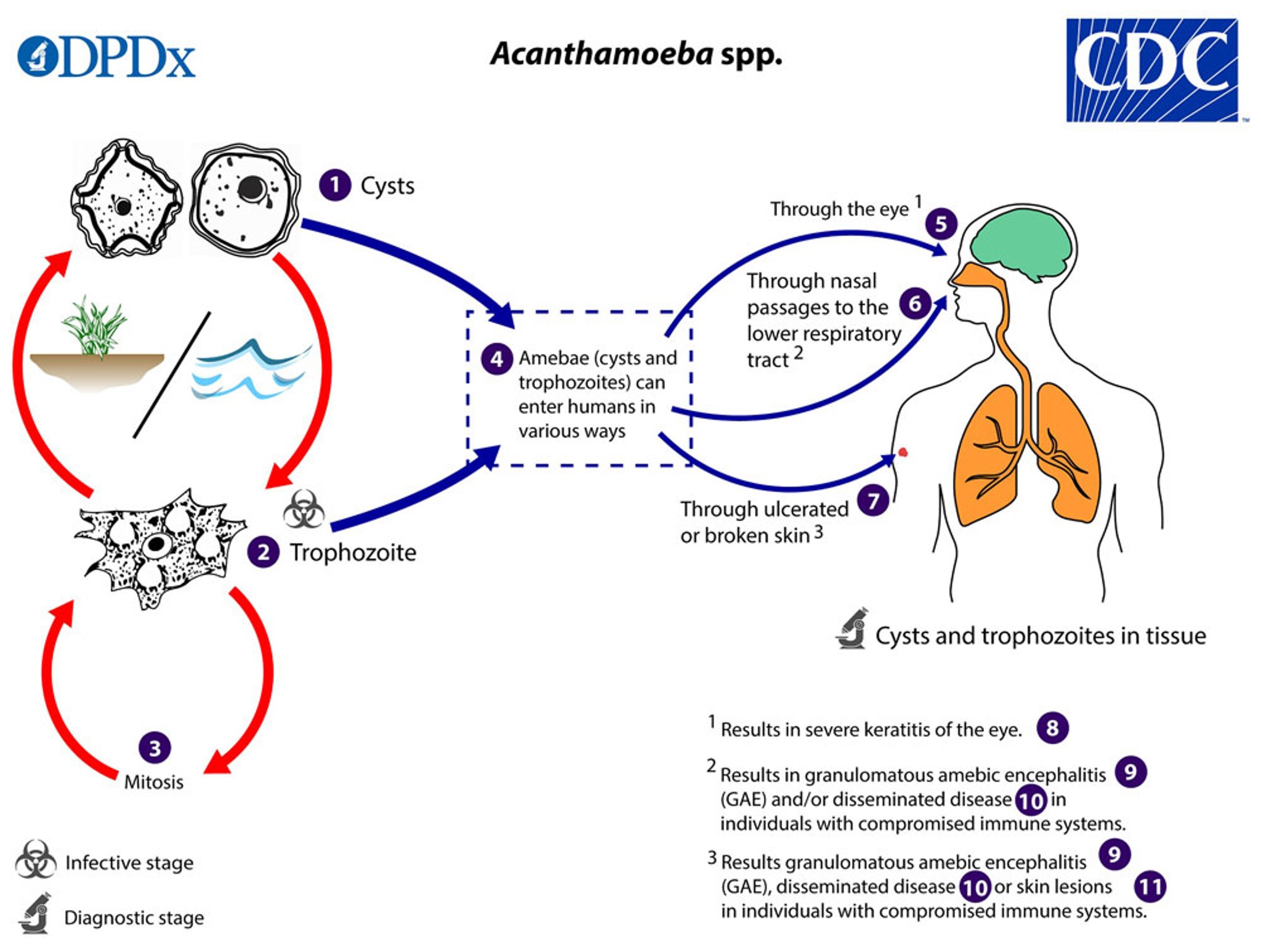
1–2. The Acanthamoeba life cycle has 2 stages: cysts and trophozoites. It lacks a flagellate stage.
3. The trophozoites replicate by mitosis (the nuclear membrane does not remain intact).
4–7. The trophozoites are the infective form, but both cysts and trophozoites can enter the body (4) through the eye (5), through the nasal passages to the lower respiratory tract (6), or through ulcerated or broken skin (7).
8. When Acanthamoeba enter through the eye, they can cause severe keratitis in otherwise healthy people, particularly contact lens wearers.
9–11. When Acanthamoeba enter through the respiratory system or through the skin, they can invade the central nervous system by hematogenous dissemination causing granulomatous amebic encephalitis (9) or disseminated disease (10), or skin lesions (11) in people with immunocompromise. Acanthamoeba cysts and trophozoites may disseminate widely and can be found in tissue (eg, skin, cerebrospinal fluid).
Image from the Centers for Disease Control and Prevention, Global Health, Division of Parasitic Diseases and Malaria.
Symptoms and Signs of Amebic Keratitis
Lesions in patients with amebic keratitis are typically very painful and produce a foreign body sensation, redness, photosensitivity, excess tearing, and diminished vision but typically not systemic symptoms. Lesions are commonly unilateral; rarely, they may be bilateral.
Initially, lesions may have a dendriform appearance resembling herpes simplex keratitis. Later, there are patchy stromal infiltrates and sometimes a characteristic ring-shaped lesion. Anterior uveitis is usually also present.
Diagnosis of Amebic Keratitis
Examination and culture of corneal scrapings
Consultation with an ophthalmologist is important for diagnosis and treatment of amebic keratitis.
Diagnosis of amebic keratitis is confirmed by examination of Giemsa- or trichrome-stained corneal scrapings and by culture on special media.
Real-time polymerase chain reaction technique is also available for identification of Acanthamoeba ribosomal DNA, which is highly sensitive and specific.
In vivo confocal microscopy to identify cysts in the cornea requires expertise to perform but has high sensitivity and specificity for diagnosis (1).
Diagnosis reference
1. Goh JWY, Harrison R, Hau S, Alexander CL, Tole DM, Avadhanam VS. Comparison of In Vivo Confocal Microscopy, PCR and Culture of Corneal Scrapes in the Diagnosis of Acanthamoeba Keratitis. Cornea. 2018;37(4):480-485. doi:10.1097/ICO.0000000000001497
Treatment of Amebic Keratitis
Corneal debridement
Chlorhexidine, polyhexamethylene biguanide, or both
Sometimes keratoplasty
Early, superficial amebic keratitis responds better to treatment.
Epithelial lesions are debrided, and intensive drug therapy is applied. Topical chlorhexidine 0.02%, topical polyhexamethylene biguanide 0.02%, or both drugs may be used (1).
For the first 3 days, treatment is given every 1 to 2 hours. Other topical medications used as adjunct therapy include the diamidines propamidine 0.1% or hexamidine 0.1%.
Early recognition and treatment have eliminated the need for therapeutic keratoplasty (corneal transplantation) in most instances, but keratoplasty remains an option when pharmacologic therapy fails. Intensive treatment is required for the first month; it is tapered per clinical response but continued for 6 to 12 months. Recurrence is common if treatment is stopped prematurely.
Treatment reference
1. Durand ML, Barshak MB, Sobrin L. Eye Infections. N Engl J Med. 2023;389(25):2363-2375. doi:10.1056/NEJMra2216081
Prevention of Amebic Keratitis
To prevent amebic keratitis, contact lenses should be cleaned and stored following the recommendations of eye care providers and manufacturers. Hands should be washed thoroughly before handling them.
Contact lens solutions should be kept fresh, not reused, and not topped off; tap water should never be used to store contact lenses. Nonsterile homemade contact lens solutions should not be used.
Both overnight wear while awake and sleeping with contact lenses in can increase the risk of developing amebic keratitis. Wearing contact lenses while swimming or bathing should be avoided.
Key Points
Various Acanthamoeba species can cause chronic and progressively destructive keratitis in otherwise healthy hosts, mainly in contact lens users.
Consult with an ophthalmologist about management.
Diagnose by examining Giemsa- or trichrome-stained corneal scrapings or by culturing the sample using special media; real-time polymerase chain reaction (PCR) technique and in vivo confocal microscopy are other modalities with high sensitivity and specificity.
Debride corneal lesions and treat with topical chlorhexidine, polyhexamethylene biguanide, or both, plus possibly a diamidine for 6 to 12 months.
More Information
The following English-language resource may be useful. Please note that The Manual is not responsible for the content of this resource.
Centers for Disease Control and Prevention (CDC): Clinical Overview of Acanthamoeba Keratitis
Drug Information for the Topic