Human papillomavirus (HPV) infects epithelial cells. Most of the > 100 subtypes infect cutaneous epithelium and cause skin warts; some types infect mucosal epithelium and cause anogenital warts. Skin or anogenital warts are diagnosed based on clinical appearance and are usually treated with topical medications or cytodestructive treatments. Genital warts may persist and spread widely in patients with decreased cell-mediated immunity (eg, due to pregnancy or HIV infection). Some types that infect mucosal epithelium can lead to anogenital or oropharyngeal cancer. Pap tests and/or HPV testing is recommended to screen for cervical cancer and anal cancer in high-risk patients. Vaccines are available to protect against many of the HPV strains that can cause genital warts and cancer.
(See also Overview of Sexually Transmitted Infections.)
Human papillomavirus (HPV) is the most common sexually transmitted infection (STI). HPV is so common that over 80% of sexually active unvaccinated people are infected with the virus at some point in their life (1, 2).
In the United States, approximately 13 million people become newly infected with HPV each year; before the HPV vaccine became available (3, 4), each year roughly 340,000 to 360,000 patients sought care for genital warts caused by HPV (5).
Most HPV infections clear spontaneously within 1 to 2 years. Those that persist can develop into cervical, anal, oropharyngeal, and other cancers (6).
General references
1. Centers for Disease Control and Prevention (CDC): Clinical Overview of HPV. Accessed February 6, 2025.
2. Gardella B, Pasquali MF, Dominoni M. Human Papillomavirus Cervical Infection: Many Ways to a Single Destination. Vaccines (Basel). 2022;11(1):22. Published 2022 Dec 22. doi:10.3390/vaccines11010022
3. CDC: About HPV. Accessed February 6, 2025.
4. Lewis RM, Laprise JF, Gargano JW, et al. Estimated Prevalence and Incidence of Disease-Associated Human Papillomavirus Types Among 15- to 59-Year-Olds in the United States. Sex Transm Dis. 2021;48(4):273-277. doi:10.1097/OLQ.0000000000001356
5. Workowski KA, Bachmann LH, Chan PA, et al. Sexually Transmitted Infections Treatment Guidelines, 2021. MMWR Recomm Rep. 2021;70(4):1-187. Published 2021 Jul 23. doi:10.15585/mmwr.rr7004a1. Erratum: Vol. 70, No. RR-4. MMWR Morb Mortal Wkly Rep. 2023;72(4):107-108. Published 2023 Jan 27. doi:10.15585/mmwr.mm7204a5
6. Markowitz LE, Unger ER. Human Papillomavirus Vaccination. N Engl J Med. 2023;388(19):1790-1798. doi:10.1056/NEJMcp2108502
Etiology of HPV Infection
There are > 100 known types of HPV. Some infect cutaneous epithelium and cause common skin warts. Some infect primarily the mucosa of the anogenital region, as well as the oropharyngeal and laryngeal areas.
Important manifestations of anogenital HPV include
Genital warts (condyloma acuminatum)
Intraepithelial neoplasia and carcinoma of the cervix, vulva, vagina, anus, or penis
Laryngeal and oropharyngeal cancers
Bowenoid papulosis
Condylomata acuminata are benign anogenital warts most often caused by HPV types 6 and 11; these types also cause laryngeal and oropharyngeal warts.
HPV-associated precancerous cervical lesions are referred to as squamous intraepithelial lesions or cervical intraepithelial neoplasia. Virtually all cervical cancer itself is caused by HPV; approximately 70% is caused by types 16 and 18, and many of the rest result from types 31, 33, 45, 52, and 58 (1). HPV types 16 and 18 can also cause cancer in other areas, including the vulva, vagina, anus, and penis. HPV types that affect mainly the anogenital area can be transmitted to the oropharynx by orogenital contact; type 16 seems responsible for many cases of oropharyngeal cancer.
Etiology reference
1. de Martel C, Plummer M, Vignat J, Franceschi S. Worldwide burden of cancer attributable to HPV by site, country and HPV type. Int J Cancer. 2017;141(4):664-670. doi:10.1002/ijc.30716
Symptoms and Signs of HPV Infection
Warts caused by HPV appear after an incubation period of 1 to 6 months.
Visible anogenital warts are usually small (< 3 mm in diameter), soft plaques or papules, smooth or papillated, and often occur in clusters. The may be skin-colored or the raised surface may be whitened. Warts may increase in size or number over a period of weeks to months.
The warts are usually asymptomatic, but some patients have itching, burning, or discomfort.
In men, warts occur most commonly under the foreskin, on the coronal sulcus, within the urethral meatus, and on the penile shaft. They may occur around the anus and in the rectum, especially in men who have sex with men.
In women, warts occur most commonly on the vulva, vaginal wall, cervix, and perineum; the urethra and anal region may be affected.
HPV types 16 and 18 usually cause endocervical or anal intraepithelial lesions that are difficult to see and diagnose clinically.

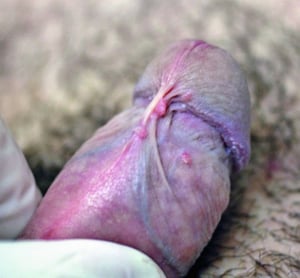
This photo shows small, soft, pink genital warts on the penile shaft.
This photo shows small, soft, pink genital warts on the penile shaft.
© Springer Science+Business Media

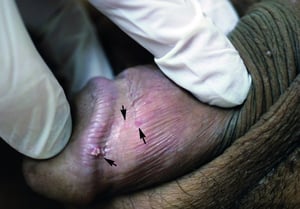
This photo shows pink and raised genital warts (arrows) at the coronal sulcus of the penis.
This photo shows pink and raised genital warts (arrows) at the coronal sulcus of the penis.
© Springer Science+Business Media


This photo shows the typical rough, pedunculated appearance of genital warts on the glans.
This photo shows the typical rough, pedunculated appearance of genital warts on the glans.
© Springer Science+Business Media

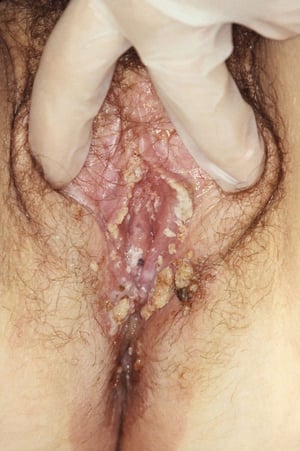
Genital warts on the vulva may be raised and light-colored with an irregular, rough surface.
Genital warts on the vulva may be raised and light-colored with an irregular, rough surface.
Image courtesy of Joe Millar via the Public Health Image Library of the Centers for Disease Control and Prevention.

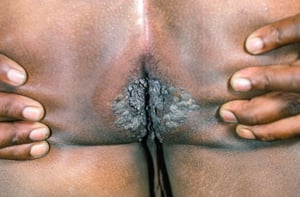
This photo shows a severe case of genital warts around the anus.
This photo shows a severe case of genital warts around the anus.
Photo courtesy of Karen McKoy, MD.

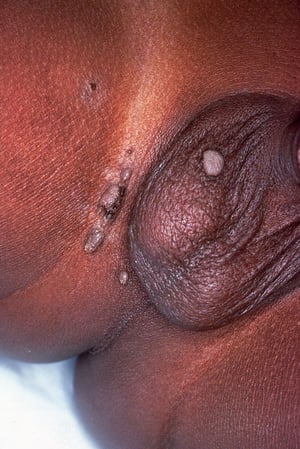
This photo shows warts occurring on the scrotum and in the perineal area.
This photo shows warts occurring on the scrotum and in the perineal area.
Photo courtesy of Karen McKoy, MD.
This photo shows small, soft, pink genital warts on the penile shaft.
This photo shows small, soft, pink genital warts on the penile shaft.
© Springer Science+Business Media
This photo shows pink and raised genital warts (arrows) at the coronal sulcus of the penis.
This photo shows pink and raised genital warts (arrows) at the coronal sulcus of the penis.
© Springer Science+Business Media
This photo shows the typical rough, pedunculated appearance of genital warts on the glans.
This photo shows the typical rough, pedunculated appearance of genital warts on the glans.
© Springer Science+Business Media
Genital warts on the vulva may be raised and light-colored with an irregular, rough surface.
Genital warts on the vulva may be raised and light-colored with an irregular, rough surface.
Image courtesy of Joe Millar via the Public Health Image Library of the Centers for Disease Control and Prevention.
This photo shows a severe case of genital warts around the anus.
This photo shows a severe case of genital warts around the anus.
Photo courtesy of Karen McKoy, MD.
This photo shows warts occurring on the scrotum and in the perineal area.
This photo shows warts occurring on the scrotum and in the perineal area.
Photo courtesy of Karen McKoy, MD.
Diagnosis of HPV Infection
History and physical examination
Nucleic acid amplification tests (NAATs)
Cervical, and sometimes anal, cytology (Pap test)
Sometimes colposcopy, anoscopy, or both
Genital warts are usually diagnosed with gross visual inspection. Their appearance usually differentiates them from condyloma lata of secondary syphilis (which are flat-topped) and from carcinomas. However, serologic tests for syphilis should be performed initially and after 3 months. Biopsies of atypical, bleeding, ulcerated, or persistent warts may be necessary to exclude carcinoma.
Cervical and anal intraepithelial lesions can be visualized only by colposcopy and anoscopy. Applying a 3 to 5% solution of acetic acid for a few minutes before colposcopy causes lesions to whiten and enhances visualization and detection of small lesions. (See also Cervical Cancer Screening and Prevention.)
In low-resource settings without access to routine Pap tests or colposcopy, screening and evaluation for cervical cancer include HPV testing and/or visual inspection with use of acetic acid or Lugol iodine (1, 2).
NAATs for oncogenic HPV subtypes are used as part of routine cervical cancer screening in women. Initial tests typically detect any one of 13 common high-risk types. Follow-up HPV genotype tests may be performed to detect the most high-risk types, typically 16, 18, or 45. No HPV testing for men is available for clinical use.
Clinicians should check for malignant oral lesions potentially caused by HPV during routine examination of the oral cavity.
Diagnosis references
1. World Health Organization (WHO): Human papillomavirus (HPV) nucleic acid amplification tests (NAATs) to screen for cervical pre-cancer lesions and prevent cervical cancer; policy brief; 16 March 2022
2. International Agency for Research on Cancer: A practical manual on visual screening for cervical neoplasia; Anatomical and pathological basis of visual inspection with acetic acid (VIA) and with Lugol’s iodine (VILI). IARC Technical Publication No. 41, 2003. ISBN 92 832 2423 X
Treatment of HPV Infection
Cytodestructive therapy or excision (eg, by caustics, cryotherapy, electrocauterization, laser, or surgical excision)
Topical medications (eg, with antimitotics or interferon inducers)
No treatment of anogenital warts is completely satisfactory, and relapses are frequent and require retreatment. In immunocompetent patients, genital warts often resolve without treatment. In immunocompromised patients, warts may be less responsive to treatment.
Because no treatment is clearly more efficacious than others, treatment of anogenital warts should be guided by other considerations, mainly wart size, number, and anatomic site; patient preference; cost of treatment; convenience; adverse effects; and the clinician's experience (1).
Genital warts may be treated with
Caustics
Topical medications
Cryotherapy
Electrocauterization
Laser therapy
Surgical excision
A local or general anesthetic is used depending on the size and number to be removed. Extensive vulvovaginal warts may require laser ablation. For anal warts, removal with a resectoscope may be the most effective treatment; a general anesthetic is used.
Topical treatments include antimitotics (eg, podophyllotoxin, podophyllin, 5-fluorouracil), caustics (eg, trichloroacetic acid), interferon inducers (eg, imiquimod), and sinecatechins (a botanical product with an unknown mechanism). These are widely used but usually require multiple applications over weeks to months and are generally less effective than laser therapy, if available (2). Before topical treatments are applied, surrounding tissue should be protected with petroleum jelly. Patients should be warned that after treatment, the area may be painful.

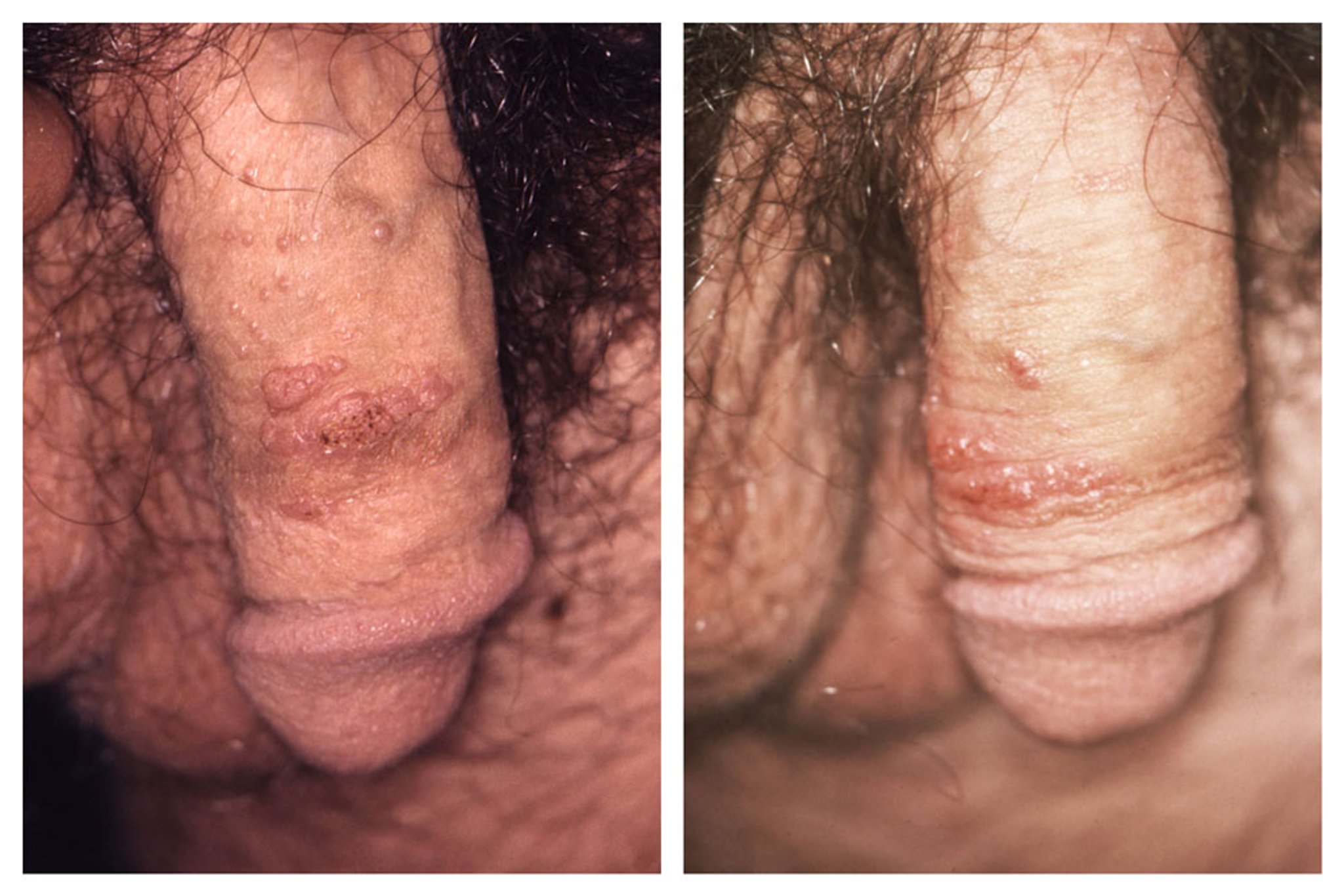
The left photo shows genital warts (condyloma acuminata) on the shaft of the penis. The right photo shows the warts 12 hours after topical podophyllin treatment.
Images courtesy of Dr. M.F. Rein via the Public Health Image Library of the Centers for Disease Control and Prevention.
Interferon alfa (eg, interferon alfa-2b, interferon alfa-n3), intralesionally or IM, has cleared intractable lesions on the skin and genitals, but optimal administration and long-term effects are unclear. Also, in some patients with bowenoid papulosis of the genitals (caused by type 16 HPV), lesions initially disappear after treatment with interferon alfa but reappear as invasive cancers.
Current sex partners of people with genital warts should be examined and, if infected, treated.
For intraurethral lesions, thiotepa (an alkylating medication), instilled in the urethra, is effective. In men, 5-fluorouracil applied 2 to 3 times a day is highly effective for urethral lesions, but, rarely, it causes swelling, leading to urethral obstruction. Intraurethral lesions are typically managed by a urologist.
Cervical intraepithelial neoplasia (CIN) is monitored with serial Pap tests and/or HPV testing or is treated with cryotherapy or excisional biopsy.
Vulvar and vaginal intraepithelial neoplasia are treated with surgical excision.
Sex partners of patients with cervical intraepithelial neoplasia or carcinoma and of patients with bowenoid papulosis should be counseled and screened regularly for HPV-related lesions. A similar approach can be used for HPV in the rectum.
Management of cancers caused by HPV is discussed Treatment of Cervical Cancer, Treatment of Oropharyngeal Squamous Cell Carcinoma, and Treatment of Recurrent Respiratory Papillomatosis.
Treatment references
1. Workowski KA, Bachmann LH, Chan PA, et al. Sexually Transmitted Infections Treatment Guidelines, 2021. MMWR Recomm Rep. 2021;70(4):1-187. Published 2021 Jul 23. doi:10.15585/mmwr.rr7004a1. Erratum: Vol. 70, No. RR-4. MMWR Morb Mortal Wkly Rep. 2023;72(4):107-108. Published 2023 Jan 27. doi:10.15585/mmwr.mm7204a5
2. Barton S, Wakefield V, O'Mahony C, Edwards S. Effectiveness of topical and ablative therapies in treatment of anogenital warts: a systematic review and network meta-analysis. BMJ Open. 2019;9(10):e027765. Published 2019 Oct 31. doi:10.1136/bmjopen-2018-027765
Prevention of HPV Infection
The HPV vaccine is a routine childhood vaccination (see CDC: Child and Adolescent Immunization Schedule by Age). See also Advisory Committee on Immunization Practices (ACIP) Recommendations: Human Papillomavirus (HPV) Vaccine.
A human papillomavirus 9-valent vaccine protects against the 2 types of HPV that cause > 90% of visible genital warts (types 6 and 11). This vaccine also protects against the 2 types of HPV that cause most cervical cancers (types 16 and 18). The 9-valent vaccine also protects against other types of HPV (types 31, 33, 45, 52, and 58) that cause approximately 10 to 20% of cervical cancers (1).
A human papillomavirus quadrivalent vaccine (HPV4) protects against 6, 11, 16, and 18.
A human papillomavirus bivalent vaccine (HPV2) protects against types 16 and 18.
Only the 9-valent vaccine is available in the United States.
Recommendations from the Advisory Committee on Immunization Practices (ACIP) of the Centers for Disease Control are as follows (2, 3):
For both females and males up to age 26 years: HPV vaccine is recommended at age 11 or 12 years (can start at age 9 years) and for previously unvaccinated or not adequately vaccinated patients up through age 26 years.
For adults 27 to 45 years: Clinicians should engage in a shared decision-making discussion with patients to determine whether they should be vaccinated.
Because HPV can be transmitted by skin-to-skin contact, condoms do not fully protect against infection.
Circumcision can reduce the risk of HPV infection in men and in their female sex partners (4).
Prevention references
1. National Cancer Institute: Human papillomavirus (HPV) vaccines. 2019.
2. Workowski KA, Bachmann LH, Chan PA, et al. Sexually Transmitted Infections Treatment Guidelines, 2021. MMWR Recomm Rep. 2021;70(4):1-187. Published 2021 Jul 23. doi:10.15585/mmwr.rr7004a1. Erratum: Vol. 70, No. RR-4. MMWR Morb Mortal Wkly Rep. 2023;72(4):107-108. Published 2023 Jan 27. doi:10.15585/mmwr.mm7204a5
3. Meites E, Szilagyi PG, Chesson HW, Unger ER, Romero JR, Markowitz LE. Human Papillomavirus Vaccination for Adults: Updated Recommendations of the Advisory Committee on Immunization Practices. MMWR Morb Mortal Wkly Rep. 2019;68(32):698-702. Published 2019 Aug 16. doi:10.15585/mmwr.mm6832a3
4. Shapiro SB, Laurie C, El-Zein M, Franco EL. Association between male circumcision and human papillomavirus infection in males and females: a systematic review, meta-analysis, and meta-regression. Clin Microbiol Infect. 2023;29(8):968-978. doi:10.1016/j.cmi.2023.03.028
Key Points
Anogenital warts are caused by human papillomavirus (HPV), most commonly types 6 and 11.
HPV types 16 and 18 cause approximately 70% of cervical cancers and can cause cancer in other areas, including the vulva, vagina, penis, anus, and oropharynx.
Diagnose warts by inspection; HPV testing is available to screen for cervical cancer.
Treat warts with cytodestructive treatments, topical medications, or surgical excision.
Treat cervical, vaginal, vulvar, or anal intraepithelial neoplasia with ablation or excision or manage with close surveillance.
HPV vaccination is recommended as a routine vaccination for children and young adults ages 9 to 26 years.
Drug Information for the Topic