Lymphogranuloma venereum is a disease caused by 3 unique strains of Chlamydia trachomatis and characterized by a small, often asymptomatic skin lesion, followed by regional lymphadenopathy in the groin or pelvis. Alternatively, if acquired by anal sex, it may manifest as severe proctitis. Without treatment, lymphogranuloma venereum may cause obstruction of lymph flow and chronic swelling of genital tissues. Diagnosis is by history and physical examination, but laboratory confirmation with serologic or immunofluorescent testing is usually possible. Treatment is 21 days of a tetracycline, azithromycin, or erythromycin.
(See also Overview of Sexually Transmitted Infections and Chlamydia.)
Lymphogranuloma venereum (LGV) is caused by serovars L1, L2, and L3 of the bacteria Chlamydia trachomatis. These serotypes differ from the chlamydial serotypes that cause trachoma, inclusion conjunctivitis, and chlamydial urethritis and cervicitis because they can invade and reproduce in regional lymph nodes.
LGV is endemic in parts of Africa, Southeast Asia, and other areas of the world (1). It is diagnosed much more often in men than women. LGV is being increasingly reported in North America, Europe, and Australia among men who have sex with men (MSM) (2).
General references
1. de Vries HJC, de Barbeyrac B, de Vrieze NHN, et al. 2019 European guideline on the management of lymphogranuloma venereum. J Eur Acad Dermatol Venereol. 2019;33(10):1821-1828. doi:10.1111/jdv.15729
2. Williamson DA, Chen MY. Emerging and Reemerging Sexually Transmitted Infections. N Engl J Med. 2020;382(21):2023-2032. doi:10.1056/NEJMra1907194
Symptoms and Signs of LGV
LGV occurs in 3 stages.
Stage 1 begins after an incubation period of about 3 days with a small skin lesion at the site of entry. It may cause the overlying skin to ulcerate but heals so quickly that it may pass unnoticed. People who engage in receptive anal sex may have severe proctitis or proctocolitis with bloody purulent rectal discharge.
Stage 2 in men usually begins after about 2 to 4 weeks, with the inguinal lymph nodes on one or both sides enlarging and forming large, tender, sometimes fluctuant masses or abscesses (buboes). The buboes adhere to deeper tissues and cause the overlying skin to become inflamed, sometimes with fever and malaise.

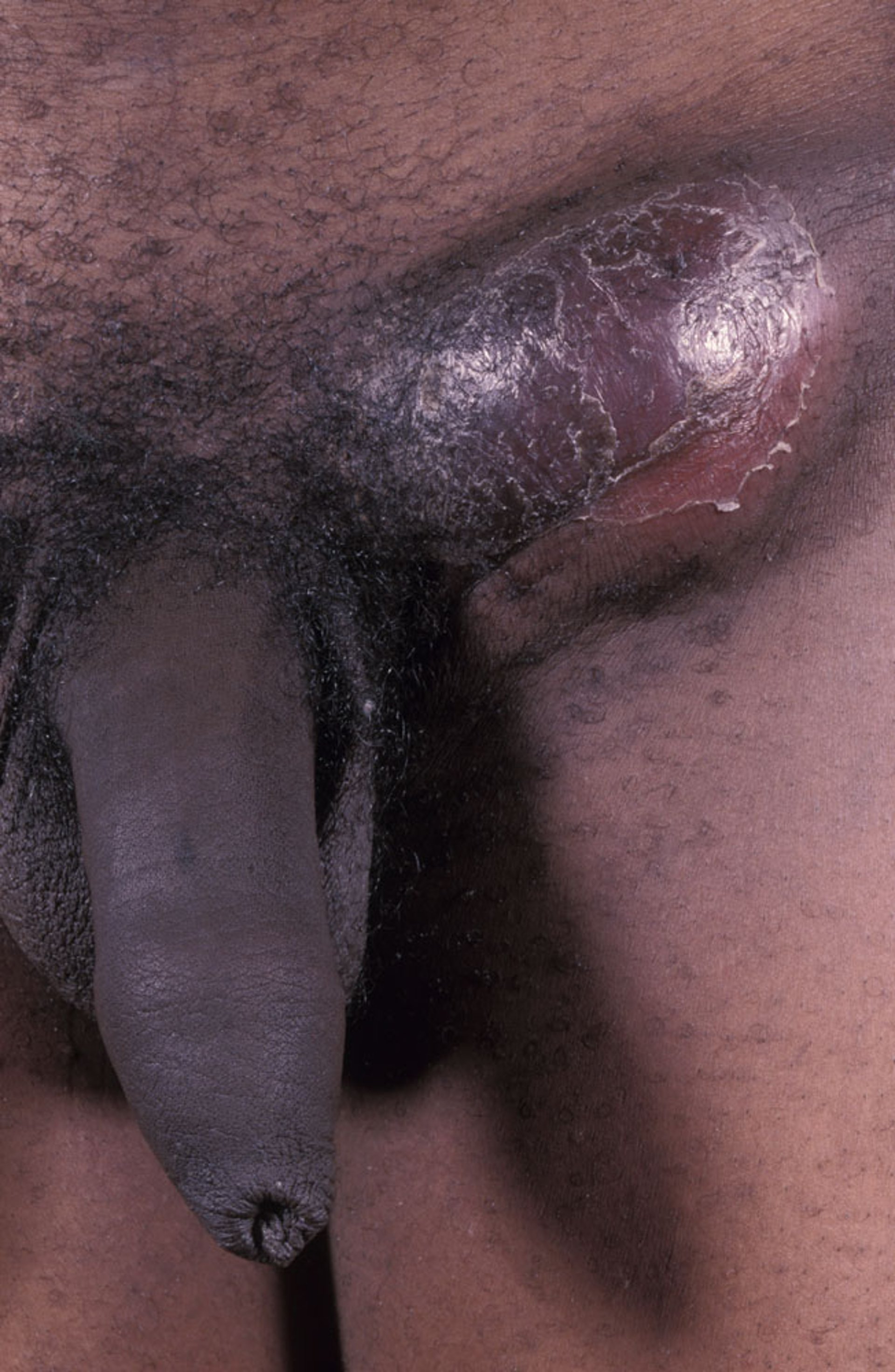
This photo shows swelling in the lymph nodes on the right-hand side of a man's groin in the sexually transmitted infection lymphogranuloma venereum. Swelling is especially prominent in an inguinal lymph node. A swelling of inguinal lymph node is called a bubo.
SCIENCE PHOTO LIBRARY
Stage 2 in women commonly causes backache or pelvic pain; the initial lesions may be on the cervix or upper vagina, resulting in enlargement and inflammation of deeper perirectal and pelvic lymph nodes backache or pelvic pain is common.
In both sexes, multiple draining sinus tracts may develop and discharge pus or blood.
In stage 3, lesions heal with scarring, but sinus tracts can persist or recur. Persistent inflammation due to untreated infection obstructs the lymphatic vessels, causing swelling and skin sores.
Strictures in the rectum may occur and/or pain due to inflamed pelvic lymph nodes may develop. Proctoscopy may detect diffuse inflammation, polyps, and masses or mucopurulent exudate. These findings resemble inflammatory bowel disease, including Crohn disease.
Diagnosis of LGV
History and physical examination
Nucleic acid amplification testing (NAAT)
Lymphogranuloma venereum is suspected in patients who have genital ulcers, swollen inguinal lymph nodes, or proctitis and who live in, have visited, or have sexual contact with people from areas where infection is common. LGV is also suspected in patients with buboes, which may be mistaken for abscesses caused by other bacteria.
NAAT for C. trachomatis in general or, when available, for the LGV-specific variants is the diagnostic testing of choice. Antibody detection via serology is not recommended for routine use, but it may have a role in some cases particularly when NAAT is not available (1, 2).
After apparently successful treatment, patients should be monitored for 6 months.
Diagnosis references
1. Workowski KA, Bachmann LH, Chan PA, et al. Sexually Transmitted Infections Treatment Guidelines, 2021. MMWR Recomm Rep. 2021;70(4):1-187. Published 2021 Jul 23. doi:10.15585/mmwr.rr7004a1. Erratum: Vol. 70, No. RR-4. MMWR Morb Mortal Wkly Rep. 2023;72(4):107-108. Published 2023 Jan 27. doi:10.15585/mmwr.mm7204a5
2. de Vries HJC, de Barbeyrac B, de Vrieze NHN, et al. 2019 European guideline on the management of lymphogranuloma venereum. J Eur Acad Dermatol Venereol. 2019;33(10):1821-1828. doi:10.1111/jdv.15729
Treatment of LGV
Oral tetracyclines, azithromycin, or erythromycin
Possibly drainage of buboes for symptomatic relief
Oral doxycycline 100 mg orally 2 times a day for 21 days is the preferred treatment. Alternatively, erythromycin 500 mg orally 4 times a day for 21 days or azithromycin 1 g orally once/week for 3 weeks can be used. Because the erythromycin/azithromycin regimen has not been validated, a test of cure with nucleic acid amplification testing for C. trachomatis 4 weeks after completion of treatment can be considered. All treated patients should be retested in 3 months (1).
Swelling of damaged tissues in later stages may not resolve despite elimination of the bacteria. Buboes may be drained by needle or surgically if necessary for symptomatic relief, but most patients respond quickly to antibiotics. Buboes and sinus tracts may require surgery, but rectal strictures can usually be dilated.
People who have had sexual contact with a patient with LGV during the 60 days before the patient's symptoms began should be examined and tested for urethral, cervical, or rectal chlamydia depending on the site of exposure. They should be treated presumptively with doxycycline 100 mg orally 2 times a day for 7 days (alternatives include a single dose of azithromycin 1 g orally, or levofloxacin) regardless of whether evidence suggests that they have LGV.
Treatment reference
1. Workowski KA, Bachmann LH, Chan PA, et al. Sexually Transmitted Infections Treatment Guidelines, 2021. MMWR Recomm Rep. 2021;70(4):1-187. Published 2021 Jul 23. doi:10.15585/mmwr.rr7004a1. Erratum: Vol. 70, No. RR-4. MMWR Morb Mortal Wkly Rep. 2023;72(4):107-108. Published 2023 Jan 27. doi:10.15585/mmwr.mm7204a5
Drug Information for the Topic