A popliteal (Baker) cyst is a fluid-filled mass in the popliteal fossa that represents distention of a preexisting bursa, most commonly the gastrocnemius-semimembranosus bursa. It is filled with synovial fluid and usually communicates with the knee joint. It is frequently asymptomatic but can cause pain, swelling behind the knee, and knee stiffness and decreased range of motion. Diagnosis is usually clinical; however, ultrasound or MRI may be needed if clinical findings are inconclusive. If symptomatic, treatment includes nonsteroidal anti-inflammatory drugs (NSAIDs) and, sometimes, drainage, glucocorticoid injection, or surgical removal of the cyst.
A popliteal (Baker) cyst is a fluid-filled popliteal bursa that develops from an accumulation of synovial fluid from the knee. Most cysts are small and do not cause symptoms. When they become larger (> 5 cm), they can be noticed by the patient as a swelling behind the knee.
Etiology of Popliteal Cysts
A popliteal cyst is a fluid-filled distention of the gastrocnemius-semimebranosus bursa, most often occurring when it communicates with the knee joint through an opening in the posterior joint capsule near the medial femoral condyle (1). The cyst typically develops through a valvelike mechanism that permits synovial fluid to flow from the joint into the bursa while limiting its return, leading to progressive enlargement of the bursa. Popliteal cysts can also develop without communication with the knee joint, which more commonly occurs in children.
Popliteal cysts are commonly caused by an underlying joint disease, including
Prior knee injury (eg, meniscal tear)
Rheumatoid arthritis and other inflammatory arthropathies
Osteoarthritis in patients with significant knee effusions

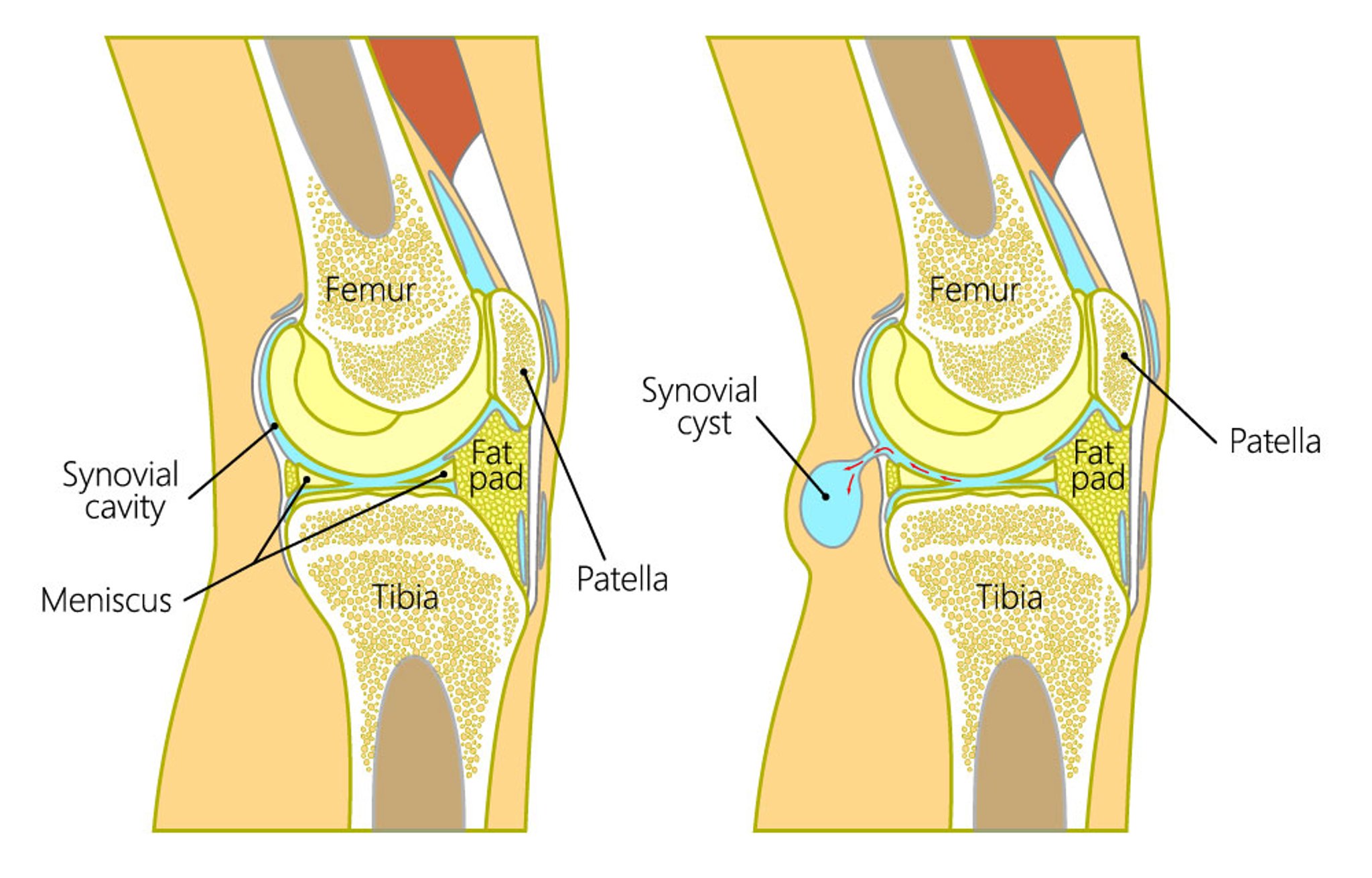
When an influx of synovial fluid from the adjacent knee joint space accumulates in and distends the gastrocnemius-semimebranosus bursa, the result is a popliteal cyst (right).
Aksana/stock.adobe.com
Etiology reference
1. Herman AM, Marzo JM. Popliteal cysts: a current review. Orthopedics. 2014;37(8):e678-e684. doi:10.3928/01477447-20140728-52
Symptoms and Signs of Popliteal Cysts
Popliteal cysts may be asymptomatic but become noticeable when they become swollen (eg, ≥ 5 cm). Compression of adjacent tissue may cause pain usually with extension of the knee. Patients complain of worsening pain, usually in the posterior part of the knee; increased knee stiffness; and decreased range of motion as the cyst becomes larger. Cysts can rupture and release fluid into the calf, simulating deep vein thrombosis, with distal leg swelling, erythema, warmth, and sometimes causing a positive Homan sign. A ruptured popliteal cyst can also present with ecchymotic changes in the posterior aspect of the calf extending down to the medial malleolus, called the "crescent sign" (1).
Pearls & Pitfalls
|
Symptoms and signs reference
1. Erkus S, Soyarslan M, Kose O, Kalenderer O. Compartment syndrome secondary to Baker's cyst rupture: A case report and up-to-date review. Int J Crit Illn Inj Sci. 2019;9(2):82-86. doi:10.4103/IJCIIS.IJCIIS_84_18
Diagnosis of Popliteal Cyst
Primarily history and physical examination
Sometimes ultrasound
Sometimes MRI
Popliteal cysts are so named because they are located in the popliteal fossa. The cysts are more prominent and firm when the patient is standing and the knee is fully extended.
If clinical findings are inconclusive (eg, if cysts are small or painful or require differentiation from deep vein thromboses or popliteal fat deposition), ultrasound can be done. Magnetic resonance imaging is occasionally done if the ultrasound is inconclusive or to diagnose and characterize coexisting internal knee derangements that may require surgery.
If the onset is acute or subacute, with suspected inflammation, aspiration of the joint or the cyst should be performed to exclude infection or crystal-associated arthritis (as is appropriate in any acute monoarticular arthritis).
Treatment of Popliteal Cyst
Nonsteroidal anti-inflammatory drugs (NSAIDs)
Joint aspiration and glucocorticoid injection
Sometimes aspiration and glucocorticoid injection of the cyst under ultrasound guidance
Rarely surgical removal of the cyst
Asymptomatic cysts do not require treatment. Nonsteroidal anti-inflammatory drugs (NSAIDs) are the primary treatment for mildly symptomatic popliteal cysts.
Joint aspiration can be done to remove fluid and relieve pain and swelling (1). Arthrocentesis and glucocorticoid injection are sometimes used to treat inflammation. The cyst can also be aspirated under ultrasound guidance followed by glucocorticoid injection directly into the cyst. Ultrasound guidance is required for accurate needle placement into the popliteal cyst and to avoid damage to the adjacent neurovascular structures (eg, popliteal artery). Removing the cyst surgically is an alternative if other treatments are not effective.
Treatment reference
1. Van Nest DS, Tjoumakaris FP, Smith BJ, Beatty TM, Freedman KB. Popliteal Cysts: A Systematic Review of Nonoperative and Operative Treatment. JBJS Rev. 2020;8(3):e0139. doi:10.2106/JBJS.RVW.19.00139
Key Points
The usual causes of popliteal cysts are prior injury, rheumatoid arthritis, osteoarthritis, or overuse of the knee.
If clinical findings are inconclusive, ultrasound or, less often, MRI is performed.
If symptomatic, treat most cases with NSAIDs, and sometimes arthrocentesis and glucocorticoid injection of the joint.
The popliteal cyst can also be aspirated and injected with glucocorticoids under ultrasound guidance.