Paget disease of the nipple (also called Paget disease of the breast) is a rare type of carcinoma that appears as a unilateral eczematous to psoriasiform plaque of the nipple and areola. It results from extension to the epidermis of an underlying ductal adenocarcinoma of the breast. Diagnosis is by biopsy. Treatment is based on the presence of an associated breast cancer with the addition of removal of the nipple and areola.
The great majority (90%) of cases of Paget disease of the nipple are associated with intramammary ductal carcinoma in situ (DCIS) or invasive cancer (1).
Extramammary Paget disease is a rare adenocarcinoma that can either arise from apocrine glands of the skin or extend from a cancer in the bladder, anus, or rectum. For extramammary Paget disease, treatment is with surgery or topical, radiation, or laser therapy.
Paget disease of the nipple should not be confused with the metabolic bone disease that is also called Paget disease.
Diagnosis of Paget Disease of the Nipple
Biopsy
The redness, oozing, and crusting closely resemble dermatitis, but physicians should suspect carcinoma because the lesion is sharply marginated, unilateral, and unresponsive to topical glucocorticoid therapy. Biopsy shows typical histologic changes with Paget cells in the epidermis of the nipple.

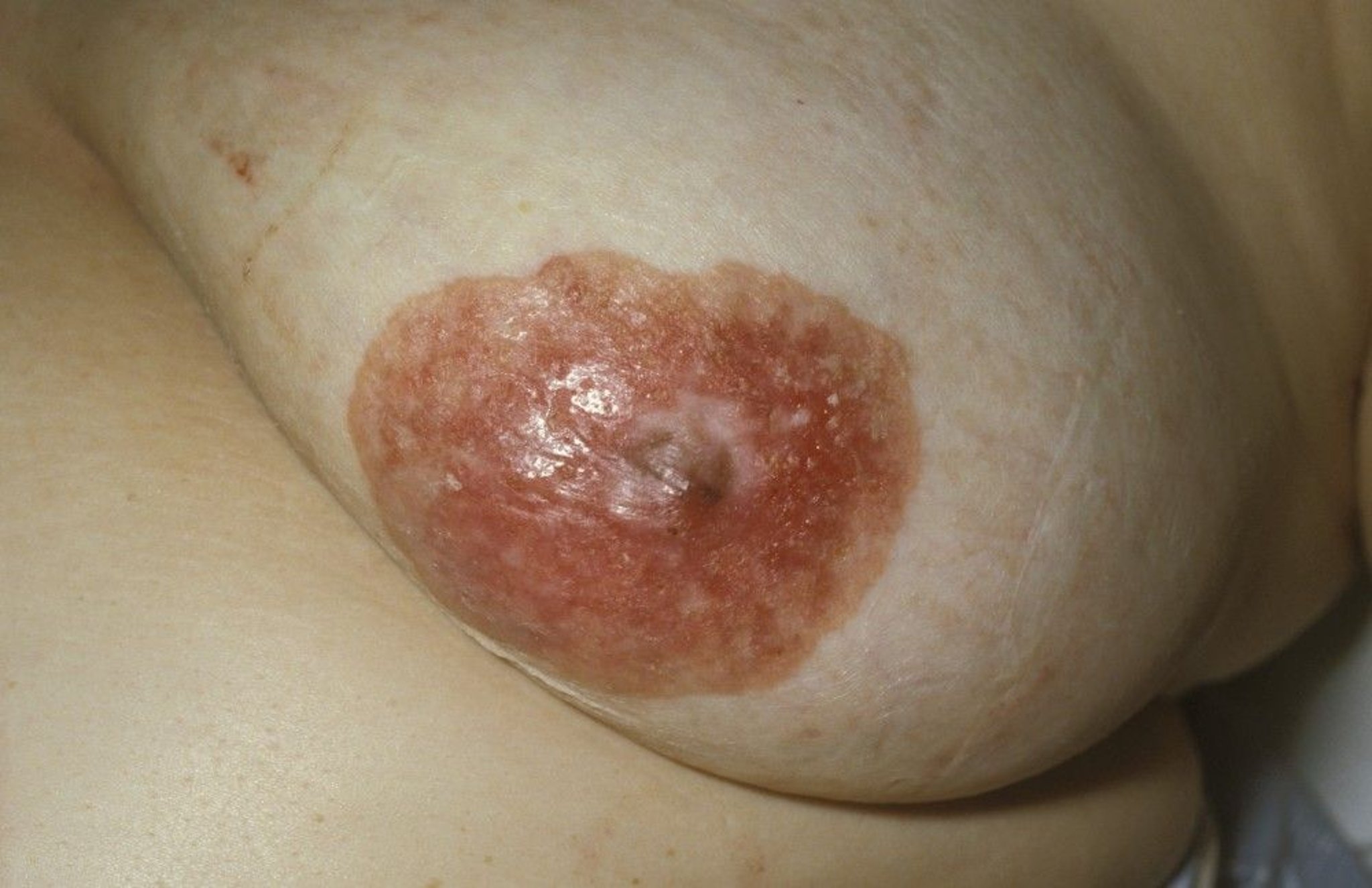
In Paget disease of the nipple, ductal carcinoma in situ extends over the nipple and areola and causes scaling, pruritus, and burning pain in the affected nipple.
DR M.A. ANSARY/SCIENCE PHOTO LIBRARY


The typical appearance of Paget disease of the nipple can include scaling and erythema.
Clinical Photography/SCIENCE PHOTO LIBRARY
Because this tumor is associated with underlying cancer, systemic evaluation (eg, history and physical examination, age-appropriate cancer screening, imaging) is required.
Treatment of Paget Disease of the Nipple
Treatment of underlying tumor
Excision of the nipple-areolar complex
Treatment of Paget disease of the nipple involves appropriate breast cancer treatment for discovered underlying tumors and includes wide excision of the nipple-areolar complex (1). If no underlying breast cancer is found, either mastectomy or nipple-areolar complex resection followed by radiation treatment may be used.
Treatment of extramammary Paget disease may also involve ablation of overlying cutaneous involvement by using topical therapies (eg, topical 5-fluorouracil, imiquimod, photodynamic therapy), radiation therapy, surgery, or CO2 laser ablation. A thorough evaluation should be performed to exclude an internal cancer.
Reference
1. Ortiz-Pagan S, Cunto-Amesty G, Narayan S, et al. Effect of Paget's disease on survival in breast cancer: an exploratory study. Arch Surg. 2011;146(11):1267-1270. doi:10.1001/archsurg.2011.278
Drug Information for the Topic