An encephalocele is a congenital neurologic anomaly with a protrusion of neural tissue and meninges through a skull defect. Surgical repair is possible in many cases.
An encephalocele is caused by incomplete closure of the cranial vault (cranium bifidum).
Encephaloceles usually occur in the midline and protrude anywhere along a line from the occiput to the nasal passages but can be present asymmetrically in the frontal or parietal regions.
Encephaloceles may also occur internally, eg, at the anterior pole of the temporal lobe, and may be discovered only later in life during evaluation for associated neurodevelopmental symptoms such as epilepsy.
Approximately 40% of affected infants have other congenital anomalies (1). Hydrocephalus often occurs with encephalocele.

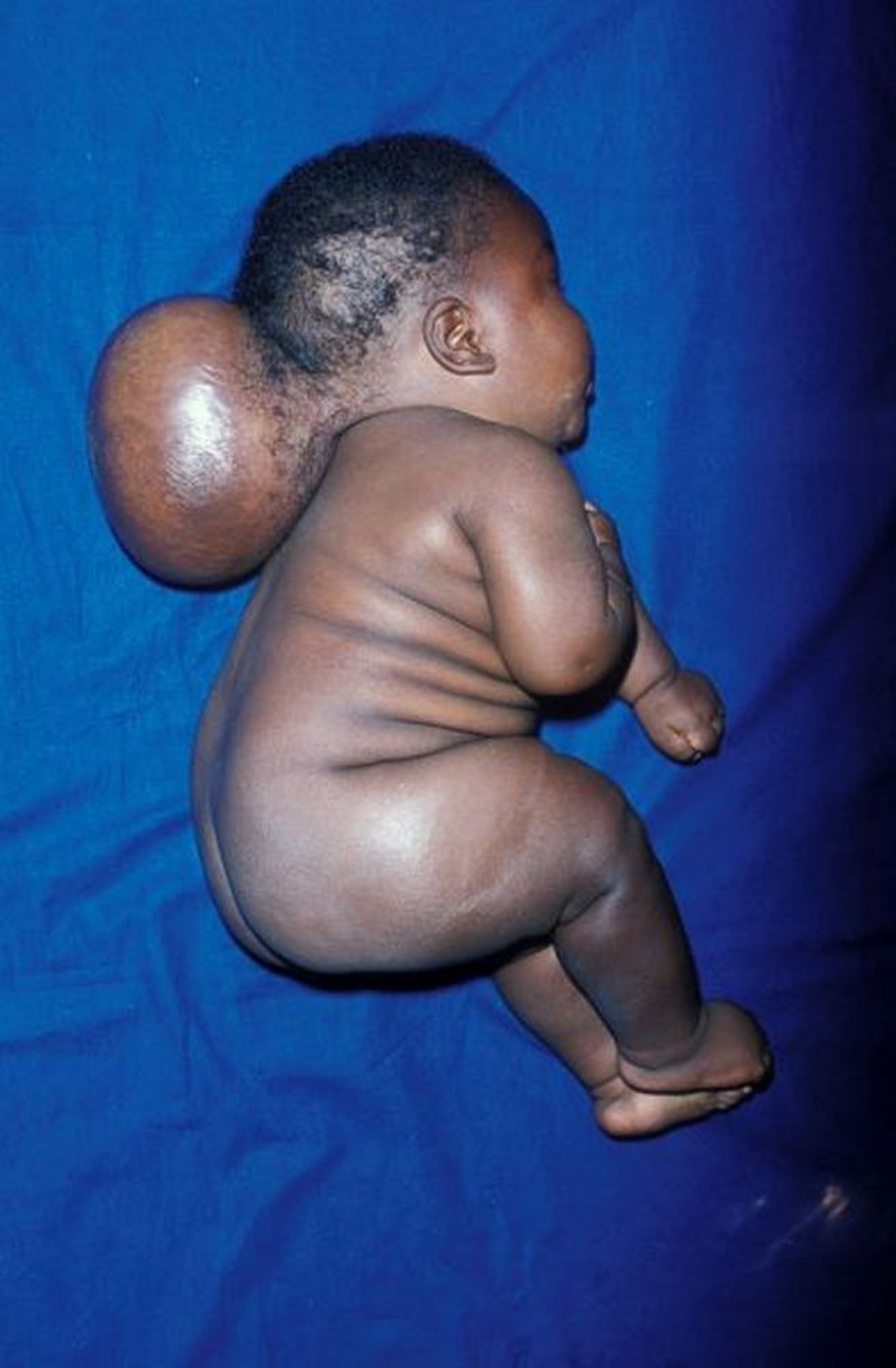
This image shows a baby girl with an encephalocele. The brain tissue in the hernia is often abnormal, and the brain is often damaged. Most encephaloceles, like this one, are found extending from the rear of the head.
DR M.A. ANSARY/SCIENCE PHOTO LIBRARY
Reference
1. Stoll C, Dott B, Alembik Y, Roth MP. Associated malformations among infants with neural tube defects. Am J Med Genet A. 2011;155A(3):565-568. doi:10.1002/ajmg.a.33886
Symptoms and Signs of Encephalocele
Symptoms and signs of encephalocele include the visible defect, seizures, and impaired cognition, including intellectual and developmental disability.
Diagnosis of Encephalocele
Prenatal ultrasound
Diagnosis of encephalocele may be made by routine prenatal ultrasound.
Small encephaloceles may resemble cephalohematomas; a distinguishing radiographic feature is a bony skull defect at the base of the encephalocele.
Treatment of Encephalocele
Surgical repair
Most encephaloceles can be surgically repaired. Even large ones often contain mostly heterotopic neural tissue, which can be removed without adversely impacting functional ability.
When other major physical malformations coexist, the decision to repair may be more difficult.
Neurodevelopmental symptoms that result from an encephalocele often persist even after surgical removal because the normal developmental sequence of brain structure and neural network formation was disrupted.
Prognosis for Encephalocele
Prognosis depends on the location and size of the lesion.