Teething is the process in infants and young children of tooth eruption through the gums.
Although there is wide variation, a child's first tooth usually erupts between 5 and 10 months of age, and a complete set of 20 deciduous teeth usually develops by approximately 2½ years of age (1).
Clinicians often counsel parents that before a tooth erupts, the child may cry, be fussy, and sleep and eat poorly. Also, during tooth eruption, the child may drool, have red and tender gums, and chew constantly on objects such as toys and crib rails.
Tooth Eruption Times*
Teeth | Number | Age at Eruption† |
|---|---|---|
Deciduous (20 total) | ||
Lower central incisors | 2 | 5–10 months |
Upper central incisors | 2 | 8–12 months |
Upper lateral incisors | 2 | 10–14 months |
Lower lateral incisors | 2 | 14–16 months |
First molars‡ | 4 | 12–20 months |
Canines | 4 | 16–24 months |
Second molars‡ | 4 | 22–32 months |
Permanent (32 total) | ||
First molars‡ | 4 | 5–7 years |
Incisors | 8 | 5-11 years |
Bicuspids (premolars) | 8 | 8–12 years |
Canines | 4 | 9–13 years |
Second molars‡ | 4 | 10–13 years |
Third molars‡ | 4 | 17–25 years |
*Muthu MS, Vandana S, Akila G, Anusha M, Kandaswamy D, Aswath Narayanan MB. Global variations in eruption chronology of primary teeth: A systematic review and meta-analysis. Arch Oral Biol. 2024;158:105857. doi:10.1016/j.archoralbio.2023.105857; and Vandana S, Muthu MS, Akila G, Anusha M, Kandaswamy D, Aswath Narayanan MB. Global variations in eruption chronology of permanent teeth: A systematic review and meta-analysis. Am J Hum Biol. 2024;36(8):e24060. doi:10.1002/ajhb.24060 † Varies greatly. | ||
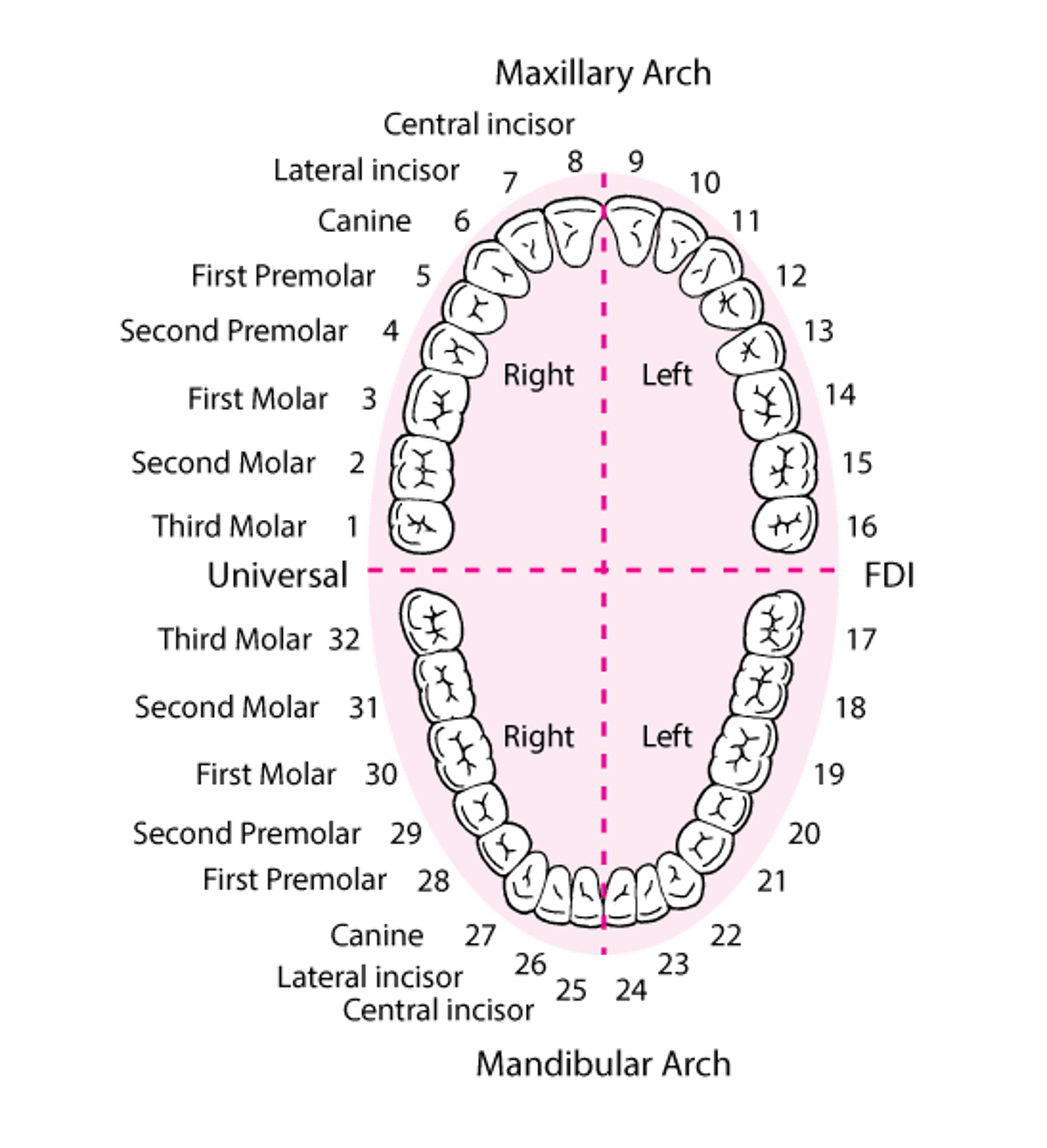
‡ Molars are numbered from the back of the mouth to the front (see figure Identifying the Permanent Teeth). | ||
Teething may cause a mild elevation in body temperature but does not cause fever (T ≥ 38 degrees C) (2). Children who have fever and who are especially fussy should be evaluated for infection, because these symptoms are not caused by teething.
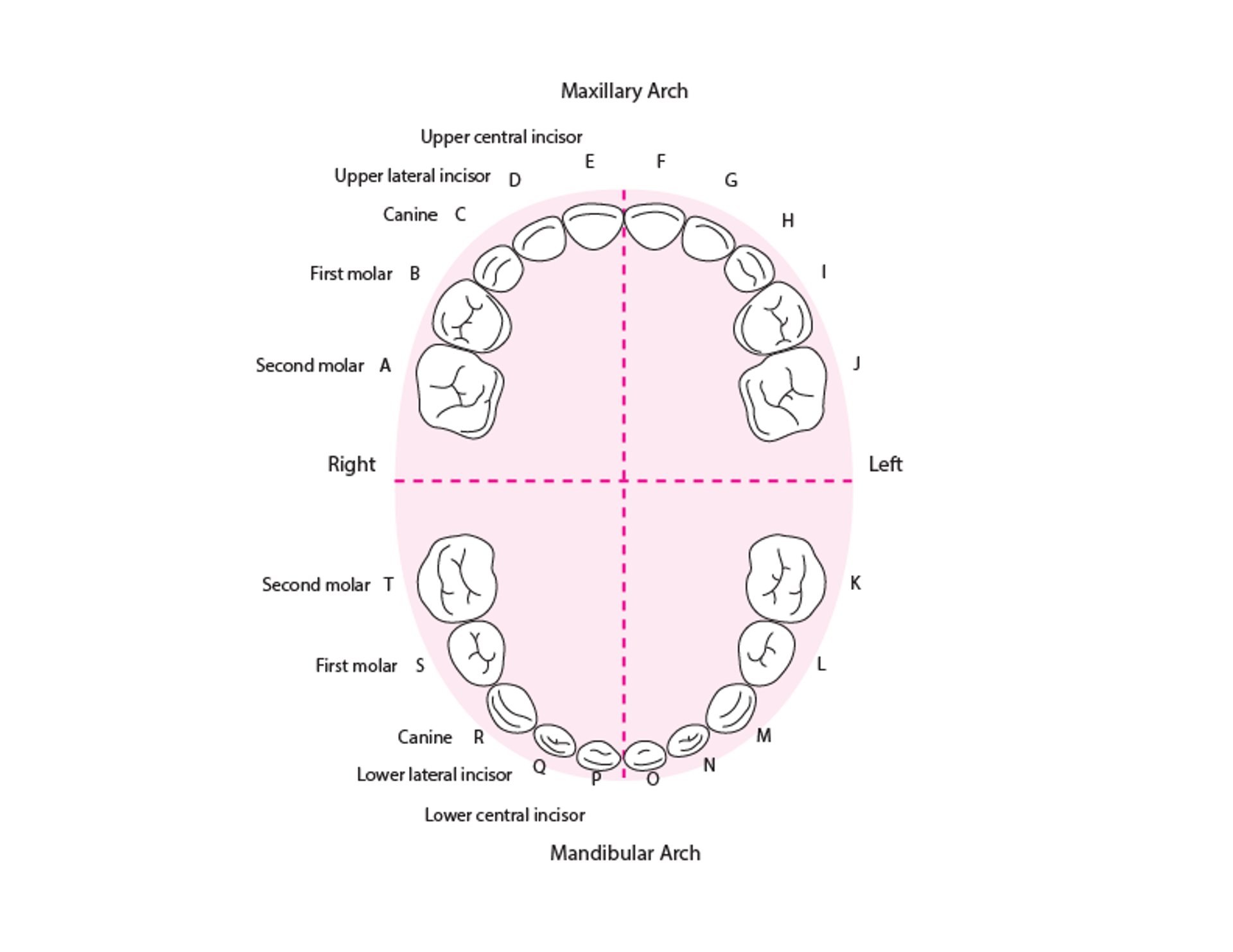
Identifying the Deciduous Teeth
Although there are several tooth numbering systems, the one shown is the Universal Numbering System and is the one most commonly used in the United States. (Dental Education Hub: Teeth Names and Numbering Systems: You need to know. May 2020.) |

Identifying the Permanent Teeth
Although there are several tooth numbering systems, the one shown is the Universal Numbering System and is the one most commonly used in the United States. (Dental Education Hub: Teeth Names and Numbering Systems: You need to know. May 2020.) |

Teething infants get some relief from chewing on hard (eg, teething biscuits) or cold (eg, firm rubber or gel-containing teething rings) objects. Massaging the child's gums with or without ice also may help. Children may be treated with weight-based doses of acetaminophen or ibuprofen.
Teething devices worn around the child's neck should be avoided.
Teething gels are not recommended because they are not any more effective than other measures, and some contain benzocaine (3, 4). Benzocaine can rarely cause methemoglobinemia.
References
1. Muthu MS, Vandana S, Akila G, Anusha M, Kandaswamy D, Aswath Narayanan MB. Global variations in eruption chronology of primary teeth: A systematic review and meta-analysis. Arch Oral Biol. 2024;158:105857. doi:10.1016/j.archoralbio.2023.105857
2. Massignan C, Cardoso M, Porporatti AL, et al. Signs and Symptoms of Primary Tooth Eruption: A Meta-analysis. Pediatrics. 2016;137(3):e20153501. doi:10.1542/peds.2015-3501
3. Carrasco-Labra A, Polk DE, Urquhart O, et al. Evidence-based clinical practice guideline for the pharmacologic management of acute dental pain in children: A report from the American Dental Association Science and Research Institute, the University of Pittsburgh School of Dental Medicine, and the Center for Integrative Global Oral Health at the University of Pennsylvania. J Am Dent Assoc. 2023;154(9):814-825.e2. doi:10.1016/j.adaj.2023.06.014
4. Monaghan N. Teething products may be harmful to health. Br Dent J. 2019;227(6):485-487. doi:10.1038/s41415-019-0715-7
Drug Information for the Topic