Wheezing is a relatively high-pitched whistling noise produced by movement of air through narrowed or compressed small airways. It is relatively common in the first few years of life and is typically triggered by viral respiratory tract infections or asthma, but other possible causes include inhaled irritants or allergens, gastroesophageal reflux, foreign body, and heart failure. Asthma is a common, noncommunicable, chronic respiratory disease characterized by chronic airway inflammation and hyperresponsiveness.
(See also Wheezing in adults and Asthma in adults.)
Asthma is a common, noncommunicable, chronic respiratory disease. It is a heterogenous disease that is usually characterized by chronic airway inflammation and hyperresponsiveness (1). Asthma is defined by a history of multiple respiratory symptoms including wheezing, shortness of breath, chest tightness, and cough that vary over time and in intensity, together with variable expiratory airflow limitation. Asthma is a leading cause of hospitalization for children and is the most common chronic condition causing school absenteeism (1).
Wheezing may occur in children before they have been diagnosed with (or as the first presentation of) asthma. Recurrent episodes of wheezing are relatively common in the first few years of life. Because such wheezing typically responds to bronchodilators, this presentation has historically been considered a phenotype of asthma. However,evidence has shown that many children who have had recurrent wheezing in early childhood do not always go on to develop asthma later in childhood or adolescence (2). Thus, alternative diagnoses (eg, viral-induced wheezing) should be considered in young children with recurrent wheezing.


Pearls & Pitfalls
|
General references
1. Global Initiative for Asthma. Global Strategy for Asthma Management and Prevention, 2025. Updated November 2025. Accessed January 14, 2026.
2. Papadopoulos NG, Apostolidou E, Miligkos M, Xepapadaki P. Bacteria and viruses and their role in the preschool wheeze to asthma transition. Pediatr Allergy Immunol. 2024;35(3):e14098. doi:10.1111/pai.14098
Etiology of Wheezing and Asthma in Young Children
In general, the likelihood of future asthma development in a child with recurrent wheezing depends on the interplay between genetic (ie, a family history of atopy and/or asthma) and environmental (eg, infections, allergens, pollution) factors (1). In infants and young children, wheezing with viral illnesses, particularly those caused by respiratory syncytial virus and human metapneumovirus, is associated with an increased risk of developing childhood asthma (2, 3). An eventual diagnosis of asthma is more likely in children who have atopic symptoms, more severe wheezing episodes, and a family history of atopy and/or asthma.
Wheezing may be associated with atopic disease (ie, food allergies, allergic rhinitis, atopic dermatitis) in some children. In one study of children with recurrent wheezing, those with atopic disease had a higher individual risk of developing asthma because both conditions are driven by the same T2-high (ie, high CD4+ T-helper 2 cell cytokines) inflammatory pathways; however, nonallergic phenotypes constituted the majority of asthma diagnoses at 5 years of age (4).
In about one-third of young children, recurrent wheezing episodes are the initial manifestations of asthma, and these children will continue to have persistent wheezing later in childhood or adolescence (1). In other children, wheezing episodes, even if recurrent, are transient and stop by age 6 to 10 years; thus, they are not thought to represent a phenotype of asthma.
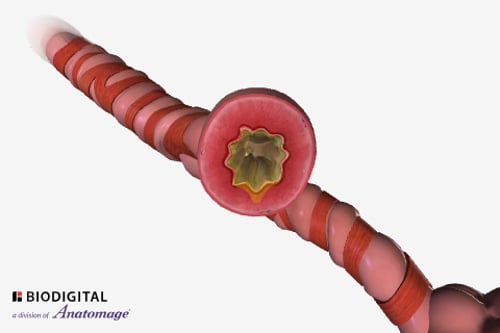
Wheezing usually results from bronchospasm that may be worsened by inflammation of the small and medium airways that causes edema and further airway narrowing. An acute wheezing episode in infants and young children is usually triggered by respiratory viral infections, but airway inflammation may also be triggered (or worsened) by allergies or inhaled irritants (eg, tobacco smoke).
The cause of recurrent wheezing in young children can often be unclear. Some causes that could be associated with recurrent wheezing include frequent viral respiratory infections, allergies, or asthma. Less common causes of recurrent wheezing include chronic dysphagia that causes recurrent aspiration, gastroesophageal reflux, airway malacia (eg, tracheomalacia), a retained aspirated foreign body, or heart failure.
(See also Pathophysiology of Asthma in adults).
Etiology references
1. Coleman A, Gern JE. Viral-Induced Wheeze and Asthma Development. Allergy, Immunity and Tolerance in Early Childhood. 2016:65–82. doi:10.1016/B978-0-12-420226-9.00005-X
2. Jartti T, Gern JE. Role of viral infections in the development and exacerbation of asthma in children. J Allergy Clin Immunol. 2017;140(4):895–906. doi:10.1016/j.jaci.2017.08.003
3. Mikhail I, Grayson MH. Asthma and viral infections: An intricate relationship. Ann Allergy Asthma Immunol. 2019;123(4):352–358. doi:10.1016/j.anai.2019.06.020
4. Lu Z, Petersen C, Dai R, et al. Early-preschool wheeze trajectories are predominantly nonallergic with distinct biologic and microbiome traits. J Allergy Clin Immunol. 2025;156(6):1556-1572. doi:10.1016/j.jaci.2025.07.034
Symptoms and Signs of Wheezing and Asthma in Young Children
Wheezing is often accompanied by recurrent dry or productive cough. Wheezing without cough is uncommon; however, a subset of children with a true asthma phenotype may have cough in the absence of wheezing (also called cough-variant asthma).
Other symptoms depend on the etiology and may include fever, runny nose (viral infection), and feeding difficulties (eg, due to heart failure or dysphagia). Dyspnea and, in older children, a feeling of chest tightness, may be present. Children with respiratory infection–induced wheezing may have fever.
Children with a history of concomitant atopic disease are more likely to develop wheezing on exertion (eg, exercising, laughing, crying) or in the absence of respiratory infection (1).
On examination, wheezing is appreciable mainly on expiration, unless airway narrowing is severe, in which case wheezing can be heard on inspiration as well. Other findings present with more severe illness may include tachypnea, nasal flaring, intercostal and/or subxiphoid retractions, and cyanosis. In very advanced cases of respiratory distress, wheezing may not be appreciable (also called silent chest), which is an ominous sign requiring immediate management.
Symptoms and signs reference
1. Global Initiative for Asthma. Global Strategy for Asthma Management and Prevention, 2025. Updated November 2025. Accessed December 11, 2025.
Diagnosis of Wheezing and Asthma in Young Children
Chest radiograph for severe initial episode and sometimes for atypical or recurrent episodes
Tests to exclude other causes
For a first episode of severe wheezing, most clinicians perform chest radiography to exclude other causes (eg, detect signs of an aspirated foreign body, pneumonia, or heart failure) and pulse oximetry to assess the need for supplemental oxygen therapy. The presence of generalized hyperinflation on radiographs suggests diffuse air trapping as seen in asthma, whereas localized findings suggest structural abnormalities or foreign body aspiration. The chest radiograph may also indicate the presence of a vascular ring as the cause of wheezing (eg, right aortic arch).
For children with recurrent episodes, exacerbations typically do not require testing unless there are signs of respiratory distress. Spirometry can be done in patients ≥ 6 years of age to assess for airway obstruction and its reversibility with bronchodilators. Tests such as swallowing studies (eg, contrast esophagram), CT, or bronchoscopy (to exclude aspirated foreign bodies, airway malacia, or other abnormalities) (1, 2) may have clinical use in excluding causes other than asthma for the few children with frequent or severe exacerbations or symptoms who do not respond to bronchodilators or other asthma medications.
Diagnosis references
1. Tugcu GD, Polat SE, Demir R, et al. Prediction and diagnosis of suspected foreign body aspiration in children using flexible bronchoscopy: a retrospective cohort study. Eur J Pediatr. 2025;184(10):642. Published 2025 Sep 26. doi:10.1007/s00431-025-06474-1
2. Wallis C, Alexopoulou E, Anton-Pacheco JL, et al. ERS statement on tracheomalacia and bronchomalacia in children. Eur Respir J. 2019;54(3):1900382. Published 2019 Sep 28. doi:10.1183/13993003.00382-2019
Treatment of Wheezing and Asthma in Young Children
For acute wheezing episodes, inhaled bronchodilators and, if warranted, systemic glucocorticoids
For children with frequent severe wheezing episodes, a trial of maintenance therapy (eg, inhaled corticosteroids [glucocorticoids]) as used for asthma
Infants and young children with acute wheezing are given inhaled bronchodilators (eg, short-acting beta agonists such as albuterol) and, if the wheezing is severe, systemic glucocorticoids (1) (see Treatment of acute asthma exacerbation).
Children who are unlikely to develop persistent asthma, such as children who do not have atopy or a family history of atopy or asthma, and whose wheezing episodes are relatively mild and infrequent can usually be managed with only intermittent inhaled bronchodilators used as needed.
Most young children with more frequent and/or severe wheezing episodes benefit from maintenance therapy with bronchodilators as needed and anti-inflammatory medications (eg, inhaled corticosteroids [glucocorticoids]) as used for asthma. The use of a leukotriene modifier (eg, montelukast), after relevant boxed label warnings have been appropriately communicated, may also provide relief of symptoms in patients with persistent asthma with concomitant atopic disease (especially allergic rhinitis) (1). However, although chronic use of a leukotriene modifier or low-dose inhaled corticosteroid (glucocorticoid) decreases the severity and frequency of wheezing episodes, it does not alter the natural course of the disorder.
Treatment reference
1. Global Initiative for Asthma. Global Strategy for Asthma Management and Prevention, 2025. Updated November 2025. Accessed December 11, 2025.
Prognosis for Wheezing and Asthma in Young Children
About two-thirds of children with recurrent wheezing in early childhood will not have clinically important wheezing later in life (1). Conversely, of all older children and adults with chronic asthma, a substantial proportion first experienced wheezing in early childhood.
Prognosis reference
1. Coleman A, Gern JE. Viral-Induced Wheeze and Asthma Development. Allergy, Immunity and Tolerance in Early Childhood. 2016:65–82. doi:10.1016/B978-0-12-420226-9.00005-X
Key Points
Recurrent wheezing is common among young children and may not necessarily represent asthma.
An acute wheezing episode in infants and young children is usually caused by respiratory viral infections, but airway inflammation may also be caused (or worsened) by allergens or inhaled irritants (eg, tobacco smoke).
Recurrent wheezing may be caused by frequent viral respiratory infections, allergies, or asthma.
A dry or productive cough often accompanies wheezing.
Perform chest radiography for the first episode of severe wheezing to rule out an aspirated foreign body, pneumonia, and heart failure.
Treat acute wheezing episodes with inhaled bronchodilators and possibly glucocorticoids; for children with more frequent or severe wheezing episodes, consider maintenance therapy with bronchodilators and inhaled corticosteroids (glucocorticoids) as used in asthma.
Drug Information for the Topic