Erythema infectiosum is caused by acute infection with human parvovirus B19. In children, it causes mild constitutional symptoms and a blotchy or maculopapular rash beginning on the cheeks and spreading primarily to exposed extremities. In a pregnant patient, it may cause fetal demise. Diagnosis is clinical, and treatment is generally not needed.
Erythema infectiosum, often referred to as fifth disease, is caused by human parvovirus B19. The name "fifth disease" is used because erythema infectiosum is the fifth of six historically numbered infections that commonly cause rashes, or exanthems, in children (measles, scarlet fever, rubella, and roseola infantum are the four others) (1). This infection is also sometimes called slapped-cheek disease.
Outbreaks typically occur in the late winter and early spring (2), with surges every few years. In 2024, the Centers for Disease Control and Prevention (CDC) received reports of increases in parvovirus B19 infection (3).
Spread is by respiratory droplets, percutaneous exposure to contaminated blood or blood products, and vertical transmission (2). Rates of secondary infection are high (up to 50%) among household contacts; infection can be asymptomatic. People who work in day care centers or who are in close contact with children are also at greater risk of infection.
Infection may also occur in adults and may cause various clinical syndromes, including papular-purpuric gloves-and-socks syndrome, arthropathy, transient aplastic crisis, and pregnancy loss or hydrops fetalis. Based on seroprevalence surveys, 50 to 90% of adults have evidence of prior parvovirus B19 infection, which likely confers protective immunity for immunocompetent people (2, 4).
General references
1. Bialecki C, Feder HM Jr, Grant-Kels JM. The six classic childhood exanthems: a review and update. J Am Acad Dermatol. 1989;21(5 Pt 1):891-903. doi:10.1016/s0190-9622(89)70275-9
2. Committee on Infectious Diseases, American Academy of Pediatrics. Parvovirus B19 (Erythema Infectiosum, Fifth Disease) in Red Book: 2024–2027 Report of the Committee on Infectious Diseases, ed. 33, edited by Kimberlin DW, Banerjee R, Barnett ED, Lynfield R, and Sawyer MH. Itasca, American Academy of Pediatrics, 2024.
3. Centers for Disease Control and Prevention (CDC). Increase in Human Parvovirus B19 Activity in the United States. August 13, 2024. Accessed October 15, 2025.
4. Cohen BJ, Buckley MM. The prevalence of antibody to human parvovirus B19 in England and Wales. J Med Microbiol. 1988;25(2):151-153. doi:10.1099/00222615-25-2-151
Pathophysiology of Erythema Infectiosum
Parvovirus B19 is a single-stranded DNA virus that causes transient suppression of erythropoiesis that is mild and asymptomatic except in children with underlying hemoglobinopathies (eg, sickle cell disease) or other red blood cell (RBC) disorders (eg, hereditary spherocytosis), who may develop transient aplastic crisis. Also, immunocompromised children can develop protracted viremia (lasting weeks to months), leading to severe anemia (pure RBC aplasia). Parvovirus B19 is also one of the more common viral causes of myocarditis in children (1). See table .
Clinical Manifestations of Parvovirus B19 Infection
Clinical Manifestation | Description | Patient Population |
|---|---|---|
Erythema infectiosum (fifth disease) | Mild flu-like symptoms (eg, low-grade fever, slight malaise) Rash, usually both of the following:
| Usually children, sometimes in adults |
Papular-purpuric gloves-and-socks syndrome (PPGSS) | Papular, purpuric, or petechial lesions limited to the hands and feet Often accompanied by fever and oral and/or genital lesions | Usually children, sometimes in adults |
Transient aplastic crisis | Suppression of erythropoiesis, resulting in severe anemia | Usually children with hemoglobinopathies (eg, sickle cell disease) or other red blood cell disorders (eg, hereditary spherocytosis) Sometimes in adults |
Arthralgia or arthritis | Joint pain of small joints of the hands, wrists, knees, and feet—usually symmetric Often with rash | Usually adults, most common among women |
Pregnancy-related issues | Severe fetal anemia resulting in nonimmune hydrops fetalis | Pregnant patients |
Prolonged infection/chronic anemia | Often asymptomatic, sometimes can result in severe anemia | Immunocompromised patients |
Viral myocarditis | Range from mild respiratory symptoms or exercise intolerance to cardiogenic shock | Children |
Parvovirus B19 infection in pregnancy
Erythema infectiosum can be transmitted transplacentally, sometimes resulting in miscarriage, stillbirth, or severe fetal anemia with widespread edema (hydrops fetalis). However, about half of pregnant patients are immune because of previous infection.
The risk of fetal death is approximately 6% after maternal infection, and the risk is higher during the earlier trimesters (up to 18% during the first trimester and 12% during the second trimester) (2, 3).
Pathophysiology references
1. Law YM, Lal AK, Chen S, et al. Diagnosis and Management of Myocarditis in Children: A Scientific Statement From the American Heart Association. Circulation. 2021;144(6):e123-e135. doi:10.1161/CIR.0000000000001001
2. Enders M, Weidner A, Zoellner I, et al. Fetal morbidity and mortality after acute human parvovirus B19 infection in pregnancy: Prospective evaluation of 1018 cases. Prenat Diagn. 2004;24(7):513–518. doi:10.1002/pd.940
3. Boissiere J, Watkins V, Kuller JA, Dotters-Katz SK. Parvovirus B19 in Pregnancy. Obstet Gynecol Surv. 2024;79(5):281-289. doi:10.1097/OGX.0000000000001263
Symptoms and Signs of Erythema Infectiosum
The incubation period of parvovirus B19 infection is 4 to 14 days (1). Typical initial manifestations of erythema infectiosum are nonspecific flu-like symptoms (eg, low-grade fever, slight malaise).
Several days later, an indurated, confluent erythema appears over the cheeks (“slapped-cheek” appearance), and a symmetric rash appears prominently on the arms, legs (often extensor surfaces), and trunk, usually sparing the palms and soles. The rash is maculopapular, tending toward confluence; it forms reticular or lacy patterns of slightly raised, blotchy areas with central clearing, usually most prominent on exposed areas. The rash can be pruritic.
The rash and the entire illness typically last 5 to 10 days. However, the rash may recur for several weeks, exacerbated by sunlight, exercise, heat, fever, or emotional stress.

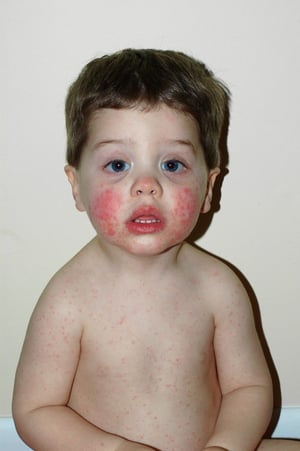
This photo shows confluent erythematous rash on the face ("slapped-cheek" appearance) with a maculopapular rash on the trunk and arms.
This photo shows confluent erythematous rash on the face ("slapped-cheek" appearance) with a maculopapular rash on the
John Kaprielian/SCIENCE PHOTO LIBRARY

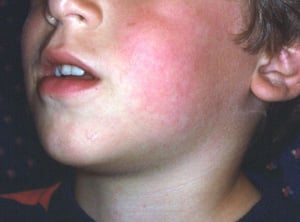
This image shows an erythematous, lacy rash on the face ("slapped-cheek" appearance) resulting from erythema infectiosum.
This image shows an erythematous, lacy rash on the face ("slapped-cheek" appearance) resulting from erythema infectiosu
Image courtesy of Karen McKoy, MD.

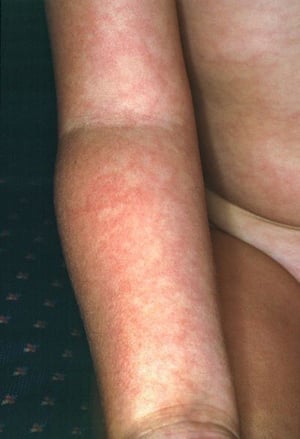
This image shows a maculopapular, lacy rash resulting from erythema infectiosum.
This image shows a maculopapular, lacy rash resulting from erythema infectiosum.
Image courtesy of Karen McKoy, MD.
This photo shows confluent erythematous rash on the face ("slapped-cheek" appearance) with a maculopapular rash on the trunk and arms.
This photo shows confluent erythematous rash on the face ("slapped-cheek" appearance) with a maculopapular rash on the
John Kaprielian/SCIENCE PHOTO LIBRARY
This image shows an erythematous, lacy rash on the face ("slapped-cheek" appearance) resulting from erythema infectiosum.
This image shows an erythematous, lacy rash on the face ("slapped-cheek" appearance) resulting from erythema infectiosu
Image courtesy of Karen McKoy, MD.
This image shows a maculopapular, lacy rash resulting from erythema infectiosum.
This image shows a maculopapular, lacy rash resulting from erythema infectiosum.
Image courtesy of Karen McKoy, MD.
Other manifestations of parvovirus B19 infection
A few patients (more commonly children) develop papular-purpuric gloves-and-socks syndrome (PPGSS), which causes papular, purpuric, or petechial lesions limited to the hands and feet and is often accompanied by fever and oral and/or genital lesions (see table ).


Papular, purpuric, or petechial lesions limited to the hands and feet can be seen in this image of parvovirus B19 infection.
© Springer Science+Business Media
Some adults with parvovirus B19 infection develop mild joint pain and swelling (nonerosive arthritis) that may persist or recur for weeks to months.
Other manifestations include transient aplastic anemia in patients with sickle cell disease and hemoglobinopathies, chronic anemia in immunocompromised patients with impaired antibody production, and viral myocarditis.
Symptoms and signs reference
1. Committee on Infectious Diseases, American Academy of Pediatrics. Parvovirus B19 (Erythema Infectiosum, Fifth Disease) in Red Book: 2024–2027 Report of the Committee on Infectious Diseases, ed. 33, edited by Kimberlin DW, Banerjee R, Barnett ED, Lynfield R, and Sawyer MH. Itasca, American Academy of Pediatrics, 2024.
Diagnosis of Erythema Infectiosum
Physical examination with characteristic rash
For children with transient aplastic crisis or adults with arthropathy, IgM-specific antibody to parvovirus B19
For pregnant patients, antibody measurement and fetal ultrasound
The rash's appearance and pattern of spread are the only diagnostic features; however, some enteroviruses may cause similar rashes. Distinguishing between these viral etiologies is seldom needed for the clinical care of otherwise healthy children.
Serum IgM can be used to diagnose a recent parvovirus infection but is rarely indicated. Serum IgG may persist for life (1).
In children with transient aplastic crisis or adults with arthropathy, the presence of IgM-specific antibody to parvovirus B19 in the late acute or early convalescent phase strongly supports the diagnosis.
Parvovirus B19 viremia also can be detected by quantitative polymerase chain reaction (PCR) tests, which are generally used for patients with transient or chronic aplasia, patients who are immunocompromised, and fetuses or neonates with hydrops fetalis or congenital infection (2). Parvovirus B19 DNA may be detected for months or years after acute infection and may not be clinically relevant.
In pregnant patients, antibodies are measured; IgG suggests immunity due to prior infection (which is usually reassuring) and IgM may indicate current or recent infection (which raises concern for potential fetal morbidity). Initial assessment of fetal status is with ultrasound.
Diagnosis references
1. Committee on Infectious Diseases, American Academy of Pediatrics. Parvovirus B19 (Erythema Infectiosum, Fifth Disease) in Red Book: 2024–2027 Report of the Committee on Infectious Diseases, ed. 33, edited by Kimberlin DW, Banerjee R, Barnett ED, Lynfield R, and Sawyer MH. Itasca, American Academy of Pediatrics, 2024.
2. Miller JM, Binnicker MJ, Campbell S, et al. Guide to Utilization of the Microbiology Laboratory for Diagnosis of Infectious Diseases: 2024 Update by the Infectious Diseases Society of America (IDSA) and the American Society for Microbiology (ASM). Clin Infect Dis. Published online March 5, 2024. doi:10.1093/cid/ciae104
Treatment of Erythema Infectiosum
Supportive care
Only symptomatic treatment of erythema infectiosum is needed.
IV immune globulin is used to curtail viremia and increase erythropoiesis in immunocompromised patients who have anemia due to parvovirus B19 infection (1).
Treatment reference
1. Committee on Infectious Diseases, American Academy of Pediatrics. Parvovirus B19 (Erythema Infectiosum, Fifth Disease) in Red Book: 2024–2027 Report of the Committee on Infectious Diseases, ed. 33, edited by Kimberlin DW, Banerjee R, Barnett ED, Lynfield R, and Sawyer MH. Itasca, American Academy of Pediatrics, 2024.
Key Points
Children develop low-grade fever and slight malaise followed several days later by an indurated, confluent erythema on the cheeks (“slapped-cheek” appearance) and a symmetric rash that is most prominent on the arms, legs, and trunk.
There is mild, transient suppression of erythropoiesis that is asymptomatic except sometimes in children with hemoglobinopathies (eg, sickle cell disease) or other red blood cell disorders (eg, hereditary spherocytosis), or immunosuppression.
Risk of fetal death is approximately 6% after maternal infection, and risk is greatest during the first and second trimesters.
Testing is performed mainly in children with transient aplastic crisis, adults with arthropathy, and pregnant patients.
Treatment is symptomatic, but immunocompromise patients may benefit from IV immune globulin.