Mumps is an acute, contagious, systemic viral disease, usually causing painful enlargement of the salivary glands, most commonly the parotids. Complications may include orchitis, meningoencephalitis, and pancreatitis. Diagnosis is usually clinical; all cases are reported promptly to public health authorities. Treatment is supportive. Vaccination is effective for prevention.
The virus that causes mumps, a paramyxovirus, is spread by respiratory droplets or saliva. The virus typically enters through the nose or mouth. It is present in saliva up to 7 days before salivary gland swelling appears, and transmissibility is highest just before the development of parotitis. The virus is also in blood and urine in varying amounts, and, if the central nervous system (CNS) is involved, in cerebrospinal fluid (CSF).
Infection with mumps usually confers permanent immunity.
Mumps is less communicable than measles. It occurs mainly in unimmunized populations, but outbreaks among largely immunized populations have occurred. A combination of primary vaccine failure (failure to develop immunity after vaccination) and waning immunity may play a part in these outbreaks. People are most contagious from 2 days before and until 5 days after parotid swelling (1).
In 2006, there was a resurgence of mumps in the United States with 6584 cases, which occurred primarily in young adults with prior vaccination. Since that time, sporadic outbreaks, mainly at college campuses and in other close-knit communities, have contributed to cases fluctuating from a low of 229 in 2012 to another high of 6369 in 2016. In 2024, 400 cases were reported, and in 2025 348 cases were reported (2).
As with measles, mumps cases may be imported then lead to community transmission. Such spread is especially likely in congregate settings (eg, college campuses) or among people in close-knit communities who live in crowded conditions (1, 3).
Peak incidence of mumps is during late winter and early spring (3).
Disease can occur at any age but is unusual in children < 2 years, particularly those < 1 year.
General references
1. Committee on Infectious Diseases, American Academy of Pediatrics. Mumps in Red Book: 2024–2027 Report of the Committee on Infectious Diseases, ed. 33, edited by Kimberlin DW, Banerjee R, Barnett ED, Lynfield R, and Sawyer MH. Itasca, American Academy of Pediatrics, 2024.
2. Centers for Disease Control and Prevention (CDC). Mumps Cases and Outbreaks. January 6, 2026. Accessed February 6, 2026.
3. Lam E, Rosen JB, Zucker JR. Mumps: an Update on Outbreaks, Vaccine Efficacy, and Genomic Diversity. Clin Microbiol Rev. 2020;33(2):e00151-19. Published 2020 Feb 26. doi:10.1128/CMR.00151-19
Symptoms and Signs of Mumps
After a 12- to 25-day incubation period (most commonly 16 to 18 days), most people develop headache, anorexia, malaise, myalgia, and a low- to moderate-grade fever. Approximately 20 to 30% of unvaccinated people are asymptomatic (1, 2). Symptoms and severity of illness are reduced in people who are vaccinated (1).
Glandular swelling peaks on about the 2nd day and lasts 5 to 7 days. Parotitis may be unilateral or bilateral; however, in initially unilateral cases, the contralateral parotid gland is eventually involved 70% of the time) (1, 3). Involved glands are extremely tender during the febrile period. In some instances, parotitis may emerge within weeks or months after apparent recovery.

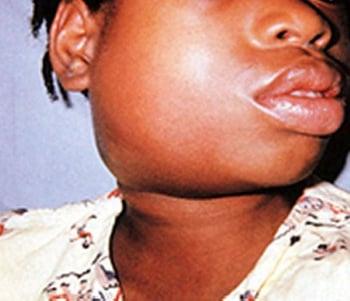
This image shows a child with right-sided parotid swelling due to mumps parotitis, obscuring the angle of the mandible. Parotitis also characteristically causes lifting of the earlobe upward and outward, which is best viewed by standing behind the patient.

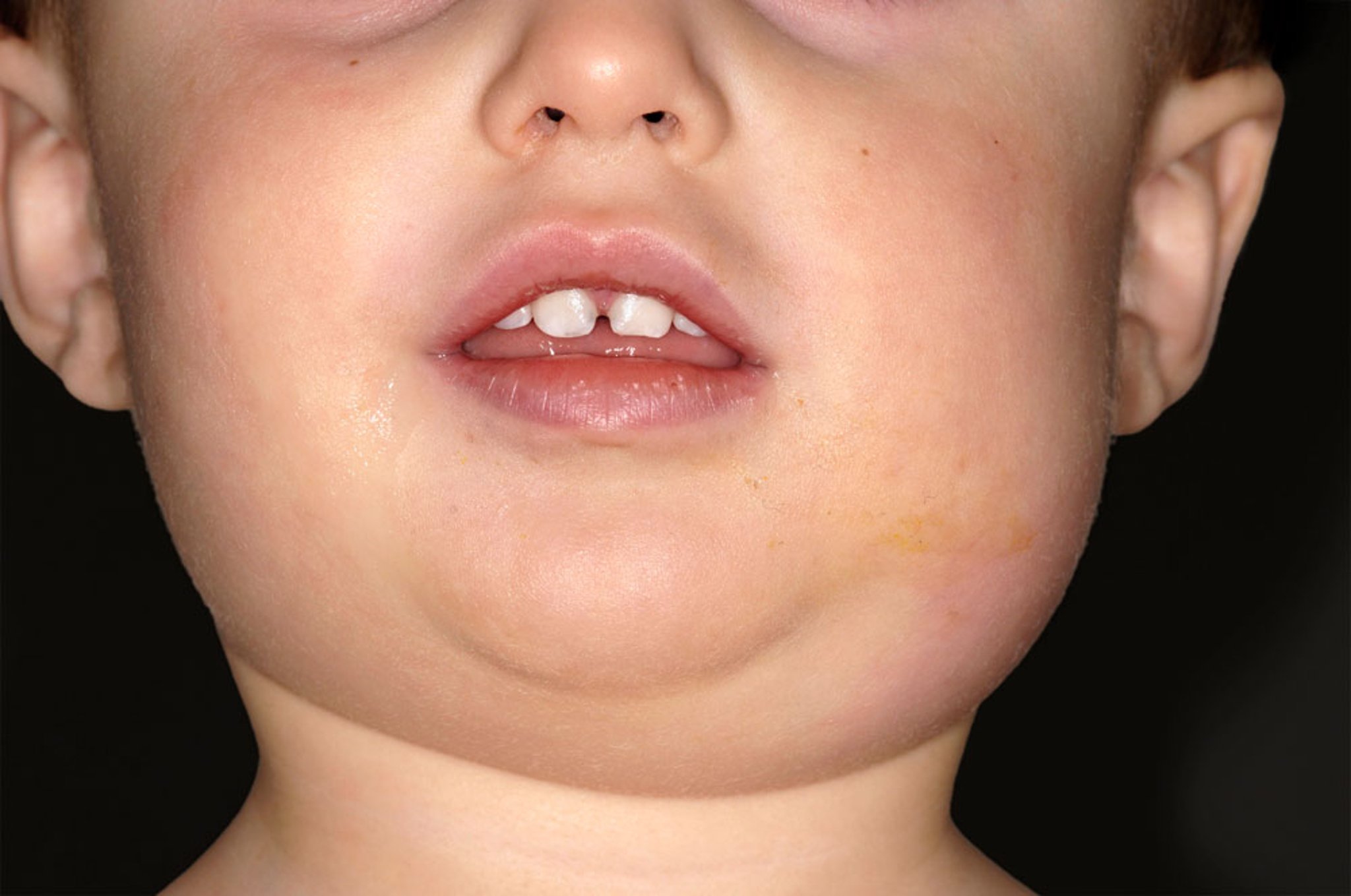
This image shows left-sided parotid swelling due to mumps parotitis in an unvaccinated 2-year-old child.
DR P. MARAZZI/SCIENCE PHOTO LIBRARY
Pain while chewing or swallowing, especially while swallowing acidic liquids such as vinegar or citrus juice, is its earliest symptom. It later causes swelling beyond the parotid in front of and below the ear. Parotitis also characteristically causes displacement of the earlobe upward and outward, which is best viewed by standing behind the patient.
Occasionally, the submandibular and sublingual glands also swell and, more rarely, are the only glands affected. Submandibular gland involvement causes neck swelling beneath the jaw, and suprasternal edema may develop, perhaps because of lymphatic obstruction by enlarged salivary glands. When sublingual glands are involved, the tongue may swell. The oral duct openings of the affected glands are edematous and slightly inflamed. The skin over the glands may become tense and shiny.
Complications of mumps
Mumps may involve organs other than the salivary glands, particularly in postpubertal patients. Such complications include:
Orchitis or oophoritis
Meningitis or encephalitis
Pancreatitis
Approximately 30% of unvaccinated and 6% of vaccinated infected postpubertal males develop orchitis (testicular inflammation) (1, 3), usually unilateral, with pain, tenderness, edema, erythema, and warmth of the scrotum. Some testicular atrophy may ensue, but testosterone production and fertility are usually preserved.
In females, oophoritis (gonadal involvement) is less commonly recognized, is less painful, and may mimic appendicitis.
Meningitis, typically with headache, vomiting, stiff neck, and CSF pleocytosis, occurs in up to 10% of unvaccinated patients (3). Encephalitis, hearing loss, and transverse myelitis are other rare neurologic complications.
Pancreatitis, typically with sudden severe nausea, vomiting, and epigastric pain, may occur toward the end of the first week. These symptoms disappear in about 1 week, leading to complete recovery.
Prostatitis, nephritis, myocarditis, hepatitis, mastitis, polyarthritis, and lacrimal gland involvement occur extremely rarely.
Inflammation of the thyroid and thymus glands may cause edema and swelling over the sternum, but sternal swelling more often results from submandibular gland involvement with obstruction of lymphatic drainage.
Symptoms and signs references
1. Committee on Infectious Diseases, American Academy of Pediatrics. Mumps in Red Book: 2024–2027 Report of the Committee on Infectious Diseases, ed. 33, edited by Kimberlin DW, Banerjee R, Barnett ED, Lynfield R, and Sawyer MH. Itasca, American Academy of Pediatrics, 2024.
2. Lam E, Rosen JB, Zucker JR. Mumps: an Update on Outbreaks, Vaccine Efficacy, and Genomic Diversity. Clin Microbiol Rev. 2020;33(2):e00151-19. Published 2020 Feb 26. doi:10.1128/CMR.00151-19
3. Centers for Disease Control and Prevention. Epidemiology and Prevention of Vaccine-Preventable Diseases. Chapter 15: Mumps. CDC Pink Book. 2021. Accessed October 7, 2025.
Diagnosis of Mumps
History of exposure (particularly if unvaccinated) and characteristic symptoms (eg, fever, headache, anorexia, malaise, myalgia)
Physical examination with unilateral or bilateral enlarged parotid glands
Viral detection via reverse transcription–polymerase chain reaction (RT-PCR)
Serologic testing
Mumps is suspected in patients with evidence of salivary gland inflammation and typical systemic symptoms, particularly if there is parotitis or a known mumps outbreak. Laboratory testing is usually not needed to make a diagnosis in typical cases but is strongly recommended for public health purposes.
Mumps is also suspected in patients with unexplained aseptic meningitis or encephalitis during mumps outbreaks. Lumbar puncture is necessary for patients with meningeal signs.
Both mumps-specific IgM testing and RT-PCR may be used for diagnostic purposes; however, RT-PCR is preferred in vaccinated patients because IgM response may be transient or nondetectable after vaccination (1). The preferred specimen for RT-PCR is a buccal swab after parotid gland massage (2, 3).
Differential diagnosis includes other conditions that can cause similar glandular involvement (see table ).
Non-Mumps Causes of Parotid and Other Salivary Gland Enlargement
Suppurative bacterial parotitis |
HIV parotitis |
Other viral parotitis (eg, Epstein-Barr virus, adenovirus, human herpesvirus 6, parainfluenza types 1 and 3, influenza A, enteroviruses) |
Metabolic disorders (eg, uremia, diabetes mellitus) |
Mikulicz syndrome (a chronic, usually painless parotid and lacrimal gland swelling of unknown etiology that occurs with tuberculosis, sarcoidosis, systemic lupus erythematosus, leukemia, and lymphosarcoma) |
Malignant and benign salivary gland tumors |
Medication-related parotid enlargement (eg, due to iodides, phenylbutazone, or propylthiouracil) |
Laboratory diagnosis of mumps is necessary if disease has features atypical for mumps such as the following:
Unilateral
Recurrent
Occurs in previously immunized patients
Causes prominent involvement of tissues other than the salivary glands
Parotitis lasting ≥ 2 days without an identified cause
RT-PCR is the preferred method of diagnosis; however, serologic testing of acute and convalescent sera by complement fixation or enzyme-linked immunosorbent assays (ELISA) can be performed. In previously immunized patients, IgM testing may be falsely negative; therefore, RT-PCR assays should be performed on samples of saliva or throat washings as early in the course of the disease as possible (1, 4).
Other laboratory tests are generally unnecessary. In undifferentiated aseptic meningitis, an elevated serum amylase level can be a helpful clue in the diagnosis of mumps despite the absence of parotitis. White blood cell count is nonspecific; it may be normal but usually shows slight leukopenia and neutropenia.
In meningitis, CSF glucose is usually normal but is occasionally between 20 and 40 mg/dL (1.1 and 2.2 mmol/L), as in bacterial meningitis. CSF protein is only mildly elevated.
Diagnosis references
1. Lam E, Rosen JB, Zucker JR. Mumps: an Update on Outbreaks, Vaccine Efficacy, and Genomic Diversity. Clin Microbiol Rev. 2020;33(2):e00151-19. Published 2020 Feb 26. doi:10.1128/CMR.00151-19
2. CDC. Clinical Overview of Mumps. January 17, 2025. Accessed February 9, 2026.
3. CDC. Mumps Clinical Testing. June 10, 2024. Accessed February 9, 2026.
4. Committee on Infectious Diseases, American Academy of Pediatrics. Mumps in Red Book: 2024–2027 Report of the Committee on Infectious Diseases, ed. 33, edited by Kimberlin DW, Banerjee R, Barnett ED, Lynfield R, and Sawyer MH. Itasca, American Academy of Pediatrics, 2024.
Treatment of Mumps
Isolation
Supportive care
Patients are isolated for 5 days at onset of parotitis or at onset of their first symptom if they do not develop parotitis (1).
Treatment of mumps and its complications is supportive.
A soft diet reduces pain caused by chewing. Acidic substances (eg, citrus fruit juices) that cause discomfort should be avoided.
Repeated vomiting due to pancreatitis may necessitate IV hydration.
For orchitis, bed rest with elevation and support of the scrotum by using a commercial scrotal supporter, a folded towel, or an adhesive-tape bridge between the thighs to minimize tension. Ice packs often relieve pain. Glucocorticoids have not been shown to hasten resolution of orchitis and may decrease testosterone concentration, facilitating testicular atrophy and potentially increasing the risk of infertility (2, 3).
Treatment references
1. Centers for Disease Control and Prevention. Mumps Clinical Diagnosis Fact Sheet. August 19, 2025. Accessed September 29, 2026.
2. Lane TM, Hines J. The management of mumps orchitis. BJU Int. 2006;97(1):1-2. doi:10.1111/j.1464-410X.2006.05869.x
3. Hviid A, Rubin S, Mühlemann K. Mumps. Lancet. 2008;371(9616):932-944. doi:10.1016/S0140-6736(08)60419-5
Prognosis for Mumps
Uncomplicated mumps usually resolves, although, rarely, a relapse occurs after about 2 weeks.
Although infertility is rare in males with mumps orchitis, testicular atrophy has been reported in up to 50%, and abnormal sperm count, morphology, or motility in 25% (1). The incidence of infertility in females with mumps oophoritis not well characterized.
Prognosis for patients with meningitis is usually good, although permanent sequelae, such as unilateral (or rarely bilateral) nerve deafness or facial paralysis, may result. Mumps is thought to be a major cause of acquired sensorineural hearing loss in children in parts of the world where vaccination rates are low (2).
Postinfectious encephalitis, acute cerebellar ataxia, transverse myelitis, and polyneuritis occur rarely.
Prognosis references
1. Hviid A, Rubin S, Mühlemann K. Mumps. Lancet. 2008;371(9616):932-944. doi:10.1016/S0140-6736(08)60419-5
2. Cohen BE, Durstenfeld A, Roehm PC. Viral causes of hearing loss: a review for hearing health professionals. Trends Hear. 2014;18:2331216514541361. Published 2014 Jul 29. doi:10.1177/2331216514541361
Prevention of Mumps
Vaccination with live-attenuated virus vaccine containing measles, mumps, and rubella (MMR) is administered routinely to children in most nations that have a robust health care system. In the United States, the MMR vaccine is recommended for children and is administered in 2 doses: 1 at age 12 to 15 months and 1 at age 4 to 6 years.
A large meta-analysis of cohort studies found the effectiveness of the MMR vaccine in preventing mumps in children from age 9 months to 15 years was 72% after 1 dose and 86% after 2 doses (1). However, immunity to mumps after vaccination may wane over time (2).
MMR is a live vaccine and is contraindicated during pregnancy. It is also contraindicated in certain immunocompromised patients and in patients who have had an anaphylactic reaction to a vaccine component or previous vaccine dose (3).
See MMR Vaccine for more information, including indications, contraindications and precautions, dosing and administration, and adverse effects.
Postexposure vaccination does not protect against mumps from that exposure. Mumps immune globulin is not available, and serum immune globulin is not helpful (4).
The CDC recommends isolation of infected patients with standard and respiratory droplet precautions for 5 days after the onset of parotitis (5). Susceptible contacts should be vaccinated, and a third dose is recommended for previously immunized people at increased risk of mumps during an outbreak, as determined by public health officials. Robust data are lacking, but a third dose and additional measures may help control an outbreak (6). Nonimmune asymptomatic health care professionals should be excused from work from 12 days after the initial exposure through 25 days after the last exposure.
Prevention references
1. Di Pietrantonj C, Rivetti A, Marchione P, et al. Vaccines for measles, mumps, rubella, and varicella in children. Cochrane Database Syst Rev. 2020;4(4):CD004407. doi:10.1002/14651858.CD004407.pub4
2. Shepersky L, Marin M, Zhang J, Pham H, Marlow MA. Mumps in Vaccinated Children and Adolescents: 2007-2019. Pediatrics. 2021;148(6):e2021051873. doi:10.1542/peds.2021-051873
3. National Center for Immunization and Respiratory Diseases. General recommendations on immunization --- recommendations of the Advisory Committee on Immunization Practices (ACIP). MMWR Recomm Rep. 2011;60(2):1-64.
4. Centers for Disease Control and Prevention (CDC). Mumps Vaccine Recommendations. September 20, 2024. Accessed October 14, 2025.
5. CDC. Clinical Overview of Mumps. January 17, 2025. Accessed December 16, 2025.
6. Marin M, Marlow M, Moore KL, Patel M. Recommendation of the Advisory Committee on Immunization Practices for use of a third dose of mumps virus–containing vaccine in persons at increased risk for mumps during an outbreak. MMWR Morb Mortal Wkly Rep. 2018;67:33–38. doi:10.15585/mmwr.mm6701a7
Key Points
Mumps causes painful enlargement of the salivary glands, most commonly the parotids.
Cases may occur in vaccinated people because of primary vaccination failure or waning immunity.
Approximately 30% of unvaccinated and 6% of vaccinated infected postpubertal males develop orchitis, usually unilateral; some testicular atrophy may occur, but testosterone production and fertility are usually preserved.
Other complications include meningoencephalitis and pancreatitis.
Laboratory diagnosis is done mainly for public health purposes and when disease manifestations are atypical, such as absence of parotitis, unilateral or recurrent parotitis, parotitis in previously immunized patients, or prominent involvement of tissues other than the salivary glands.
Universal vaccination is imperative unless contraindicated (eg, by pregnancy or severe immunosuppression).