


Trichotillomania is characterized by recurrent pulling out of one's hair resulting in hair loss. Treatment is cognitive-behavioral therapy (habit reversal training), and/or pharmacotherapy, including glutamate modulators, selective serotonin reuptake inhibitors (SSRIs), clomipramine, or neuroleptics.
Patients with trichotillomania repeatedly pull or pluck out their hair for noncosmetic reasons. Most commonly, they pull hair from their scalp, eyebrows, and/or eyelids, but any body hair may be pulled out. Sites of hair pulling may change over time.
For some patients, this activity is somewhat automatic (ie, without full awareness); others are more conscious of the activity. Hair pulling is not triggered by obsessions or concerns about appearance (as in body dysmorphic disorder) but may be preceded by a feeling of tension or anxiety that is relieved by the hair pulling, which is often then followed by a feeling of gratification.
Patients with hair-pulling disorder try to stop pulling their hair out or to pull less often, but they are unable to do so (1, 2).
Lifetime prevalence of trichotillomania is estimated at between 0.6% and 2.2%, with equal distribution across genders or a slight female predominance, particularly in adults (1, 3). Onset is typically in adolescence.

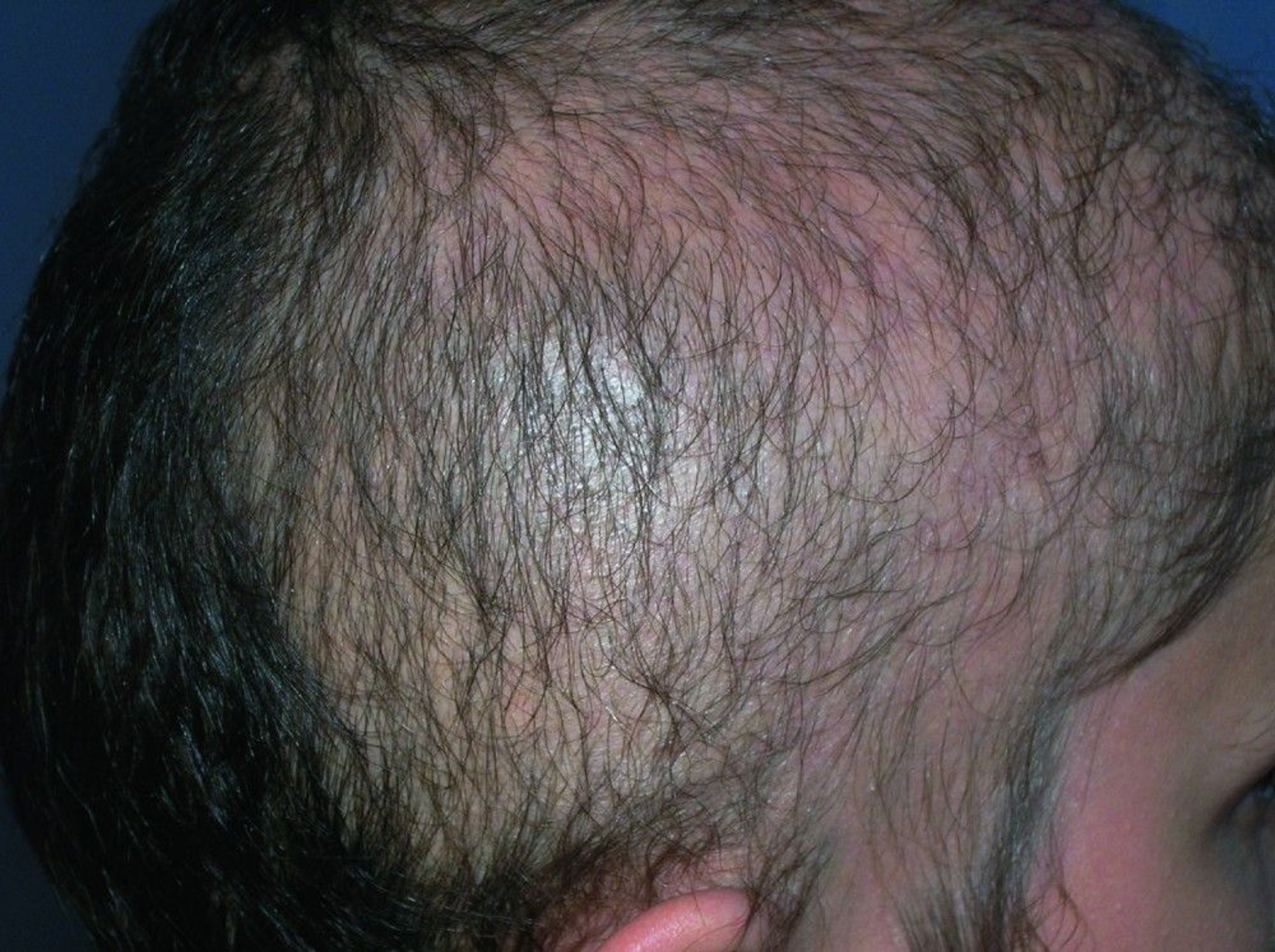
In this photo, the hair pulling is limited to the range of the person's right hand.
© Springer Science+Business Media
Hair pulling typically begins just before or after puberty. Over a 12-month period, approximately 1 to 2% of people have the disorder. In clinical samples, approximately 80 to 90% of adults with trichotillomania are female.
General references
1. Grant JE, Chamberlain SR. Trichotillomania. Am J Psychiatry. 173:868-74, 2016.
2. Christensen RE, Tan I, Jafferany M. Recent advances in trichotillomania: a narrative review. Acta Dermatovenerol Alp Pannonica Adriat. 32:151-157, 2023.
3. American Psychiatric Association. Diagnostic and Statistical Manual of Mental Disorders. 5th ed, Text Revision. American Psychiatric Association Publishing; 2022:281-284.
Symptoms and Signs of Trichotillomania
Hair pulling is usually chronic, with waxing and waning of symptoms if untreated.
Patterns of hair loss vary from patient to patient. Some have areas of complete alopecia or missing eyelashes and/or eyebrows; others merely have thinned hair.
A range of behaviors (rituals) may accompany hair pulling. Patients may search fastidiously for a particular kind of hair to pull; they may try to ensure that hair is pulled out in a particular way. They may roll the hair between their fingers, pull the strands between their teeth, or bite the hair once it is pulled. Many patients swallow their hair. Swallowing hair sometimes results in trichobezoars (tightly packed collections of swallowed hair that are unable to exit the gastrointestinal tract), which on occasion lead to medical complications (eg, gastric obstruction or perforation) and which may require surgical removal.
Patients may feel embarrassed or ashamed because of their appearance or their inability to control their behavior. Many try to camouflage the hair loss by covering the bald areas (eg, wearing wigs, hats, or scarves). Some patients pull out hair from widely scattered areas to disguise the loss. They may avoid situations in which other people may see the hair loss; typically, they do not pull hair out in front of others, except perhaps for family members. However, individuals with trichotillomania, if asked, typically admit that their alopecia is due to hair pulling.
Some patients pull hair from other people or from pets or pull strands from fibrous materials (eg, clothing, blankets).
Most patients also have other body-focused repetitive behaviors, such as skin picking or nail biting (1). Many also have major depressive disorder.
Symptoms and signs reference
1. American Psychiatric Association. Diagnostic and Statistical Manual of Mental Disorders. 5th ed, Text Revision. American Psychiatric Association Publishing; 2022:281-284.
Diagnosis of Trichotillomania
Psychiatric assessment
Sometimes general medical evaluation and medical tests to rule out a medical disorder that can cause hair loss
Clinical criteria for diagnosis of trichotillomania from the Diagnostic and Statistical Manual of Mental Disorders, 5th edition, Text Revision (DSM-5-TR) include the following (1):
Recurrently removing hair, resulting in hair loss (which may be hidden)
Making repeated attempts to decrease or stop the hair pulling
Experiencing significant distress and/or impairment in functioning from the activity
To diagnose trichotillomania, the hair pulling must not be better explained by a general medical condition or by another psychiatric disorder (such as body dysmorphic disorder).
Diagnosis reference
1. American Psychiatric Association. Diagnostic and Statistical Manual of Mental Disorders. 5th ed, Text Revision. American Psychiatric Association Publishing; 2022:281-284.
Treatment of Trichotillomania
Cognitive-behavioral therapy (usually habit reversal training)
N-Acetylcysteine (NAC) or memantine (glutamate modulators/antagonists)
Selective serotonin reuptake inhibitors (SSRIs) or clomipramine
Cognitive-behavioral therapy that is tailored to treat the specific symptoms of hair-pulling disorder is the preferred initial therapy (1). Habit reversal training, a predominantly behavioral therapy, is recommended; it includes the following:
Awareness training (eg, self-monitoring, identification of triggers for the behavior)
Stimulus control (modifying situations—eg, avoiding triggers—to reduce the likelihood of initiating pulling)
Competing response training (teaching patients to substitute other behaviors—such as clenching their fist, knitting, or sitting on their hands—for hair pulling)
In randomized trials, the glutamate modulators/inhibitors N-acetylcysteine (NAC) and memantine were effective for adults (2, 3). However, in a small study in children, N-acetylcysteine was no more effective than placebo (4). There is limited evidence that low-dose neuroleptics such as olanzapine or aripiprazole are effective, but the risk:benefit ratio must be carefully assessed (5).
Clomipramine (a tricyclic antidepressant with potent serotonergic effects) may be useful for reducing severity of symptoms (6). Clomipramine appears to be more effective than desipramine (a tricyclic antidepressant that inhibits reuptake of norepinephrine) (7). Studies of SSRIs in patients with trichotillomania are limited, but clinical experience suggests that they may be useful for some patients.
Treatment references
1. Farhat LC, Olfson E, Nasir M, et al. Pharmacological and behavioral treatment for trichotillomania: An updated systematic review with meta-analysis. Depress Anxiety. 37(8):715-727, 2020. doi: 10.1002/da.23028
2. Grant JE, Odlaug BL, Kim SW. N-Acetylcysteine, a glutamate modulator, in the treatment of trichotillomania: A double-blind, placebo-controlled study. Arch Gen Psychiatry. 66(7):756–763, 2009. doi: 10.1001/archgenpsychiatry.2009.60
3. Grant JE, Chesivoir E, Valle S, et al. Double-blind placebo-controlled study of memantine in trichotillomania and skin-picking disorder. Am J Psychiatry. 180(5):348-356, 2023. doi: 10.1176/appi.ajp.20220737
4. Bloch MH, Panza KE, Grant JE, et al. N-Acetylcysteine in the treatment of pediatric trichotillomania: A randomized, double-blind, placebo-controlled add-on trial. J Am Acad Child Adolesc Psychiatry. 52(3):231–240, 2013. doi: 10.1016/j.jaac.2012.12.020
5. White MP, Koran LM. Open-label trial of aripiprazole in the treatment of trichotillomania. J Clin Psychopharmacol. 2011;31(4):503-506. doi:10.1097/JCP.0b013e318221b1ba
6. Hoffman J, William T, Rothbart R, et al. Pharmacotherapy for trichotillomania. Cochrane Database Syst Rev. 9(9):CD007662, 2021. doi: 10.1002/14651858.CD007662.pub3
7. Swedo SE, Leonard HL, Rapoport JL, et al. A double-blind comparison of clomipramine and desipramine in the treatment of trichotillomania (hair pulling). N Engl J Med. 1989;321(8):497-501. doi:10.1056/NEJM198908243210803
Key Points
In trichotillomania, hair pulling is not triggered by obsessions or concerns about appearance but may be preceded by a feeling of tension or anxiety that is relieved by the hair pulling, often followed by a feeling of gratification.
Patterns of hair loss vary from areas of thinned hair to missing eyelashes and/or eyebrows to areas of complete alopecia.
Patients with trichotillomania try to stop pulling their hair out or to do it less often, but they cannot.
Treat using cognitive-behavioral therapy that is tailored to treat trichotillomania symptoms (specifically habit reversal training) and possibly an SSRI or clomipramine, N-acetylcysteine, or memantine, or a neuroleptic such as olanzapine or aripiprazole.
Drug Information for the Topic







