Ichthyosis is scaling and flaking of skin ranging from mild but annoying dryness to severe disfiguring disease. Ichthyosis can also be a sign of systemic disease. Diagnosis is clinical. Treatment involves emollients and sometimes oral retinoids.
Ichthyosis differs from simple dry skin (xeroderma) by its association with a systemic disorder or medication, heritability, severity, or a combination. Ichthyosis can also be much more severe than xeroderma.
Inherited ichthyoses
Inherited ichthyoses are characterized by excessive accumulation of dry, scaly, and thickened skin, and may involve most of the body surface area. They are classified according to clinical and genetic criteria (see table ). Pruritus, peeling, skin tightness, and occasionally blistering can occur. Dryness of the mucous membranes (eg, oral mucosa, conjunctiva) is common.
Collodion baby is a term used to describe a newborn who at birth presents with a parchment-like membrane covering the body, often resulting in everted lips (eclabium) and eyelids (ectropion) along with overall postural flexion. Alopecia may be present as well.
Some occur in isolation and are not part of a syndrome (eg, ichthyosis vulgaris, X-linked ichthyosis, lamellar ichthyosis, congenital ichthyosiform erythroderma [epidermolytic hyperkeratosis], harlequin ichthyosis).

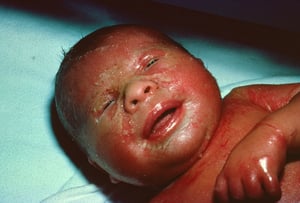
This photo shows a neonate with ectropion (everted eyelids), eclabium (everted lips), and a thin, parchment-like membrane over the face, features that are characteristic of a collodion baby.
This photo shows a neonate with ectropion (everted eyelids), eclabium (everted lips), and a thin, parchment-like membra
Photo courtesy of Karen McKoy, MD.

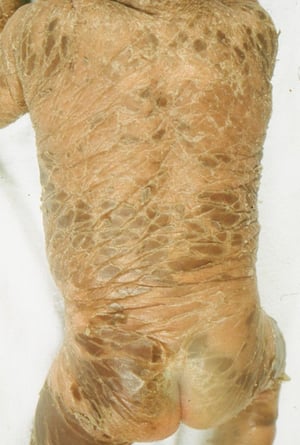
This photo shows lamellar ichthyosis in an infant beyond the neonatal period. When the tight collodion membrane is shed, diffuse, large, polygonal (plate-like) scales appear, most commonly on the trunk and back.
This photo shows lamellar ichthyosis in an infant beyond the neonatal period. When the tight collodion membrane is shed
© Springer Science+Business Media

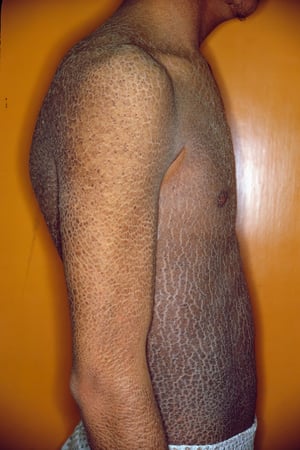
This photo shows a young adult with features of X-linked ichthyosis including diffuse, large, geometric scale throughout the trunk with characteristic sparing of the skin flexures (antecubital fossa).
This photo shows a young adult with features of X-linked ichthyosis including diffuse, large, geometric scale throughou
Photo courtesy of Karen McKoy, MD.
This photo shows a neonate with ectropion (everted eyelids), eclabium (everted lips), and a thin, parchment-like membrane over the face, features that are characteristic of a collodion baby.
This photo shows a neonate with ectropion (everted eyelids), eclabium (everted lips), and a thin, parchment-like membra
Photo courtesy of Karen McKoy, MD.
This photo shows lamellar ichthyosis in an infant beyond the neonatal period. When the tight collodion membrane is shed, diffuse, large, polygonal (plate-like) scales appear, most commonly on the trunk and back.
This photo shows lamellar ichthyosis in an infant beyond the neonatal period. When the tight collodion membrane is shed
© Springer Science+Business Media
This photo shows a young adult with features of X-linked ichthyosis including diffuse, large, geometric scale throughout the trunk with characteristic sparing of the skin flexures (antecubital fossa).
This photo shows a young adult with features of X-linked ichthyosis including diffuse, large, geometric scale throughou
Photo courtesy of Karen McKoy, MD.
Other ichthyoses can be part of a syndrome that involves multiple organs. For example, Sjögren-Larsson syndrome (hereditary intellectual disability and spastic paralysis caused by a defect in fatty aldehyde dehydrogenase) is an autosomal recessive condition with skin and extracutaneous organ involvement.
Another example of a condition with skin and extracutaneous organ involvement is keratitis ichthyosis deafness (KID) syndrome, which is characterized by vascularizing keratitis, ichthyosis, and sensorineural hearing loss and caused by mutations in the connexin-26 gene.
Clinical and Genetic Features of Some Inherited Ichthyoses
Disorder | Prevalence | Gene Mutation | Onset | Type of Scale | Distribution | Associated Clinical Findings |
|---|---|---|---|---|---|---|
Nonsyndromic ichthyoses | ||||||
Ichthyosis vulgaris (autosomal dominant) | Prevalence varies by ethnicity: 10:792 in a study of English schoolchildren versus 1:5025 in a Russian cohort study† | FLG | Childhood | Fine | Usually back and extensor surfaces but not intertriginous surfaces Usually many markings on palms and soles | Atopy Atopic dermatitis (eczema) |
X-linked recessive ichthyosis | Prevalence varies by ethnicity: 1:1500 males in a United States cohort study versus approximately 1:4000–6000 in European cohort studies and 1:9855 in Japanese studies† | STS | Birth or infancy | Large, dark, usually coarse (may be fine) | Prominent on neck and trunk Normal palms and soles | Corneal opacities |
Congenital autosomal recessive ichthyoses | ||||||
Lamellar ichthyosis | 3-4:1,000,000 | Many, eg, TGM1, ABCA12, ALOXE3 | Birth | Large, coarse, sometimes fine | Most of body Variable palm and sole changes | Eclabium Hypohidrosis with heat intolerance |
Congenital ichthyosiform erythroderma* | 1-2:1,000,000 | Same as lamellar ichthyosis | Birth | Thick, warty At birth: Redness and blisters In adulthood: Scaling | Most of body Especially warty in flexural creases | Bullae, frequent skin infections |
Harlequin ichthyosis | < 1:1,000,000 | ABCA12 | Birth | Thick, porcelain-like, body armor–like with deep fissures | Entire body | Ectropion, lip eversion (eclabium), nasal hypoplasia, polyhydramnios, flexion deformities, dehydration, severe infection, respiratory insufficiency |
* This disorder is also called bullous congenital ichthyosiform erythroderma, or epidermolytic hyperkeratosis. Mutations are spontaneous in approximately 50% of cases. | ||||||
† Gutiérrez-Cerrajero C, Sprecher E, Paller AS, et al. Ichthyosis. Nat Rev Dis Primers. 9(1):2, 2023. doi: 10.1038/s41572-022-00412-3 | ||||||
Acquired ichthyosis
Acquired ichthyosis typically presents in adulthood. It can be associated with systemic disorders (eg, leprosy [Hansen disease], hypothyroidism, lymphoma, late-stage HIV, multiple myeloma, systemic lupus erythematosus, dermatomyositis, systemic sclerosis). Some medications also cause ichthyosis (eg, nicotinic acid, triparanol, butyrophenones).
Unlike inherited ichthyosis, in acquired forms, dry scale ranges from fine and localized involvement of the trunk and legs to thick and widespread skin involvement, depending on the cause.

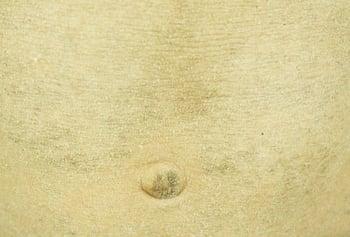
This photo shows a fine white and light gray–colored scale over the abdomen of a patient with ichthyosis vulgaris.
Diagnosis of Ichthyosis
History and physical evaluation
Diagnosis is based on clinical evaluation including dermatologic features, age of onset, family history, and evidence of an associated or underlying disorder.
Biopsy of ichthyotic skin may help differentiate between types of ichthyoses or be useful when there is diagnostic uncertainty. For example, patients with ichthyosiform sarcoidosis may develop a thick scale on the legs, and biopsy usually shows the typical granulomas.
Genetic testing is useful in establishing or confirming specific types of ichthyosis and in genetic counseling. Test panels that can be used to detect several of the gene mutations causing inherited forms of ichthyosis are available.
A dermatologist should assist in diagnosis and management, and a medical geneticist should be consulted for genetic counseling.
Treatment of Ichthyosis
Minimization of exacerbating factors
Moisturization and keratolytics
Sometimes infection prophylaxis
When ichthyosis is associated with a systemic disorder, the underlying disorder must be treated for the ichthyosis to abate.
Avoiding drying of the skin is important to prevent exacerbation of scaling. Other treatments of ichthyosis include emollients, keratolytics, and retinoids (1).
Moisturization and keratolytics
In any ichthyosis, there is impaired epidermal barrier function, and moisturizers should be applied immediately after bathing. Substances that are applied to the skin may have increased absorption. For example, hexachlorophene products should not be used because of increased absorption and toxicity. Humidification of the environment can be as useful as an adjunct therapy.
Emollients are the mainstay of therapy for all patients with ichthyosis. Preferred agents include plain petrolatum or mineral oil, which should be applied twice daily, especially after bathing while the skin is still wet. Blotting with a towel removes excess applied material. Other useful topical agents include dexpanthenol, ceramide-based creams, and a mixture of hydrophilic petrolatum and water (in equal parts). Topical calcipotriol cream has been used with success; however, this vitamin D derivative can result in hypercalcemia when used over broad areas due to the risk of excessive skin absorption, especially in small children.
Topical keratolytics are used to thin excess scale and to promote peeling of the stratum corneum. Ichthyosis typically responds well to the topical keratolytic propylene glycol. To remove scale (eg, if ichthyosis is severe), patients can apply a preparation containing 40 to 60% propylene glycol in water under occlusion (eg, a thin plastic film or bag worn overnight) every night after hydrating the skin (eg, by bathing or showering); in children, the preparation should be applied twice daily without occlusion. After scale has decreased, less frequent application is required. Lotions containing urea or alpha-hydroxy acids (eg, lactic, glycolic, and pyruvic acids) and 6% salicylic acid gel may also be used for this purpose; these can help with chemically abrading areas of hardened skin.
Retinoids are also effective in treating inherited ichthyoses (2). They have been shown to reduce scaling and thereby improve skin texture. Oral synthetic retinoids are effective for most ichthyoses. Acitretin is effective in treating most forms of inherited ichthyosis. In lamellar ichthyosis, 0.1% tretinoin cream or oral isotretinoin may be effective. The lowest effective dose should be used. Long-term (1 year) treatment with oral isotretinoin has resulted in bony exostoses in some patients, and other long-term adverse effects may arise.
Malnutrition should be treated, if present. Vitamin D deficiency is common in congenital forms of ichthyosis and must be screened for and corrected. Specialist referrals to gastroenterology and ophthalmology should be considered for the treatment of gut and eye manifestations of disease.
Research is ongoing in the development of molecular treatments for ichthyoses and related diseases, including protein and enzyme replacement, repurposed biologic agents, small-molecule agents, and gene replacement and editing (3).
Pearls & Pitfalls
|
Treatment references
1. Mazereeuw-Hautier J, Vahlquist A, Traupe H, et al. Management of congenital ichthyoses: European guidelines of care, part one. Br J Dermatol. 180(2):272–281, 2019. doi: 10.1111/bjd.17203
2. Zaenglein AL, Levy ML, Stefanko NS, et al. Consensus recommendations for the use of retinoids in ichthyosis and other disorders of cornification in children and adolescents. Pediatr Dermatol. 2021;38(1):164-180. doi:10.1111/pde.14408
3. Joosten MDW, Clabbers JMK, Jonca N, et al. New developments in the molecular treatment of ichthyosis: Review of the literature. Orphanet J Rare Dis. 17(1):269, 2022. doi: 10.1186/s13023-022-02430-6
Key Points
Ichthyosis may be acquired or inherited as an isolated disorder or as part of a syndrome.
Evaluate patients with gradual-onset ichthyosis for an underlying systemic disorder.
Emollients that speed the shedding of skin (keratolytics) are effective in treating ichthyosis.
Drug Information for the Topic