Nonatheromatous arteriosclerosis is age-related loss of elasticity due to fibrosis or calcification in the aorta and its major branches. No specific treatment is available.
(See also Atherosclerosis.)
Arteriosclerosis is a general term for several disorders that cause thickening and loss of elasticity in the arterial wall.
Atherosclerosis is discussed separately.
Nonatheromatous forms of arteriosclerosis include:
Arteriolosclerosis
Mönckeberg medial calcific sclerosis
Nonatheromatous arteriosclerosis causes intimal thickening and weakens and disrupts the elastic lamellae. The smooth muscle layer (media) atrophies, and the lumen of the affected artery widens (becomes ectatic), predisposing to aneurysm or dissection. Conditions associated with arteriosclerosis include older age, hypertension, diabetes, vitamin D deficiency or excess, and some genetic conditions (1). Intimal injury, ectasia, and ulceration may lead to thrombosis, embolism, or complete arterial occlusion.
Nonatheromatous arteriosclerosis is usually asymptomatic until complications, such as aneurysms, develop. It may be incidentally detected during imaging tests performed for unrelated reasons. Arteriolosclerosis increases arteriolar rigidity and peripheral resistance, which may contribute to the maintenance of hypertension.
There is no treatment for nonatheromatous arteriosclerosis beyond the control of typical cardiovascular risk factors such as hypertension and dyslipidemia (1).
Arteriolosclerosis
Arteriolosclerosis affects distal arteries and commonly occurs in patients with diabetes or hypertension (2). There are 2 histologically distinct forms (3):
Hyaline arteriolosclerosis affects small arteries and arterioles in patients with diabetes. It is characterized by hyaline thickening of the arteriolar wall, which degenerates and narrows the lumen, leading to diffuse ischemia, most notably in the kidneys.
Hyperplastic arteriolosclerosis is characterized by laminated, concentric thickening and luminal narrowing. It may also involve fibrinoid deposits and necrosis of the vessel wall (necrotizing arteriolitis).
Mönckeberg medial calcific sclerosis
Mönckeberg medial calcific sclerosis (also known as medial arterial calcification, Mönckeberg arteriosclerosis, or medial calcific sclerosis) typically affects patients in middle age and older (4). This age-related degeneration of the arterial media is characterized by focal calcification. The affected arterial segments may become rigid, forming calcified tubes without luminal narrowing. The diagnosis may be suggested by an elevated ankle-brachial index (though this finding is not reliable) and be visible on plain radiograph and CT, while the medial location of calcification can be confirmed on intravascular ultrasound or optical coherence tomography. While this disorder does not generally cause direct clinical symptoms, it is clinically important because the reduced compressibility of the arteries can result in false elevation of blood pressure readings.

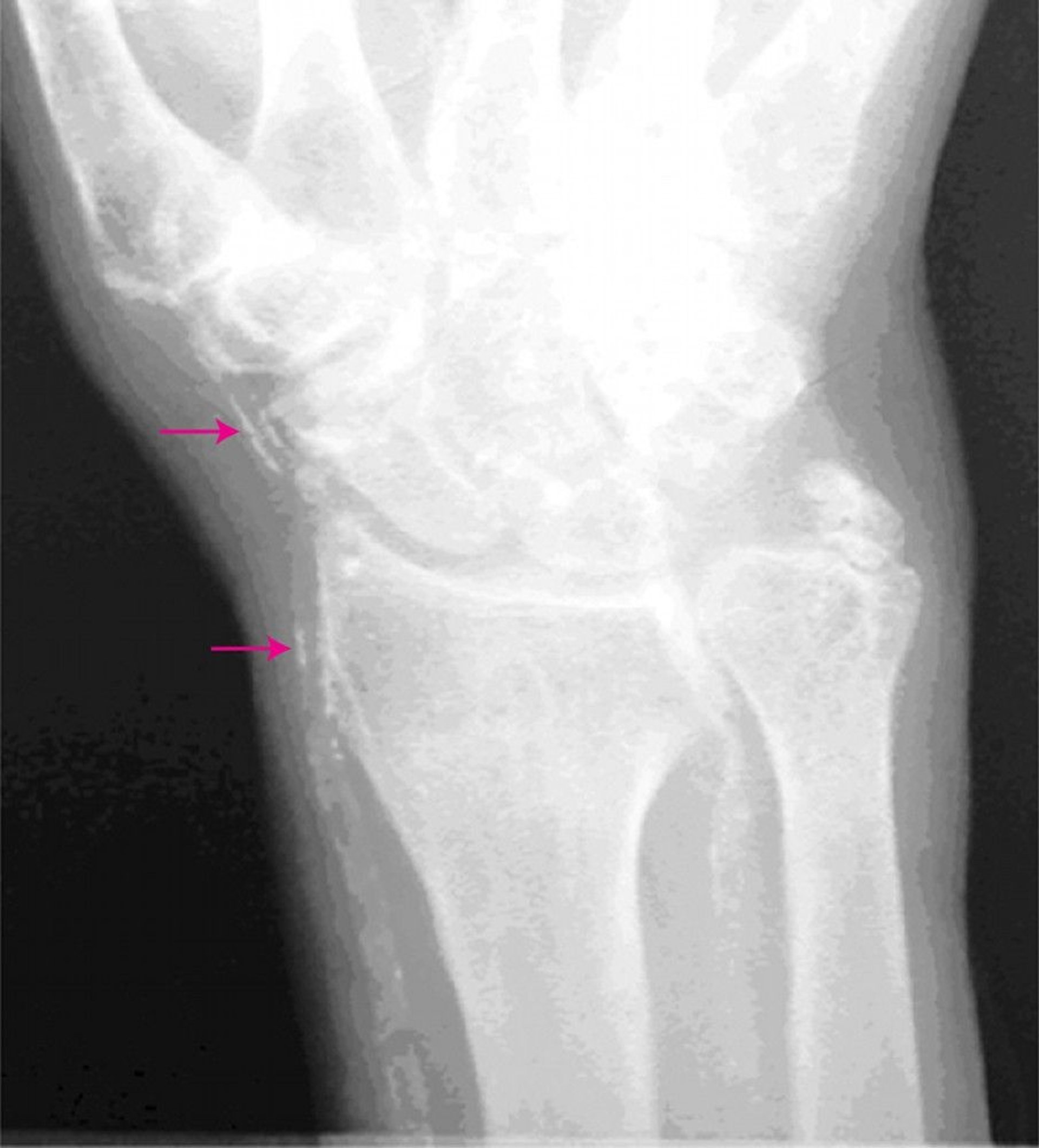
This radiograph of the hand shows calcified arteries (arrows).
© Springer Science+Business Media
References
1. Tölle M, Reshetnik A, Schuchardt M, Höhne M, van der Giet M. Arteriosclerosis and vascular calcification: causes, clinical assessment and therapy. Eur J Clin Invest. 2015;45(9):976-985. doi:10.1111/eci.12493
2. Greenberg SM, Ziai WC, Cordonnier C, et al. 2022 Guideline for the Management of Patients With Spontaneous Intracerebral Hemorrhage: A Guideline From the American Heart Association/American Stroke Association. Stroke. 2022;53(7):e282-e361. doi:10.1161/STR.0000000000000407
3. Fishbein GA, Fishbein MC. Arteriosclerosis: rethinking the current classification. Arch Pathol Lab Med. 2009;133(8):1309-1316. doi:10.5858/133.8.1309
4. Lanzer P, Schurgers L, Twarda-Clapa A, et al. Medial arterial calcification in ageing and disease: current evidence and knowledge gaps. Eur Heart J. Published online June 27, 2025. doi:10.1093/eurheartj/ehaf341
Key Points
Nonatheromatous arteriosclerosis causes thickening and loss of elasticity in the arterial wall in the absence of obvious atheromatous plaque.
There are 2 variants of nonatheromatous arteriosclerosis: arteriolosclerosis and Mönckeberg medial calcific sclerosis.
Diabetes, hypertension, and age are risk factors for the development of nonatheromatous arteriosclerosis.