Coronary artery bypass grafting (CABG) involves bypassing native coronary arteries that have high-grade stenosis or occlusion not amenable to angioplasty with stent insertion. Indications are limited as primary percutaneous coronary intervention is used preferentially for most coronary lesions. (See Overview of Revascularization for Acute Coronary Syndromes.)

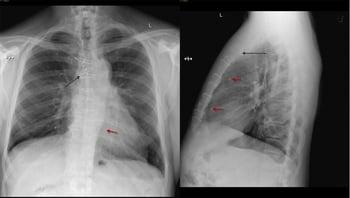
Frontal and lateral chest radiograph of a patient post coronary artery bypass surgery showing sternal sutures (black arrow) and surgical clips (red arrow).
Traditional CABG Procedure
Traditional coronary artery bypass grafting involves thoracotomy via a midline (median) sternotomy. A heart-lung machine is used to establish cardiopulmonary bypass (CPB), allowing the heart to be stopped and emptied of blood to maximize operative exposure and facilitate vessel anastomosis; stopping the heart also markedly decreases myocardial oxygen demand.


Access is through a median sternotomy. Here, the aortic cannula is placed in the ascending aorta and the venous cannulae in the superior vena cava and inferior vena cava.
Pepermpron/stock.adobe.com


Игорь Гончаров/stock.adobe.com
Before initiation of CPB, the patient is given a very high dose of heparin to prevent clotting in the bypass circuit. Then the aorta is cross-clamped and the heart is stopped by injection of a cardioplegic solution (crystalloid or more commonly blood-based) that also contains substances that help myocardial cells tolerate ischemia and reperfusion. The cardioplegic solution and the heart are sometimes cooled slightly to enhance tolerance of ischemia; the patient’s body is cooled via the CPB machine for similar reasons.
The left internal mammary artery is typically used as a pedicled graft to the left anterior descending coronary artery. Other grafts consist of segments of saphenous vein removed from the leg. Occasionally, the right internal mammary artery or radial artery from the nondominant arm can be used.


This illustration shows two graft routes that are used to bypass blocked arteries. A saphenous vein graft may be harvested from the leg and anastomosed both with the ascending proximally and with the coronary artery distal to the obstruction. An internal mammary artery graft mobilized and anastomosed distally to one or more coronary artery sites. Sometimes additional segments from other arteries, such as the radial artery, are used to elongate the graft, or to create a branch point to reach multiple coronary arteries.
VectorMine/stock.adobe.com
On completion of the vascular anastomoses, the aorta is unclamped, allowing the coronary arteries to be perfused by oxygenated blood, which typically restores cardiac activity. Heparin anticoagulation is reversed by giving protamine.
Despite cardioprotective measures, stopping the heart is not without consequences. During reperfusion, myocardial dysfunction is common and can lead to bradycardia, arrhythmias (eg, ventricular fibrillation), and low cardiac output; these events are treated by standard measures, such as pacing, defibrillation, and inotropic medications.
Typically, hospital stays are 4 to 7 days unless prolonged by complications or concomitant illnesses (1, 2).
Complications of coronary artery bypass grafting
Complications and disadvantages of traditional CABG involve mainly:
Sternotomy
Cardiopulmonary bypass
Median sternotomy is surprisingly well tolerated; however, healing takes 4 to 6 weeks. Also, wound infections occasionally cause mediastinitis or sternal osteomyelitis, which can be difficult to treat.
CPB can causes several major complications, including the following:
Bleeding
Organ dysfunction
Stroke
Post-CPB neuropsychiatric effects
Post-CPB bleeding is a common problem caused by various factors, including hemodilution, heparin use, platelet dysfunction due to exposure to the bypass pump, disseminated intravascular coagulation, and induced hypothermia.
Organ dysfunction may result from a systemic inflammatory response caused by the CPB machine (probably due to exposure of blood components to the foreign material of the bypass circuit); this response can cause organ dysfunction in any system (eg, pulmonary, renal, brain, gastrointestinal).
Aortic cannulation, cross-clamping, and release can trigger release of emboli, causing stroke. For patients with a normal-sized heart, no history of myocardial infarction, good ventricular function, and no additional risk factors, overall risk for stroke after CABG is 1 to 2% (2).
Post-CPB neuropsychiatric effects may develop, probably secondary to microemboli, in approximately 25 to 30% of patients (3). Cognitive or behavioral changes are more prevalent in older patients, prompting suspicion that these changes are most likely due to diminished "neuronal reserve," making older patients more susceptible to minor injuries incurred during cardiopulmonary bypass. Dysfunction ranges from mild to severe and may persist for weeks to years. It is not clear whether using a beating heart technique (off-pump CABG, which uses no cardiopulmonary bypass) decreases long-term risks of neuropsychiatric effects.
Other common complications of CABG include:
Arrhythmias
Focal myocardial ischemia
Global myocardial ischemia
Perioperative myocardial infarction (MI) (using definitions requiring electrocardiographic and troponin-based measures) occurs in approximately 2 to 3% of patients (4, 5). Atrial fibrillation occurs in approximately 30 to 55% of patients (6, 7), most commonly 2 to 4 days after surgery but sometimes later (8). Beta-blockers and amiodarone appear to reduce the likelihood of the development of atrial arrhythmias after cardiac surgery (9, 10). Nonsustained ventricular tachycardia is common.
Mortality depends mainly on patients’ underlying health; operator and institutional experience (ie, number of annual procedures) also is important. In a program with experience, periprocedural mortality in otherwise healthy patients is typically < 1 to 3% (11, 12). For patients with a normal-sized heart, no history of MI, good ventricular function, and no additional risk factors, risk of mortality is ≤ 1%.
Risks of stroke, perioperative MI, and mortality increase with age, poor left ventricular function, and presence of underlying disease.
The Society of Thoracic Surgeons (STS) recommends use of the Short-Term/Operative Risk Calculator in patients considering CABG. This calculator, based on the STS's Adult Cardiac Surgery Database (ACSD), is used to assess risk of operative mortality, major morbidity, and complications (eg, stroke, renal failure) after most cardiac procedures. The simpler EuroSCORE calculator categorizes risks associated with CABG into 3 groups (low, intermediate, high).


Traditional CABG procedure references
1. Afflu DK, Seese L, Sultan I, et al. Very Early Discharge After Coronary Artery Bypass Grafting Does Not Affect Readmission or Survival. Ann Thorac Surg. 2021;111(3):906-913. doi:10.1016/j.athoracsur.2020.05.159
2. Alexander JH, Smith PK. Coronary-Artery Bypass Grafting. N Engl J Med. 2016;374(20):1954-1964. doi:10.1056/NEJMra1406944
3. Kulik A, Ruel M, Jneid H, et al. Secondary prevention after coronary artery bypass graft surgery: a scientific statement from the American Heart Association. Circulation. 2015;131(10):927-964. doi:10.1161/CIR.0000000000000182
4. Hara H, Serruys PW, Takahashi K, et al. Impact of Peri-Procedural Myocardial Infarction on Outcomes After Revascularization. J Am Coll Cardiol. 2020;76(14):1622-1639. doi:10.1016/j.jacc.2020.08.009
5. Pölzl L, Thielmann M, Cymorek S, et al. Impact of myocardial injury after coronary artery bypass grafting on long-term prognosis. Eur Heart J. 2022;43(25):2407-2417. doi:10.1093/eurheartj/ehac054
6. Mathew JP, Fontes ML, Tudor IC, et al. A multicenter risk index for atrial fibrillation after cardiac surgery. JAMA. 2004;291(14):1720-1729. doi:10.1001/jama.291.14.1720
7. Wickbom A, Fengsrud E, Alfredsson J, Engdahl J, Kalm T, Ahlsson A. Incidence of atrial fibrillation after coronary artery bypass graft surgery and percutaneous coronary intervention: a prospective 2-year follow-up observational study. BMJ Open. 2025;15(11):e106364. doi:10.1136/bmjopen-2025-106364
8. Filardo G, Damiano RJ Jr, Ailawadi G, et al. Epidemiology of new-onset atrial fibrillation following coronary artery bypass graft surgery. Heart. 2018;104(12):985-992. doi:10.1136/heartjnl-2017-312150
9. Writing Committee Members, Joglar JA, Chung MK, et al. 2023 ACC/AHA/ACCP/HRS Guideline for the Diagnosis and Management of Atrial Fibrillation: A Report of the American College of Cardiology/American Heart Association Joint Committee on Clinical Practice Guidelines. J Am Coll Cardiol. 2024;83(1):109-279. doi:10.1016/j.jacc.2023.08.017
10. Writing Committee Members, Lawton JS, Tamis-Holland JE, et al. 2021 ACC/AHA/SCAI Guideline for Coronary Artery Revascularization: A Report of the American College of Cardiology/American Heart Association Joint Committee on Clinical Practice Guidelines. J Am Coll Cardiol. 2022;79(2):e21-e129. doi:10.1016/j.jacc.2021.09.006
11. Gaudino M, Andreotti F, Kimura T. Current concepts in coronary artery revascularisation. Lancet. 2023;401(10388):1611-1628. doi:10.1016/S0140-6736(23)00459-2
12. Peterson ED, Coombs LP, DeLong ER, Haan CK, Ferguson TB. Procedural volume as a marker of quality for CABG surgery. JAMA. 2004;291(2):195-201. doi:10.1001/jama.291.2.195
Alternative CABG Procedures
Alternative techniques seek to limit the complications of traditional coronary artery bypass grafting by:
Avoiding cardiopulmonary bypass (off-pump CABG)
Avoiding median sternotomy (minimally invasive CABG)
Both
Off-pump CABG
Cardiopulmonary bypass can be avoided in select patients by using techniques that allow the surgeon to revascularize the heart while it is beating. Various devices and methods stabilize a portion of the myocardium, holding the operative site relatively motionless.
Off-pump CABG procedures are more commonly performed through small parasternal or intercostal incisions (minimally invasive CABG), sometimes with endoscopy or even robotic assistance, but they may be performed through a traditional median sternotomy, which provides better operative exposure.
Allowing the heart to beat means that the myocardium requires more oxygen than when CPB is used. Thus, the heart is sensitive to the interruption of blood flow necessitated while the vascular anastomosis is performed; this interruption can cause ischemia or infarction in the myocardium supplied by the affected vessel. Some surgeons place a temporary coronary artery shunt to provide distal perfusion.
Off-pump CABG is technically more challenging but may be appropriate in patients who have significant aortic calcifications that cause manipulation of the aorta to be of higher risk, or in patients with significant pulmonary disease (1). Compared to on-pump procedures, off-pump CABG is associated with increased need for revascularization at 1 year, but no difference is observed at 5 years (2).
Minimally invasive CABG
The minimally invasive CABG technique is somewhat more difficult to perform and may not be suitable when multiple bypass grafts, particularly those involving vessels behind the heart, are required.
Minimally invasive CABG is usually performed off-pump but may be done using cardiopulmonary bypass. In such cases, CPB is performed endovascularly using special catheters inserted into the arterial and venous systems; the aorta is occluded by a balloon at the end of the aortic catheter rather than an external clamp. Although avoiding median sternotomy complications, this technique otherwise has similar rates of mortality and major perioperative complications as conventional techniques (3).
Alternative CABG procedures references
1. Writing Committee Members, Lawton JS, Tamis-Holland JE, et al. 2021 ACC/AHA/SCAI Guideline for Coronary Artery Revascularization: A Report of the American College of Cardiology/American Heart Association Joint Committee on Clinical Practice Guidelines. J Am Coll Cardiol. 2022;79(2):e21-e129. doi:10.1016/j.jacc.2021.09.006
2. Zhou P, Zhu P, Xiao Z, Lin X, Xu R, Zheng S. Meta-Analysis of Repeat Revascularization of Off-Pump and On-Pump Coronary Artery Bypass Surgery. Ann Thorac Surg. 2018;106(2):526-531. doi:10.1016/j.athoracsur.2018.02.068
3. Teman NR, Hawkins RB, Charles EJ, et al. Minimally Invasive vs Open Coronary Surgery: A Multi-Institutional Analysis of Cost and Outcomes. Ann Thorac Surg. 2021;111(5):1478-1484. doi:10.1016/j.athoracsur.2020.06.136
Drug Information for the Topic