Ultrasound-guided radial artery cannulation uses real-time (dynamic) ultrasound to guide arterial puncture; an integrated catheter-over-guidewire device or an angiocatheter (catheter-over-needle) is used to thread a catheter into the radial artery.
(See also Vascular Access.)
The radial artery is the most frequent site of arterial catheterization.
When ultrasound equipment and trained personnel are available, ultrasound guidance may be helpful in cannulating nonpalpable arteries (eg, due to obesity or a small artery) and increases the success rate of radial artery cannulation. This topic will focus on the use of ultrasound to guide arterial cannulation. The actual procedure for radial artery cannulation is the same as when ultrasound is not used and is described in detail in How To Insert a Radial Artery Catheter.
Indications
Difficulty in localizing the radial artery by palpation
Contraindications
Absolute contraindications:
None
Relative contraindications:
There are some relative contraindications for radial artery cannulation, but once an appropriate site is identified, there are no contraindications to use of ultrasound other than
Untrained or inexperienced ultrasound operator
Complications
None
There are a number of complications of radial artery cannulation, but these are unrelated to use of ultrasound.
Equipment
In addition to standard equipment needed to cannulate the radial artery, operators will need the following:
Ultrasound machine with high frequency (eg, 5 to 10 MHz or higher), linear array probe (transducer)
Sterile, water-based lubricant, single-use packet (preferred over multi-use bottle of ultrasound gel)
Sterile probe cover, to ensheathe the probe and probe cable, sterile rubber bands (alternatively, the probe may be placed within a sterile glove and the cord wrapped within a sterile drape)
Note: An assistant will be needed to help place non-sterile ultrasound gel onto the probe when placing the sterile probe cover
Additional Considerations
Arterial catheterization is performed under universal (barrier) precautions and sterile conditions.
The short-axis (transverse, cross-sectional) ultrasound view is easy to obtain and is the best view for identifying veins and arteries and their orientation to each other. However, the transverse view also shows the needle in cross-section (hyperechoic [white] dot), and the needle tip can be distinguished only by the appearance and disappearance of the white dot as the imaging plane traverses past the needle tip.
The long-axis (longitudinal, in-plane) ultrasound view is technically more difficult to obtain (must keep probe, vein, and needle in one plane), but the entire needle (including the tip) is imaged continuously, which ensures accurate intraluminal placement.
The narrowness of the radial artery increases the difficulty of obtaining the longitudinal view.
Relevant Anatomy
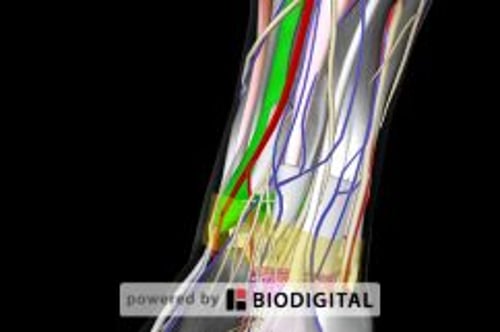
The radial artery lies close to the skin over the ventrolateral distal wrist, just medial to the radial styloid process and lateral to the flexor carpi radialis tendon. The artery runs deeper in the more proximal wrist and the forearm.
Positioning
Position the patient comfortably reclined or supine.
Rest the patient's forearm supinated and with the wrist extended on the bed or on a bedside table; support under the wrist may be useful.
Stand or sit at the side of the bed so that your nondominant hand is proximal on the arm with the artery to be cannulated; this position allows the natural movement of your dominant hand to insert the catheter in a proximal direction.
Position the ultrasound console so that you can see both the ultrasound screen and the cannulation site without having to turn your head.
Step-by-Step Description of Procedure
The procedure for preparing the site and inserting and securing the radial artery catheter is the same as when ultrasound guidance is not used and is not described in full here.
Prepare the ultrasound device and identify the radial artery
Check that the ultrasound machine is configured and functioning correctly: Set the machine to 2-dimensional mode or B mode and select a high-frequency (linear) probe. Ensure that the screen image correlates with the spatial orientation of the probe as you are holding and moving it. The side-mark on the probe corresponds to a marker dot/symbol on the ultrasound screen. Adjust the screen settings and probe position if needed to attain an accurate left-right orientation.
Do a preliminary ultrasound inspection (nonsterile) of the area to determine whether the site is suitable for cannulation. Use a transverse (cross-sectional, short-axis) view, and set the depth until the radius is just visualized at the far field of the screen (depth markers are displayed on the side of the screen). Adjust the gain on the console so that the blood vessels are anechoic (appear black on the ultrasound screen) and the surrounding tissues are gray. Arteries are generally smaller, thick-walled, and round (rather than thin-walled and ovoid) and are less easily compressed (by pressing the probe against the skin) than veins. After identifying the radial artery, adjust the depth so that it is positioned in the middle third of the screen.
Use color Doppler mode to identify a patent lumen and spectral Doppler mode to identify pulsatile blood flow in the artery.
Some clinicians ascertain the presence of ulnar artery flow by palpation or Doppler evaluation to evaluate for collateral flow (1).
Supinate the forearm and tape both the hand and the mid-forearm to a dorsally placed arm board, with a gauze roll placed under the wrist to maintain moderate wrist extension.
Prepare the equipment and the sterile field
Assemble the arterial pressure–monitoring equipment: Place the IV saline bag within the pressure bag (unpressurized), connect the arterial pressure tubing to the saline bag, and squeeze residual air from the bag into the line. Hang the bag, pinch the drip chamber to fill it halfway with fluid, and run solution through the tubing to flush the air out. Connect (plug in) the pressure transducer to the pressure monitor. Situate the transducer at the level of the heart (ie, lateral to the intersection of the mid-axillary line and fourth intercostal space). Open the transducer to air, set the transducer signal to zero on the monitor, and then close the transducer to air. Ensure all air is flushed from the tubing. Remove all vent caps and replace with sealed caps at all the ports. Then pressurize the bag to 300 mm Hg. Throughout the process, maintain sterility of all connecting points of the tubing.
Test the equipment if using an integrated catheter and guidewire device: Rotate the catheter about the needle and slide the guidewire into and out of the needle to verify smooth motion.
Swab the ventral wrist area of skin with antiseptic solution over the volar surface of distal radius where the radial pulse is palpable
Allow the antiseptic solution to dry for at least 1 minute.
Place sterile towels and large drapes about the site (large drapes are for maintaining sterility of the ultrasound probe and cord).
Put on a sterile mask and hat.
Put on a sterile gown and gloves
Place a sterile cover over the ultrasound probe
Direct your assistant (nonsterile) to apply ultrasound gel (nonsterile) and then hold the probe, with the probe footprint pointing up, just outside the sterile field.
Insert your gloved dominant hand into the sterile probe cover.
Drape the sterile probe cover over the probe, by first grasping the probe with your dominant (covered) hand and then using your nondominant hand to unroll the sterile cover down over the probe and probe cable. Do not touch the uncovered cord or allow it to touch the sterile field as you unroll the cover.
Pull the cover tightly over the probe footprint to eliminate all air bubbles.
Wrap sterile rubber bands around the probe to secure the cover in place. The probe may now rest on the sterile drapes.
Anesthetize the cannulation site
Apply sterile ultrasound gel to the covered probe footprint.
Ultrasound guidance may be used for the lidocaine injection to avoid a vascular puncture.
Draw the local anesthetic into a syringe (eg, 3 mL 1% lidocaine into 3 mL syringe)
Inject 1 to 2 mL of anesthetic into the skin and subcutaneously along the anticipated needle insertion path.
Maintain gentle negative pressure on the syringe plunger as you advance the needle, to identify intravascular placement and prevent an intravascular injection.

Insert the needle into the radial artery using ultrasound guidance
Using your nondominant hand, place the probe on the skin, always proximal to the anticipated needle-insertion point.
Always maintain ultrasound visualization of the needle tip during insertion.
Obtain an optimal cross-sectional (transverse) image of the radial artery in the distal forearm, and position the artery in the center of the screen.
Hold the cannulation device between the thumb and forefinger of your dominant hand.
Orient the needle bevel facing up.
Initially, slightly slide the ultrasound probe distally from the target artery entrance site to guide (lead) the needle from the skin insertion site to the target artery entrance proximally. Aim the needle at about a 30- to 45-degree angle into the skin and toward the midpoint of the probe. Hold the needle stationary once skin is punctured. Fan the ultrasound probe to identify the needle tip. The needle is hyperechoic (appears as a white dot on the ultrasound screen in the transverse view).
Advance the cannulation device. You may prefer to maintain the transverse view throughout the cannulation. Slightly tilt the probe fore-and-aft as you advance the needle, to continually reidentify the needle tip (disappearing/reappearing white dot as you tilt [fan] the probe). Or, you may prefer to switch to the longitudinal (long-axis) view (shown in the video) to see the needle and artery lengthwise. Turn the probe 90 degrees and maintain full longitudinal (in-plane) images of both the needle (including the tip) and the artery.
Advance the cannulation device into the artery. As the cannulation device approaches the artery, decrease the angle of insertion so the needle tip will enter with as much control as possible and on a more shallow angle to the artery. You should see the needle first indenting the superficial arterial wall and then popping through the wall to enter the lumen. A simultaneous flash of bright red, pulsatile blood in the reservoir or barrel of the device confirms intra-arterial placement.
Keep the cannulation device stationary in this spot.
If no blood flash appears after inserting an integrated catheter-over-wire device 1 to 2 cm, slowly and gradually withdraw the device. If it had initially passed completely through the artery, a blood flash may now appear as the needle tip is withdrawn, passing back into the lumen. If a flash still does not appear, withdraw the device almost to the skin surface, change direction, and try again to advance it into the artery.
If no blood flash appears after inserting a peripheral venous angiocatheter 1 to 2 cm, hold the catheter steady and slowly withdraw the needle from it. A blood flash may appear if the needle tip alone had pierced the deep arterial wall. If a flash does not appear, keep withdrawing the needle until it is removed, and then slowly withdraw the catheter. If a flash appears, stop withdrawing and try to advance the catheter into the artery.
If rapid local swelling occurs, blood is extravasating. Terminate the procedure: Remove the needle and use gauze pads to hold external pressure on the area for 10 minutes or more to help limit bleeding and hematoma formation.
Assess the blood return
Place a gauze square under the cannulation device at the insertion site.
Observe the reservoir or barrel of the device to verify pulsatile blood flow. If needed, slightly advance or withdraw the device until the pulsatile flow is evident, which confirms intra-arterial placement.
Continuously hold the cannulation device motionless at this spot.
Thread the arterial catheter
Integrated catheter-over-wire technique:
Thread the guidewire through the needle and into the artery. Do not force the guidewire; it should slide smoothly.
If the guidewire meets resistance, it may have passed into or through the arterial wall. Remove the catheter-over-wire device as a unit, use gauze pads to apply pressure to the area for 10 minutes (to help prevent bleeding and hematoma formation), and start over at a new insertion site with a new catheter-over-wire device.
Securely hold the needle hub and slide the catheter, using a twisting motion, over the needle and guidewire and into the artery.
Angiocatheter technique:
The insertion method is essentially the same as starting an IV in a peripheral vein.
Further decrease the angle of insertion and advance the angiocatheter an additional 2 mm to ensure that the catheter tip has entered the lumen. This step is done because the needle tip slightly precedes the catheter tip.
Securely hold the needle hub and slide the catheter over the needle and into the artery; it should slide smoothly.
If the catheter meets resistance, slowly withdraw the needle followed by the catheter, stopping immediately and trying to re-advance the catheter if blood flow resumes. If the catheter cannot be inserted, withdraw it and start over. Never withdraw the catheter back over the needle or reinsert the needle back into the catheter (doing so may shear off the end of the catheter within the patient). Likewise, never withdraw the guidewire through the needle. Use gauze pads for about 10 minutes to apply external pressure to the area.
Sometimes the catheter cannot be advanced although it is in the lumen; try to advance the catheter while flushing it with fluid from a syringe.
Connect the arterial line
Attach the pressure tubing (which has been pre-flushed with saline) to the catheter hub and verify an arterial pressure waveform on the monitor screen.
Dress the site
Use gauze to wipe all blood and fluid from the site, being careful not to disturb the catheter.
Suture the catheter in place at the insertion site. To avoid skin necrosis, tie air loops in the skin and then tie the suture tails to the catheter hub.
Apply a transparent occlusive dressing. Chlorhexidine-impregnated discs at the insertion point are commonly placed before the dressing.
Loop the arterial tubing and tape it to the skin away from the insertion site to help prevent accidental traction on the tubing from dislodging the catheter.
Write the date and time of cannulation on the dressing.
Warnings and Common Errors
Once the needle punctures the skin, it is no longer helpful to inspect the wrist. Instead, look at the ultrasound screen and move the probe to look for the needle tip.
During cardiopulmonary arrest or other conditions of low blood pressure and hypoxia, arterial blood may be dark and not pulsatile and may be mistaken for venous blood.
If the artery is not entered when the needle has reached an appropriate depth, do not try to reposition the needle by moving the tip to one side or another laterally; this movement can damage tissue. Instead, withdraw the needle almost to the skin surface before changing the angle and direction of insertion.
Never inject medications into an arterial line.
During cardiopulmonary arrest or other conditions of low blood pressure and hypoxia, arterial blood may be dark and not pulsatile and may be mistaken for venous blood.
Tips and Tricks
It is prudent to confirm placement by imaging the length of the catheter inside the radial artery prior to suturing the catheter in place.
If an assistant is not available, cover the ultrasound control panel with a clear sterile sheath to enable operation of the machine during the procedure.
Reference
1. Golamari R, Gilchrist IC. Collateral Circulation Testing of the Hand- Is it Relevant Now? A Narrative Review. Am J Med Sci 2021;361(6):702-710. doi:10.1016/j.amjms.2020.12.001
Drug Information for the Topic