Choledocholithiasis is the presence of stones in bile ducts; the stones can form in the gallbladder or in the ducts themselves. These stones cause biliary colic, biliary obstruction, gallstone pancreatitis, or cholangitis (bile duct infection and inflammation). Cholangitis, in turn, can lead to strictures, stasis, and choledocholithiasis. Diagnosis usually requires visualization by magnetic resonance cholangiopancreatography or endoscopic retrograde cholangiopancreatography. Early endoscopic or surgical decompression is indicated.
(See also Overview of Biliary Function.)
Stones may be described as:
Primary stones (usually brown pigment stones), which form in the bile ducts
Secondary stones (usually cholesterol), which form in the gallbladder but migrate to the bile ducts
Residual stones, which are missed at the time of cholecystectomy (evident < 3 years later)
Recurrent stones, which develop in the ducts > 3 years after surgery, though can occur within 6 months if risk factors are present
In industrialized countries, > 85% of common duct stones are secondary (1); affected patients have additional stones located in the gallbladder. Up to 10% of patients with symptomatic gallstones also have associated common bile duct stones (1, 2). After cholecystectomy, brown pigment stones may result from stasis (eg, due to a postoperative stricture) and the subsequent infection. The proportion of ductal stones that are pigmented increases with time after cholecystectomy.
Bile duct stones may pass into the duodenum asymptomatically. Biliary colic occurs when the ducts become partially obstructed. More complete obstruction causes duct dilation, jaundice and, eventually, ascending cholangitis with bacterial infection. Stones that obstruct the ampulla of Vater can cause gallstone pancreatitis, the most common cause of acute pancreatitis (2). Some patients (usually those who are older) present with biliary obstruction due to stones that have caused no symptoms previously.
In acute cholangitis, bile duct obstruction allows bacteria to ascend from the duodenum. Most (85%) cases (1) result from common bile duct stones, but bile duct obstruction can result from tumors or other conditions (see table Causes of Bile Duct Obstruction). Common infecting organisms include gram-negative bacteria (eg, Escherichia coli, Klebsiella species, Enterobacter species); less common are gram-positive bacteria (eg, Enterococcus species) and mixed anaerobes (eg, Bacteroides species, Clostridia species). Symptoms include abdominal pain, jaundice, and fever or chills (Charcot triad). The Charcot triad is specific (90%) but not particularly sensitive for cholangitis (3). The abdomen is tender, and often the liver is tender and enlarged (possibly containing abscesses). Confusion and hypotension in addition to Charcot's triad are referred to as Reynolds pentad.
Pearls & Pitfalls
|
Causes of Bile Duct Obstruction
|
Recurrent pyogenic cholangitis (cholangiohepatitis, hepatolithiasis) is characterized by intrahepatic brown pigment stone formation. This disorder occurs in patients of Asian descent (4). It consists of sludge and bacterial debris in the bile ducts along with dilation of the biliary tree. Undernutrition and parasitic infestation (eg, Clonorchis sinensis, Opisthorchis viverrini) increase susceptibility. Parasitic infestation can cause obstructive jaundice with intrahepatic ductal inflammation, proximal stasis, stone formation, and cholangitis. Repeating cycles of obstruction, infection, and inflammation lead to bile duct strictures and biliary cirrhosis. The extrahepatic ducts tend to be dilated, but the intrahepatic ducts appear straight because of periductal fibrosis.
In late-stage HIV related cholangiopathy or cholangitis, direct cholangiography may show abnormalities similar to those in primary sclerosing cholangitis or papillary stenosis (ie, multiple strictures and dilations involving the intrahepatic and extrahepatic bile ducts). Etiology is infectious, with Cryptosporidium parvum, cytomegalovirus, or microsporidia.
General references
1. Stinton LM, Shaffer EA. Epidemiology of gallbladder disease: Cholelithiasis and cancer. Gut Liver. 2012;6(2):172-187, 2012. doi: 10.5009/gnl.2012.6.2.172
2. ASGE Standards of Practice Committee, Buxbaum JL, Abbas Fehmi SM, et al. ASGE guideline on the role of endoscopy in the evaluation and management of choledocholithiasis. Gastrointest Endosc. 2019;89(6):1075-1105.e15. doi:10.1016/j.gie.2018.10.001
3. An Z, Braseth AL, Sahar N. Acute Cholangitis: Causes, Diagnosis, and Management. Gastroenterol Clin North Am. 2021;50(2):403-414. doi:10.1016/j.gtc.2021.02.005
4. Kwan KEL, Shelat VG, Tan CH. Recurrent pyogenic cholangitis: a review of imaging findings and clinical management. Abdom Radiol (NY). 2017;42(1):46-56. doi:10.1007/s00261-016-0953-y
Diagnosis of Choledocholithiasis and Cholangitis
Laboratory tests
Blood cultures
Ultrasound
Sometimes magnetic resonance cholangiopancreatography (MRCP), or endoscopic retrograde cholangiopancreatography (ERCP), or abdominal CT scan
Common duct stones should be suspected in patients with jaundice and biliary colic. Fever and leukocytosis further suggest acute cholangitis. Elevated levels of bilirubin and particularly alkaline phosphatase, alanine aminotransferase, and gamma-glutamyltransferase are consistent with extrahepatic obstruction, suggesting stones, particularly in patients with features of acute cholecystitis or cholangitis.
For suspected acute cholangitis, complete blood count and blood cultures are essential. Leukocytosis is common, and aminotransferases may reach 1000 IU/L (16.7 mckat/L), suggesting acute hepatic necrosis, often due to microabscesses. Blood cultures guide antibiotic choice.
Ultrasound may show stones in the gallbladder and occasionally in the common bile duct (less accurate). The common bile duct is dilated (> 6 mm in diameter if the gallbladder is intact; > 10 mm after a cholecystectomy). If the ducts are not dilated early in the presentation (eg, first day), stones have probably passed. If doubt exists, MRCP is highly accurate for retained stones. ERCP with or without endoscopic ultrasound is performed if MRCP is equivocal; ERCP can be therapeutic as well as diagnostic. CT, though less accurate than ultrasound, can detect liver abscesses and bile duct dilation.
Treatment of Choledocholithiasis and Cholangitis
Endoscopic retrograde cholangiopancreatography (ERCP) and sphincterotomy
If biliary obstruction is suspected, ERCP and sphincterotomy are necessary to remove the stones. Endoscopic stone fragmentation (intracorporeal mechanical or laser lithotripsy) to assist stone dissolution and clearance may be considered for stones not easily removable using standard methods (eg, an endoscopic retrieval basket or a balloon). Success rate exceeds 95% (1, 2); approximately 5% of patients have short-term complications (eg, bleeding, pancreatitis, infection) (1). Long-term complications (eg, stone recurrence, fibrosis, and subsequent duct stricture) are more common. Laparoscopic cholecystectomy, which is not as well-suited for operative cholangiography or common duct exploration, can be performed electively after ERCP and sphincterotomy; in patients at high risk of complications with cholecystectomy (eg, those who are older), sphincterotomy alone is an alternative.

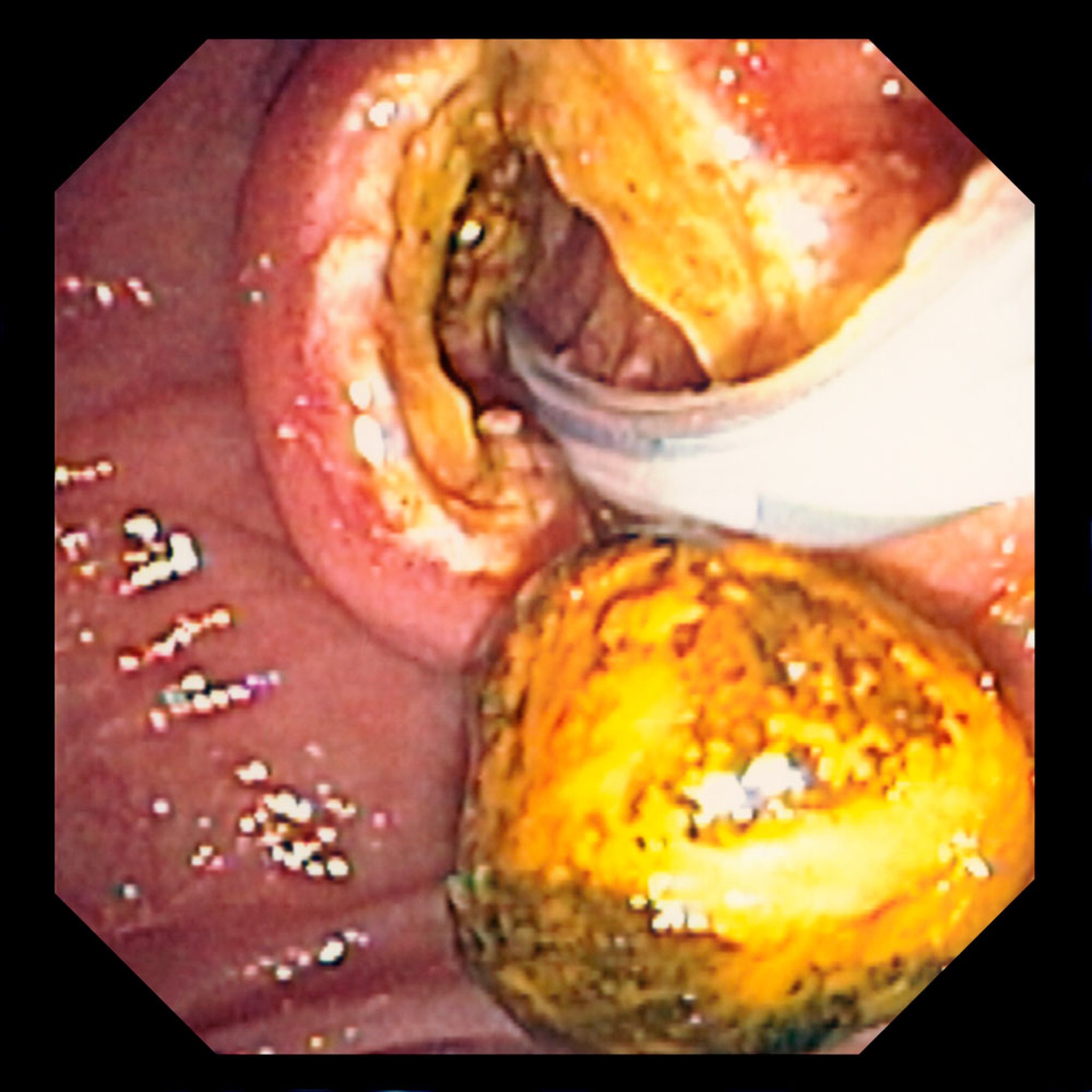
This image shows an endoscopic view of a sphincterotomy to unblock the common bile duct, which is blocked by gallstones. Two gallstones are seen: one just removed (yellow, lower right) and one still within the duct (upper center). A papillotome (white) is used to electrocauterize the muscle, which closes the ampulla of Vater, allowing gallstones to be passed.
DAVID M. MARTIN, MD/SCIENCE PHOTO LIBRARY
Acute cholangitis is an emergency requiring aggressive supportive care and urgent stone removal and drainage, endoscopically or surgically (3). Antibiotics are given, similar to those used for acute cholecystitis (see Acute Cholecystitis: Treatment). Empiric antibiotic regimens include a penicillin with beta-lactamase inhibitor (eg, piperacillin/tazobactam), a third generation cephalosporin (eg cefotaxime), or meropenem. An alternative regimen for very ill patients is meropenem and ciprofloxacin plus metronidazole to cover anaerobes.
For recurrent pyogenic cholangitis, management aims to provide supportive care (eg, broad-spectrum antibiotics), eradicate any parasites, and mechanically clear the ducts of stones and debris endoscopically (via ERCP) or surgically.
Treatment references
1. ASGE Standards of Practice Committee. The role of ERCP in benign diseases of the biliary tract. Gastrointest Endosc. 2015;81(4):795-803. doi: 10.1016/j.gie.2014.11.019
2. ASGE Standards of Practice Committee, Buxbaum JL, Abbas Fehmi SM, et al. ASGE guideline on the role of endoscopy in the evaluation and management of choledocholithiasis. Gastrointest Endosc. 2019;89(6):1075-1105.e15. doi:10.1016/j.gie.2018.10.001
3. An Z, Braseth AL, Sahar N. Acute Cholangitis: Causes, Diagnosis, and Management. Gastroenterol Clin North Am. 2021;50(2):403-414. doi:10.1016/j.gtc.2021.02.005
Key Points
In industrialized countries, > 85% of common duct stones form in the gallbladder and migrate to the bile ducts; most are cholesterol stones.
Suspect common duct stones if patients have biliary colic, unexplained jaundice, and/or elevated alkaline phosphatase and gamma-glutamyltransferase levels.
Diagnosis is made by ultrasound and, if inconclusive, MRCP.
ERCP and sphincterotomy should be performed to remove a stone that causes obstruction.
For acute cholangitis, give antibiotics and remove stones as soon as possible.
Drug Information for the Topic