Furuncles (boils) are skin abscesses that involve a hair follicle and surrounding tissue. Carbuncles are clusters of furuncles connected subcutaneously, causing deeper suppuration and scarring. They are smaller and more superficial than subcutaneous abscesses. Both are typically caused by staphylococcal infection. Diagnosis is by appearance. Treatment is warm compresses and sometimes oral antistaphylococcal antibiotics.
(See also Overview of Bacterial Skin Infections.)
Furuncles and carbuncles are common skin infections caused predominantly by Staphylococcus aureus. Both infections may affect healthy people, but, similar to other skin and soft-tissue infections, they more commonly occur and recur among people who have obesity, cancer, immunocompromise (including those with neutrophil defects), or diabetes (1).
Predisposing factors include bacterial colonization of skin or nares, hot and humid climates, and occlusion or abnormal follicular anatomy (eg, comedones in acne).
Methicillin-resistant Staphylococcus aureus (MRSA), particularly community-acquired MRSA, is a common cause in the United States (2). Clusters of cases may occur among people living in crowded quarters with relatively poor hygiene or among contacts of people who are infected with a virulent strain (3).
Furuncles are common on the neck, breasts, face, and buttocks. They are uncomfortable and may be painful when closely attached to underlying structures (eg, on the nose, ear, or fingers). Furuncles most commonly appear as a nodule or pustule that discharges necrotic tissue and sanguineous pus.

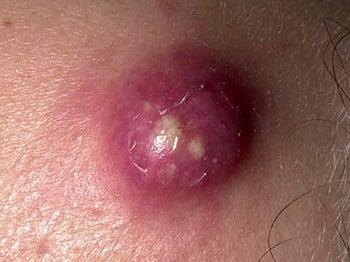
Furuncles (boils) are tender nodules or pustules that involve a hair follicle and are caused by staphylococcal infection.

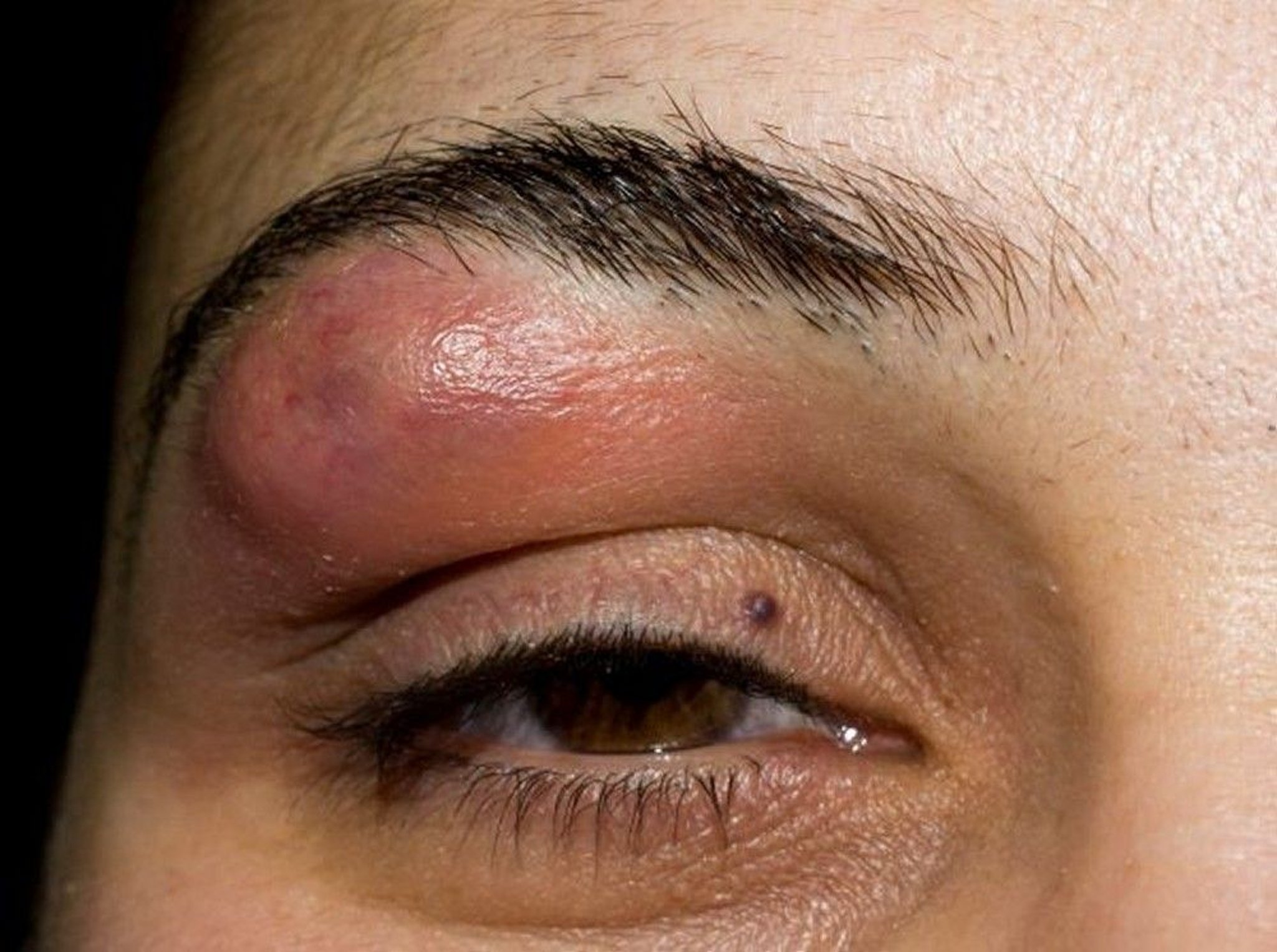
This photo shows a red, inflamed furuncle beneath a woman's eyebrow.
DermPics/SCIENCE PHOTO LIBRARY
Carbuncles are clusters of furuncles that are subcutaneously connected; as such, they are larger in size and deeper in extent than furuncles. They commonly present as painful and purulent nodules or plaques, particularly on hirsute and/or friction-prone areas such as the back of the neck, shoulders, hips, and buttocks. Larger carbuncles may present as a coalescent inflammatory mass with pus draining from multiple follicular orifices. They may be accompanied by fever.

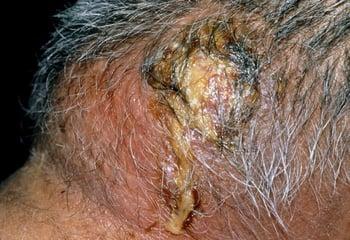
This photo shows a carbuncle on the back of the neck. It is formed by a cluster of interconnected furuncles, which are painful, pus-filled, inflamed hair follicles.
General references
1. Toschi A, Giannella M, Viale P. Recurrence of skin and soft tissue infections: identifying risk factors and treatment strategies. Curr Opin Infect Dis. 2025;38(2):71-77. doi:10.1097/QCO.0000000000001096
2. Demos M, McLeod MP, Nouri K. Recurrent furunculosis: a review of the literature. Br J Dermatol. 2012;167(4):725-732. doi:10.1111/j.1365-2133.2012.11151.x
3. DeLeo FR, Otto M, Kreiswirth BN, Chambers HF. Community-associated methicillin-resistant Staphylococcus aureus. Lancet. 2010;375(9725):1557-1568. doi:10.1016/S0140-6736(09)61999-1
Diagnosis of Furuncles and Carbuncles
History and physical examination
Culture of lesion
The diagnosis is suspected based on the characteristic clinical appearance of a furuncle or carbuncle.
The Infectious Diseases Society of America recommends Gram stain and culture of purulent material; however, antibiotic treatment (including coverage for MRSA) can be initiated empirically (1). In the United States, antibiotic sensitivity testing is recommended to exclude MRSA.
Diagnosis reference
1. Stevens DL, Bisno AL, Chambers HF, et al. Practice guidelines for the diagnosis and management of skin and soft tissue infections: 2014 update by the Infectious Diseases Society of America. Clin Infect Dis. 2014;59(2):e10-e52. doi:10.1093/cid/ciu444
Treatment of Furuncles and Carbuncles
Drainage
Antibiotics (sometimes targeting MRSA)
The treatment of choice for large furuncles and carbuncles is incision and drainage (1). Intermittent hot compresses are used to facilitate drainage. Smaller furuncles often rupture and drain spontaneously or after treatment with moist heat.
Systemic antibiotics are usually not necessary unless fever or other signs of systemic illness are present.
For moderate infections, treatment choices include oral sulfamethoxazole/trimethoprim, clindamycin, doxycycline, or minocycline.
An antibiotic effective against MRSA is recommended for patients with immunocompromise and/or sepsis. In these patients, treatment choices include IV vancomycin, daptomycin, linezolid, and ceftaroline.
Furuncles frequently recur and can be prevented by applying liquid soap containing either chlorhexidine gluconate with isopropyl alcohol or 2 to 3% chloroxylenol. Patients with recurrent furunculosis should be treated for predisposing factors such as obesity, diabetes, occupational or industrial exposure to inciting factors, and nasal carriage of S. aureus or MRSA colonization. If furuncles develop despite the aforementioned measures, rifampin plus another oral antibiotic may be considered.
Treatment reference
1. Stevens DL, Bisno AL, Chambers HF, et al. Practice guidelines for the diagnosis and management of skin and soft tissue infections: 2014 update by the Infectious Diseases Society of America. Clin Infect Dis. 2014;59(2):e10-e52. doi:10.1093/cid/ciu444
Key Points
Suspect a furuncle if a nodule or pustule involves a hair follicle and discharges necrotic tissue and sanguineous pus, particularly if on the neck, breasts, face, or buttocks.
Gram-stain and culture with antibiotic sensitivity testing should be done for furuncles and carbuncles.
The treatment of large furuncles and carbuncles is incision and drainage; small furuncles may involute spontaneously or after application of warm compresses.
Prescribe systemic antibiotics effective against methicillin-resistant Staphylococcus aureus (MRSA) (eg, vancomycin) in patients with immunocompromise and/or sepsis.
Drug Information for the Topic