A cutaneous abscess is a localized collection of pus in the skin and may occur on any skin surface. Symptoms and signs are pain and a tender and firm or fluctuant swelling. Diagnosis is usually based on clinical evaluation. Treatment is incision and drainage and sometimes antibiotics.
Cutaneous abscesses are localized, usually well-defined collections of pus within the skin. Some data from observational studies suggest that the incidence has increased in high-income countries over the past 2 decades, which may in part be attributed to the emergence of community-associated methicillin-resistant Staphylococcus aureus (MRSA) (1–3). (See also Overview of Bacterial Skin Infections.)
Carbuncles (infection of coalesced contiguous hair follicles) and furuncles (infection of a singular hair follicle) are related types of purulent skin infections.

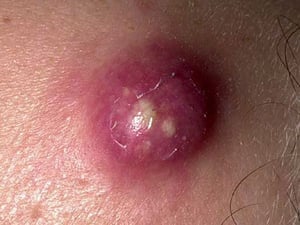
Furuncles (boils) are tender nodules or pustules that involve a hair follicle and are caused by staphylococcal infection.
Furuncles (boils) are tender nodules or pustules that involve a hair follicle and are caused by staphylococcal infectio
Image provided by Thomas Habif, MD.

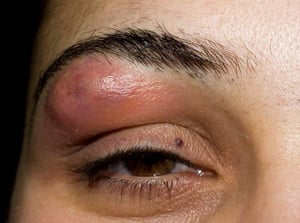
This photo shows a red, inflamed furuncle beneath a woman's eyebrow.
This photo shows a red, inflamed furuncle beneath a woman's eyebrow.
DermPics/SCIENCE PHOTO LIBRARY

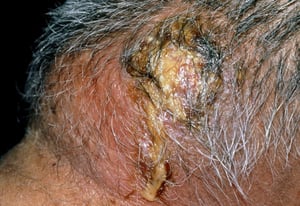
This photo shows a carbuncle on the back of the neck. It is formed by a cluster of interconnected furuncles, which are painful, pus-filled, inflamed hair follicles.
This photo shows a carbuncle on the back of the neck. It is formed by a cluster of interconnected furuncles, which are
SCIENCE PHOTO LIBRARY
Furuncles (boils) are tender nodules or pustules that involve a hair follicle and are caused by staphylococcal infection.
Furuncles (boils) are tender nodules or pustules that involve a hair follicle and are caused by staphylococcal infectio
Image provided by Thomas Habif, MD.
This photo shows a red, inflamed furuncle beneath a woman's eyebrow.
This photo shows a red, inflamed furuncle beneath a woman's eyebrow.
DermPics/SCIENCE PHOTO LIBRARY
This photo shows a carbuncle on the back of the neck. It is formed by a cluster of interconnected furuncles, which are painful, pus-filled, inflamed hair follicles.
This photo shows a carbuncle on the back of the neck. It is formed by a cluster of interconnected furuncles, which are
SCIENCE PHOTO LIBRARY
General references
1. Vaska VL, Nimmo GR, Jones M, Grimwood K, Paterson DL. Increases in Australian cutaneous abscess hospitalisations: 1999-2008. Eur J Clin Microbiol Infect Dis. 2012;31(1):93-96. doi:10.1007/s10096-011-1281-3
2. Ray GT, Suaya JA, Baxter R. Incidence, microbiology, and patient characteristics of skin and soft-tissue infections in a U.S. population: a retrospective population-based study. BMC Infect Dis. 2013;13:252. Published 2013 May 30. doi:10.1186/1471-2334-13-252
3. Shallcross LJ, Hayward AC, Johnson AM, Petersen I. Incidence and recurrence of boils and abscesses within the first year: a cohort study in UK primary care. Br J Gen Pract. 2015;65(639):e668-e676. doi:10.3399/bjgp15X686929
Etiology of Cutaneous Abscess
Risk factors for cutaneous abscesses include the following:
Skin barrier disruption
Injection drug use
Bacterial overgrowth
Antecedent trauma (particularly when a foreign body is present)
Immunosuppression
Impaired circulation
Bacteria causing cutaneous abscesses are typically commensal or colonizing organisms originating from the skin of the involved area or from adjacent mucous membranes. S. aureus (including MRSA) and streptococci continue to be common causes of abscesses on the trunk, extremities, axillae, and head and neck; these can also be polymicrobial.
Abscesses in the perineal (ie, inguinal, vaginal, buttock, perirectal) region contain organisms found in the stool, commonly anaerobes or a combination of aerobes and anaerobes (see table ).
Symptoms and Signs of Cutaneous Abscess
Cutaneous abscesses are painful, tender, indurated, and usually erythematous.
They vary in size, typically 1 to 3 cm in length, but are sometimes much larger. Initially the swelling is firm; later, as the abscess points, the overlying skin becomes thin and feels fluctuant. Fluctuance is a key feature when present; however, in very deep abscesses, fluctuance may be obscured by overlying soft tissue. The abscess may then spontaneously drain.
Local cellulitis, lymphangitis, regional lymphadenopathy, fever, and leukocytosis are variable accompanying features.
Diagnosis of Cutaneous Abscess
Primarily history and physical examination
Culture to identify MRSA
The diagnosis of cutaneous abscess is usually based on clinical evaluation. Supportive clinical findings of a cutaneous abscess include a suggestive history and painful, tender, and fluctuant erythematous swelling on examination.
Gram stain and culture are generally recommended, primarily to identify MRSA and obtain antimicrobial susceptibility testing (1). Although ruptured mimic abscesses and are often cultured, they rarely reveal pathogens because the inflammation is typically a foreign body reaction to keratin rather than a true bacterial infection.
Point-of-care ultrasound can improve diagnostic accuracy and help distinguish an abscess from cellulitis when there is diagnostic uncertainty (2).
Differential diagnosis
Conditions that resemble simple cutaneous abscesses that are usually recognizable clinically (including on a rectal examination) include hidradenitis suppurativa and ruptured epidermal cysts. Epidermal inclusion cysts (often incorrectly referred to as sebaceous cysts) rarely become infected; however, rupture releases keratin into the dermis, causing an exuberant inflammatory reaction sometimes clinically resembling infection. Culture of these ruptured cysts seldom reveals any pathogens.
Perineal abscesses may represent cutaneous emergence of a deeper perirectal abscess or drainage resulting from Crohn disease via a fistulous tract.
Diagnosis references
1. Stevens DL, Bisno AL, Chambers HF, et al. Practice guidelines for the diagnosis and management of skin and soft tissue infections: 2014 update by the Infectious Diseases Society of America. Clin Infect Dis. 2014;59(2):e10-e52. doi:10.1093/cid/ciu444
2. Subramaniam S, Bober J, Chao J, Zehtabchi S. Point-of-care Ultrasound for Diagnosis of Abscess in Skin and Soft Tissue Infections. Acad Emerg Med. 2016;23(11):1298-1306. doi:10.1111/acem.13049
Treatment of Cutaneous Abscess
Incision and drainage
Sometimes antibiotics
The treatment of cutaneous abscesses generally depends on lesion size and associated clinical features such as pain and swelling (1). Some small abscesses resolve without treatment, coming to a point and draining. Warm compresses help accelerate the process. Incision and drainage is indicated when significant pain, tenderness, and swelling are present; it is unnecessary to await fluctuance. Under sterile conditions, local anesthesia is given as either a lidocaine injection or a freezing spray.
Patients with large, extremely painful abscesses may benefit from IV sedation and analgesia during drainage. A single puncture with the tip of a scalpel is often sufficient to open the abscess. After the pus drains, the cavity should be bluntly probed with a gloved finger or curette to clear loculations. Irrigation with normal saline is optional. Packing the cavity loosely with a gauze wick reduces the dead space and prevents formation of a seroma. The wick is typically removed 24 to 48 hours later. However, data suggest that routine irrigation or packing for abscesses < 5 cm in diameter is unnecessary (2, 3). Local heat and elevation may hasten resolution of inflammation.
Antibiotics have traditionally been considered unnecessary unless the patient has signs of systemic infection, cellulitis, multiple abscesses, immunocompromise, or a facial abscess in the area drained by the cavernous sinus. In these cases, empiric therapy should be started with a medication active against MRSA (eg, sulfamethoxazole/trimethoprim, clindamycin; for severe infection, vancomycin) pending results of bacterial culture. However, subsequent studies have suggested lower rates of treatment failure and recurrence when antibiotics are added for any abscess that requires treatment in locations where MRSA is prevalent (4).
Treatment references
1. Stevens DL, Bisno AL, Chambers HF, et al. Practice guidelines for the diagnosis and management of skin and soft tissue infections: 2014 update by the Infectious Diseases Society of America. Clin Infect Dis. 2014;59(2):e10-e52. doi:10.1093/cid/ciu444
2. Chinnock B, Hendey GW. Irrigation of cutaneous abscesses does not improve treatment success. Ann Emerg Med. 2016;67(3):379-383. doi:10.1016/j.annemergmed.2015.08.007
3. O'Malley GF, Dominici P, Giraldo P, et al. Routine packing of simple cutaneous abscesses is painful and probably unnecessary. Acad Emerg Med. 2009;16(5):470-473. doi:10.1111/j.1553-2712.2009.00409.x
4. Talan DA, Mower WR, Krishnadasan A. Trimethoprim-sulfamethoxazole versus placebo for uncomplicated skin abscess. N Engl J Med. 2016;374(9):823-832. doi:10.1056/NEJMoa1507476
Key Points
Pathogens reflect flora of the involved area (eg, S. aureus and streptococci in the trunk, axilla, head, and neck).
Culture abscesses is generally recommended to identify MRSA.
Drain abscesses when accompanied by significant pain, tenderness, and swelling; provide adequate analgesia and, when indicated, sedation.
Administer antibiotics if the patient has signs of systemic infection, cellulitis, multiple abscesses, immunocompromise, or a facial abscess.
Drug Information for the Topic