
Ancylostomiasis is infection with the hookworm (a type of nematode) Ancylostoma duodenale or Necator americanus. Symptoms include rash at the site of larval entry and sometimes abdominal pain or other gastrointestinal symptoms during early infection. Later, iron deficiency may develop because of chronic blood loss. Hookworms are a major cause of iron deficiency anemia in endemic regions. Diagnosis is by finding eggs in stool. Treatment is with albendazole, mebendazole, or pyrantel pamoate.
The worldwide prevalence of hookworm infection is estimated at 406 to 480 million (1, 2). Both Ancylostoma duodenale and Necator americanus occur in Africa, Asia, and the Americas. Only A. duodenale occurs in the Middle East, North Africa, and southern Europe. N. americanus predominates in the Americas and Australia; it was once widely distributed in the southern United States and is still present in areas in that region where there is unsanitary disposal of human waste. Hookworm remains endemic on islands of the Caribbean and in Central and South America. Some strains of Ancylostoma ceylanicum, a hookworm of dogs, cats, and hamsters, also mature to adulthood in the human intestine. Infections with A. ceylanicum have been reported in residents of parts of Asia and some South Pacific islands.
Hookworms cause significant morbidity, in part due to anemia, estimated at 2 to 4 million disability-adjusted life years in 2016 (3).
(See also Approach to Parasitic Infections.)
General references
1. Global Burden of Disease Study 2013 Collaborators. Global, regional, and national incidence, prevalence, and years lived with disability for 301 acute and chronic diseases and injuries in 188 countries, 1990-2013: a systematic analysis for the Global Burden of Disease Study 2013. Lancet. 2015;386(9995):743-800. doi:10.1016/S0140-6736(15)60692-4
2. Centers for Disease Control and Prevention (CDC): About Hookworm. Accessed October 18, 2024.
3. Bartsch SM, Hotez PJ, Asti L, et al. The Global Economic and Health Burden of Human Hookworm Infection. PLoS Negl Trop Dis. 2016;10(9):e0004922. Published 2016 Sep 8. doi:10.1371/journal.pntd.0004922
Pathophysiology of Hookworm Infection
The hookworm species that reach maturity in the human intestine have similar life cycles. Eggs passed in the stool hatch in 1 to 2 days (if they are deposited in a warm, moist place on loose soil) and release rhabditiform larvae, which molt once to become slender filariform larvae in 5 to 10 days. The larvae can survive 3 to 4 weeks if environmental conditions are favorable. Filariform larvae penetrate human skin when people walk barefoot on or otherwise come into direct contact with infested soil.
The larvae reach the lungs via blood vessels, penetrate into pulmonary alveoli, ascend the bronchial tree to the epiglottis, and are swallowed. The larvae develop into adults in the small intestine; there, they attach to the wall, feeding on blood. Adult worms may live ≥ 2 years.

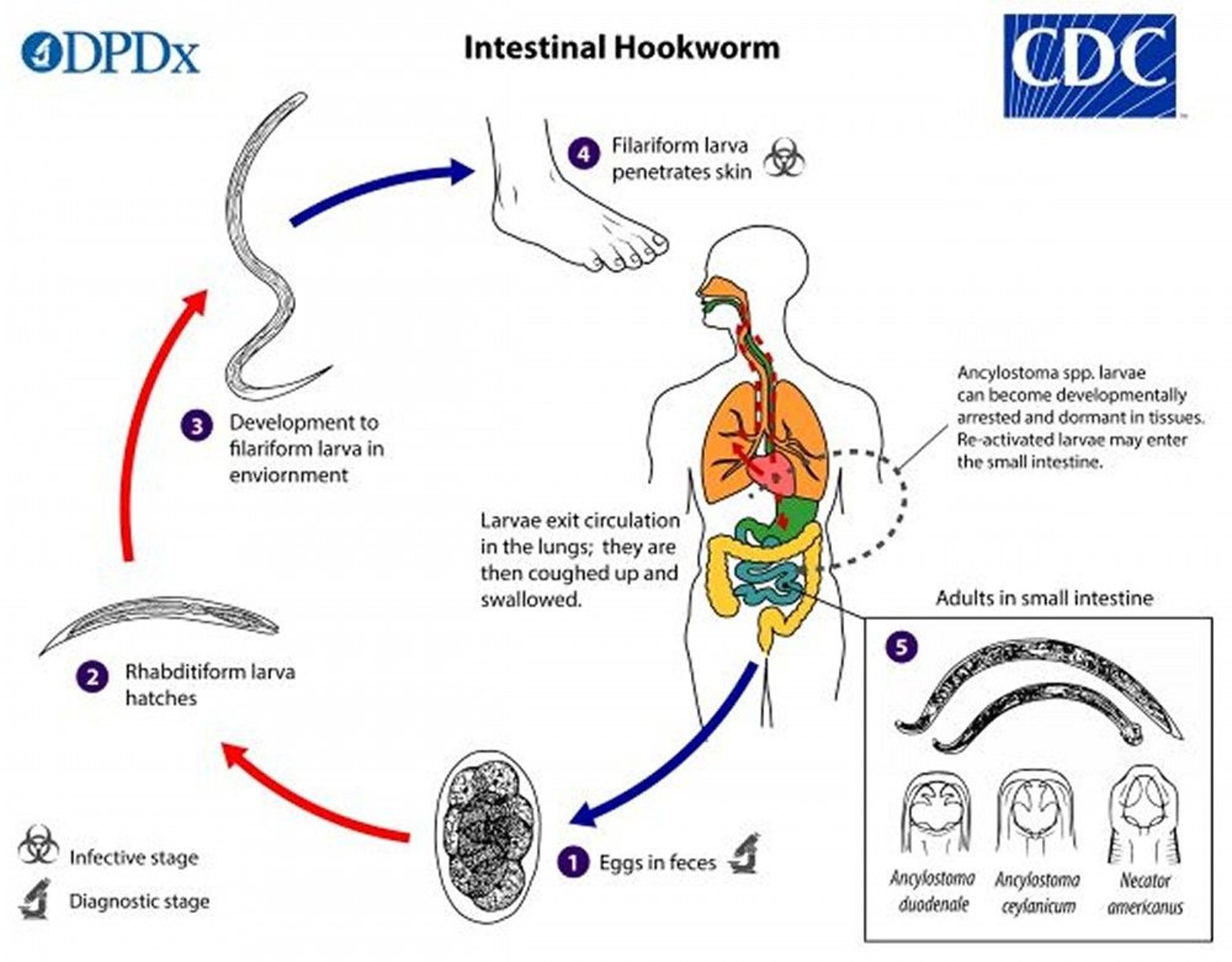
1. Eggs are passed in the stool, and if they are deposited in a warm, moist place on loose soil, larvae hatch in 1 to 2 days.
2. The eggs release rhabditiform larvae, which grow in the feces or soil.
3. After 5 to 10 days, the larvae become infective.
4. When larvae come in contact with the human host, they penetrate the skin and are carried through the blood vessels to the heart and then to the lungs. They penetrate into pulmonary alveoli, ascend the bronchial tree to the pharynx, and are swallowed.
5. The larvae reach the small intestine, where they mature into adults. Adult worms live in the lumen of the small intestine. They attach to the intestinal wall, feed on blood (resulting in blood loss by the host), and produce eggs.
Image from the Centers for Disease Control and Prevention, Global Health, Division of Parasitic Diseases and Malaria.
Chronic blood loss leads to iron deficiency anemia. Development of anemia depends on worm burden and the amount of absorbable iron in the diet.
Zoonotic (animal) hookworm infections

Zoonotic diseases are infections that can be naturally transmitted between animals and humans.
These diseases are caused by a variety of organisms, including bacteria, viruses, fungi, and parasites.
Some zoonotic diseases, such as rabies and cowpox, are transmitted directly from animals to people through contact with saliva, blood, urine, or feces. Others may spread through the air or through bites and scratches. In other diseases, transmission occurs through the bite of insects such as mosquitoes, ticks or fleas.
In Lyme disease, for example, deer ticks transmit the bacteria from infected carrier animals, such as mice, to humans or other animals. Insects that carry and transmit germs that cause diseases in people are called vectors.
Other zoonotic diseases, like Salmonella infection, are contracted by consuming food, water, or milk that has been contaminated by an infected animal, by consuming food that has been washed or grown in contaminated water, or by eating undercooked meat from an animal with Salmonella.
Zoonotic diseases make up more than half of all emerging infectious diseases (those that are rapidly increasing in incidence worldwide).
Zoonotic diseases not only cause illness and death in people, but also impact animal health, leading to illness in pets, zoo animals, wild animals and livestock, and reduced food availability. These diseases can have devastating effects on economies because of trade restrictions, health care expenditures, and negative effects on tourism.
Rabies is a viral zoonotic disease that is primarily spread through the bites or scratches of animals that are infected, called reservoirs. Common animal reservoirs for rabies include bats, skunks, raccoons, and foxes. Rabies spreads to the brain and spinal cord and can be fatal if not treated promptly.
Anthrax is a bacterial zoonotic disease commonly found in animals exposed to food, air, or water that is contaminated with anthrax spores. These spores can live in the environment and infect both people and animals when they are ingested, inhaled, or absorbed through open wounds. Humans may become infected through contact with infected animals or animal products that are contaminated with spores. Once inside the body, the spores develop into bacteria. The bacteria release toxins that can cause inflammation, bleeding, tissue death, and potentially sepsis.
Lyme disease is a bacterial zoonotic disease that is spread when a deer tick bites an infected carrier animal, such as a mouse, and ingests the bacteria that causes Lyme disease. The tick then bites animals or people, spreading the bacteria to them. Symptoms include fever, headache, fatigue, and a distinctive bull’s eye-shaped rash. If untreated, Lyme disease can affect the joints, heart, and nervous system.
The best way to prevent zoonotic disease is to limit your exposure to infected animals and vectors.
When contact with infected animals is necessary, it is important that you wear protective clothing and equipment like hats, gloves and glasses to avoid bites and scratches, and that you wash your hands thoroughly after handling animals.
To protect against insect vectors such as mosquitoes, ticks, and fleas, you can wear long pants and long-sleeve clothing, use mosquito netting, use insect repellents, and check for ticks after being outside in areas where they live.
It is also important to handle food safely and to avoid food that might be contaminated.
To protect animal health, keep healthy animals separate from infected animals and also protect them from exposure to insect vectors and contaminated food sources.
Copyright © 2026 Merck & Co., Inc., Rahway, NJ, USA and its affiliates. All rights reserved.
Zoonotic hookworms infections include
Eosinophilic enterocolitis
Ancylostoma braziliense and Ancylostoma caninum are hookworms that have cats and dogs as the primary hosts. These hookworms cannot complete their life cycle in humans. If their larvae penetrate human skin, they typically wander in the skin, causing cutaneous larva migrans, rather than migrate to the intestine.
Rarely, A. caninum larvae migrate to the intestine, where they may cause eosinophilic enterocolitis. However, they do not cause significant blood loss and anemia, and because they do not mature to full adulthood, they do not lay eggs (making diagnosis difficult). Such intestinal infection may be asymptomatic or cause acute abdominal pain and eosinophilia.
(See also Hookworms in Small Animals.)
Symptoms and Signs of Hookworm Infection
Hookworm infection is often asymptomatic. However, a transient pruritic papulovesicular rash (ground itch) may develop at the site of larval penetration, usually on the feet.
Migration of large numbers of larvae through the lungs occasionally causes Löffler syndrome, with cough, wheezing, eosinophilia, and sometimes hemoptysis.
During the acute phase, adult worms in the intestine may cause colicky epigastric pain, anorexia, flatulence, diarrhea, and weight loss.

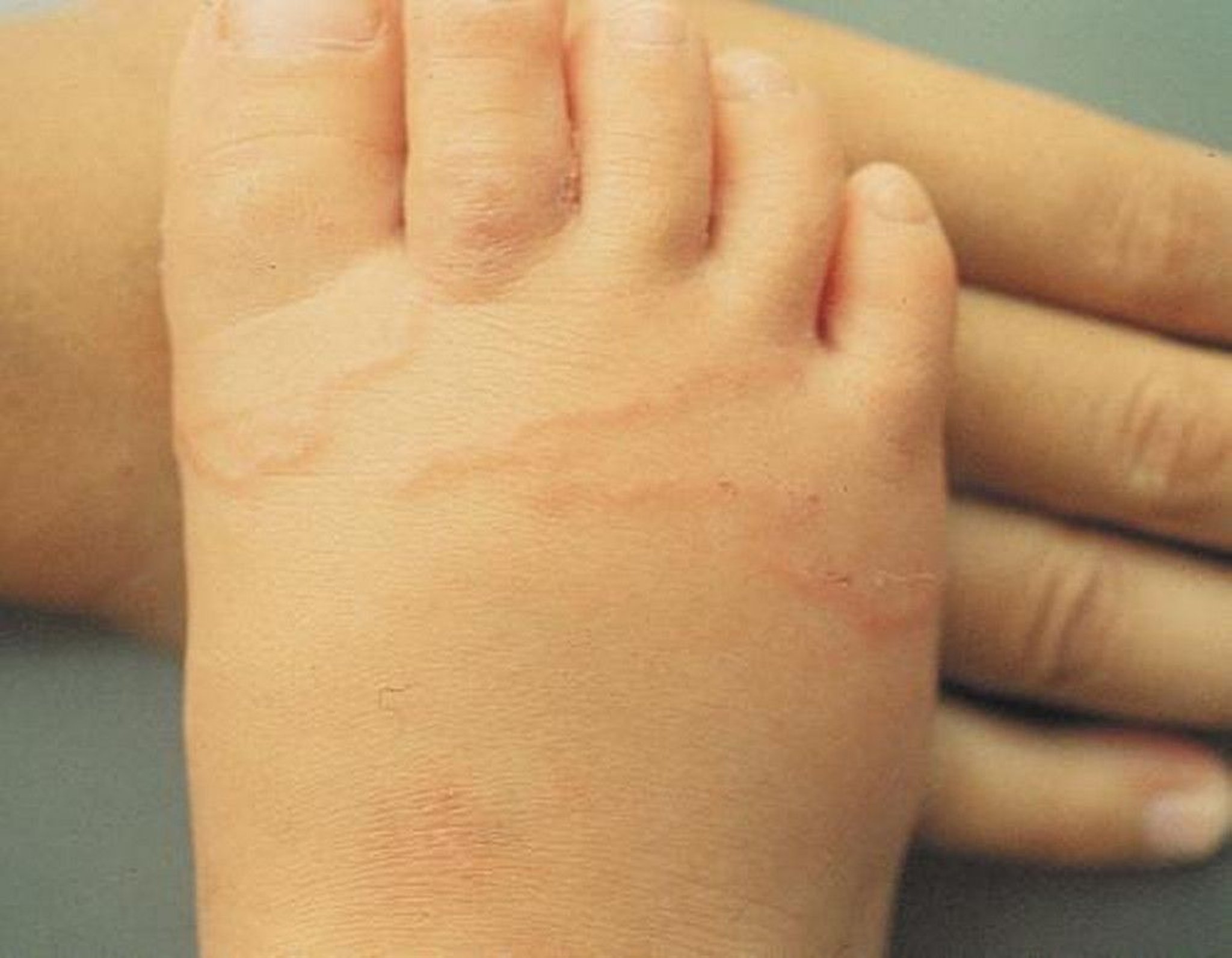
This photo shows a rash on a foot caused by the burrowing larvae of animal hookworms. The movement of the larvae beneath the skin causes distinct patterns of erythema and raised serpiginous tracts accompanied by intense pruritus.
© Springer Science+Business Media

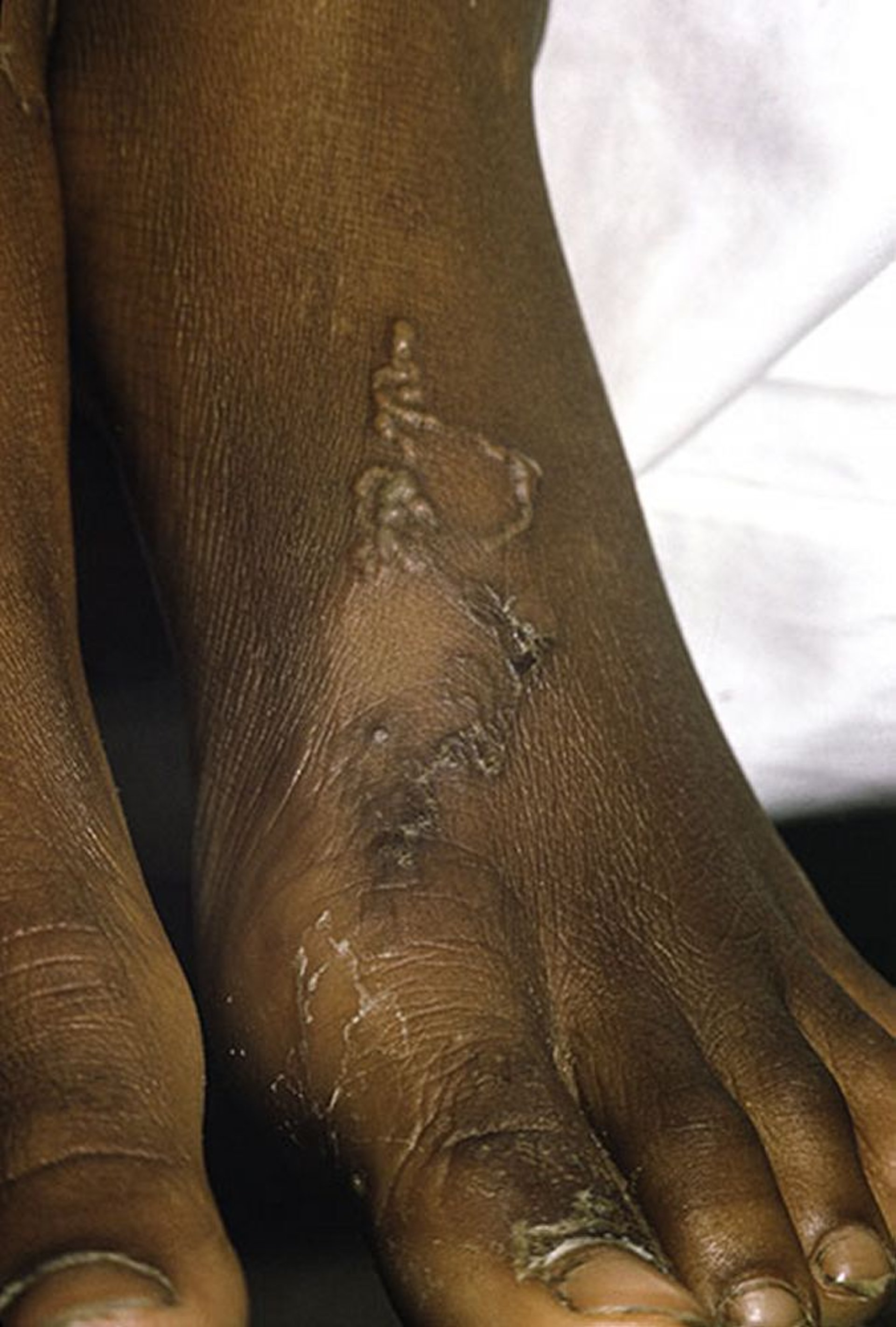
This photo shows a superficial, raised, serpiginous tract on the dorsal aspect of the foot.
Photo courtesy of Karen McKoy, MD.
Chronic, heavy, intestinal infection can lead to iron deficiency anemia, causing pallor, dyspnea, weakness, tachycardia, lassitude, and peripheral edema. A low-grade eosinophilia is often present. In children, chronic blood loss may lead to severe anemia, heart failure, and anasarca and, in pregnant women, to growth retardation in the fetus.
Cutaneous larva migrans can occur when animal hookworms infect humans but do not reach adulthood. It is caused by larvae as they migrate through the skin and is characterized by itchy, erythematous, serpiginous skin lesions. On rare occasion, A. caninum larvae reach the human intestine where they cause eosinophilic enterocolitis with abdominal pain and associated symptoms. Eggs are not present in the stool.
Diagnosis of Hookworm Infection
Microscopic examination of stool
A. duodenale, A. ceylanicum, and N. americanus produce thin-shelled oval eggs that are readily detected in fresh stool. Concentration procedures are needed to diagnose light infections. If the stool is not kept cold and examined within several hours, the eggs may hatch and release larvae that must be differentiated from those of Strongyloides stercoralis. Although the 3 hookworm species that infect humans can be differentiated by molecular probes, the ova are indistinguishable, and a species-specific diagnosis is not made in clinical laboratories.
Eosinophilia is often present in people infected with hookworms. During the prepatent period of infection (ie, the 5 to 9 weeks between penetration of larvae and appearance of eggs in the stool), eosinophilia may be the only laboratory abnormality. Hookworm infestation is an important consideration in the differential diagnosis of eosinophilia in immigrants or travelers returning from endemic regions where sanitation is poor.
Nutritional status, anemia, and iron stores should be evaluated (see Diagnosis of Iron Deficiency Anemia).
Diagnosis of cutaneous larva migrans is based on the clinical manifestations. Ova are not present in the stool.
Treatment of Hookworm Infection
Anthelmintics
Intestinal hookworm infection
Intestinal hookworm infection is treated with anthelmintics. Albendazole, mebendazole, or pyrantel pamoate may be used.
Benzimidazoles should be avoided during pregnancy, but pyrantel pamoate is considered safe. Ivermectin, a common anthelmintic, is not effective for intestinal hookworm infection.
General support and correction of iron deficiency anemia are needed if infection is heavy.
Cutaneous larva migrans
Cutaneous larva migrans is a self-limited infection, but symptoms can last 5 to 6 weeks. Treatment with albendazole or ivermectin is curative.
Prevention of Hookworm Infection
Preventing unhygienic defecation and avoiding direct skin contact with the soil (eg, wearing shoes, using barriers when seated on the ground) are effective in preventing hookworm infection but difficult to implement in many endemic areas.
Periodic mass treatment of susceptible populations at 3- to 4-month intervals has been used in high-risk areas.
Risk of developing cutaneous larva migrans can be reduced by the following:
Avoiding direct skin contact with potentially infested sand or other soil where dogs or cats have defecated.
Key Points
Hookworm larvae penetrate the skin when people walk barefoot on or otherwise come into direct contact with infested soil.
In humans, larvae of the hookworms Ancylostoma duodenale and Necator americanus travel through the bloodstream to the lungs, penetrate the alveoli, ascend to the epiglottis, are swallowed, and then mature in the small intestine.
Infection may be asymptomatic, but a pruritic rash may appear at the site of larval penetration, and pulmonary involvement may cause cough and wheezing.
Intestinal involvement may cause iron deficiency anemia.
Diagnose by microscopic examination of stool.
Treat with albendazole, mebendazole, or pyrantel pamoate.
Drug Information for the Topic