Acute or chronic injuries without freezing of tissue may result from cold exposure.
Frostnip
The mildest cold injury is frostnip, a vasoconstriction-mediated local non-freezing injury that can precede frostbite (1). Affected areas (most commonly the cheeks, ears, and nose) are numb, swollen, and red. In contrast to frostbite, tissue is not firm or waxy because ice crystals are not present. Treatment is rewarming, which causes pain and itching. Rarely, mild hypersensitivity to cold persists for months to years (2, 3), but there is no permanent damage to underlying tissues.
Immersion (trench) foot (nonfreezing cold injury)
Prolonged exposure to wet cold (< 59° F; < 15° C) can cause immersion foot, also known as trench foot or nonfreezing cold injury (1). Usually, injury is limited to peripheral nerves and microvasculature, although muscle and skin tissue may be injured in severe cases.
Initially, the foot is numb (sometimes with gait disturbance due to loss of proprioception) (4). It may be initially erythematous, then pale with decreased pulses, as well as edematous, clammy, and cold. Tissue maceration may occur if patients walk extensively. On rewarming, the foot becomes mottled or blue, then develops hyperemia, bounding pulses, and often hypersensitivity and hyperalgesia, which can persist for 6 to 10 weeks. In some cases skin may ulcerate, or a black eschar may develop. Autonomic dysfunction is common, with increased or decreased sweating, vasomotor changes, and local hypersensitivity to temperature change; chronic neuropathy may also be present. Muscle atrophy and dysesthesia or anesthesia may occur and become chronic.
Immersion foot can be prevented by avoiding or rotating out of cold, wet environments periodically, not wearing tight-fitting boots, keeping feet and boots dry, and changing socks frequently (5).
Immediate treatment involves to first addressing any hypothermia or frostbite, followed by passive rewarming at room temperature with elevation of the affected extremity and application of sterile dressings (4). Chronic neuropathic symptoms are difficult to treat; if amitriptyline is not effective, gabapentin may be tried (see Neuropathic Pain: Treatment).
Chilblains (pernio)
Localized areas of erythema, swelling, pain, and pruritus result from repeated exposure to damp nonfreezing cold; the mechanism is unclear. Blistering or ulceration may occur. Chilblains most commonly affects the fingers and pretibial area and is self-limited. Occasionally, symptoms recur. Women are most commonly affected, including some who may have Raynaud phenomenon or underlying autoimmune disorders (eg, systemic or cutaneous lupus erythematosus) (6, 7).

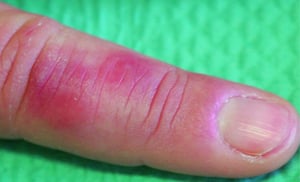
The middle phalanx has areas of localized erythema and appears swollen.
The middle phalanx has areas of localized erythema and appears swollen.
© Springer Science+Business Media

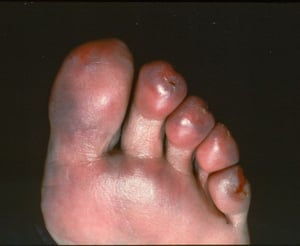
Swelling and blistering on the pads of the toes result from repeated cold exposure without freezing.
Swelling and blistering on the pads of the toes result from repeated cold exposure without freezing.
Image courtesy of Karen McKoy, MD.

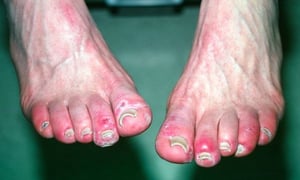
This image shows the swelling and erythema of chilblains.
This image shows the swelling and erythema of chilblains.
Image courtesy of Karen McKoy, MD.
The middle phalanx has areas of localized erythema and appears swollen.
The middle phalanx has areas of localized erythema and appears swollen.
© Springer Science+Business Media
Swelling and blistering on the pads of the toes result from repeated cold exposure without freezing.
Swelling and blistering on the pads of the toes result from repeated cold exposure without freezing.
Image courtesy of Karen McKoy, MD.
This image shows the swelling and erythema of chilblains.
This image shows the swelling and erythema of chilblains.
Image courtesy of Karen McKoy, MD.
Endothelial and neuronal damage results in vasospasm and exaggerated sympathetic response when exposed to cold. First-line treatment typically involves conservative measures, such as keeping the affected area warm and dry and avoiding nicotine. Data to support the use of pharmacologic agents are limited. Nifedipine and topical glucocorticoids are the most commonly used and may help reduce symptoms. Other approaches, such as pentoxifylline or tadalafil, may also be of benefit (6).
References
1. McIntosh SE, Freer L, Grissom CK, et al. Wilderness Medical Society Clinical Practice Guidelines for the Prevention and Treatment of Frostbite: 2024 Update. Wilderness Environ Med. 2024;35(2):183-197. doi:10.1177/10806032231222359
2. Jensen TS, Finnerup NB. Allodynia and hyperalgesia in neuropathic pain: clinical manifestations and mechanisms. Lancet Neurol. 2014;13(9):924-935. doi:10.1016/S1474-4422(14)70102-4
3. Namer B, Kleggetveit IP, Handwerker H, Schmelz M, Jorum E. Role of TRPM8 and TRPA1 for cold allodynia in patients with cold injury. Pain. 2008;139(1):63-72. doi:10.1016/j.pain.2008.03.007
4. Zafren K, Hollis S, Weiss EA, et al. Prevention and Treatment of Nonfreezing Cold Injuries and Warm Water Immersion Tissue Injuries: Supplement to Wilderness Medical Society Clinical Practice Guidelines for the Prevention and Treatment of Frostbite. Wilderness and Environmental Medicine. 34(2):172-81, 2023. doi.org/10.1016/j.wem.2023.02.006
5. Mistry K, Ondhia C, Levell NJ. A review of trench foot: a disease of the past in the present. Clin Exp Dermatol. 2020;45(1):10-14. doi: 10.1111/ced.14031
6. Dubey S, Joshi N, Stevenson O, Gordon C, Reynolds JA. Chilblains in immune-mediated inflammatory diseases: a review. Rheumatology (Oxford). 2022;61(12):4631-4642
7. Prakash S, Weisman MH. Idiopathic chilblains. Am J Med. 2009;122(12):1152-1155. doi:10.1016/j.amjmed.2009.07.011
Drug Information for the Topic