An omphalocele is a protrusion of abdominal viscera from a midline defect at the base of the umbilicus. Treatment is surgical.
(See also Overview of Congenital Gastrointestinal Anomalies.)
The estimated incidence of omphalocele is 2 to 3 in 10,000 live births (1). It is less common than gastroschisis.
In omphalocele, the herniated viscera are covered by a thin membrane and may be small (only a few loops of intestine) or may contain most of the abdominal viscera (intestine, stomach, liver). Immediate dangers are drying of the viscera, hypothermia and dehydration due to evaporation of water from the exposed viscera, and infection of the peritoneal surfaces.
Infants with omphalocele have a very high incidence of other congenital anomalies (about two-thirds), including the following:
Bowel atresia
Chromosomal abnormalities (eg, trisomy 18, trisomy 13, Down syndrome [trisomy 21])
Beckwith-Wiedemann syndrome
Omphalocele can be detected by routine prenatal ultrasound (2); if the anomaly is present, delivery should be at a tertiary care center with personnel experienced in dealing with this anomaly and the other associated congenital anomalies.

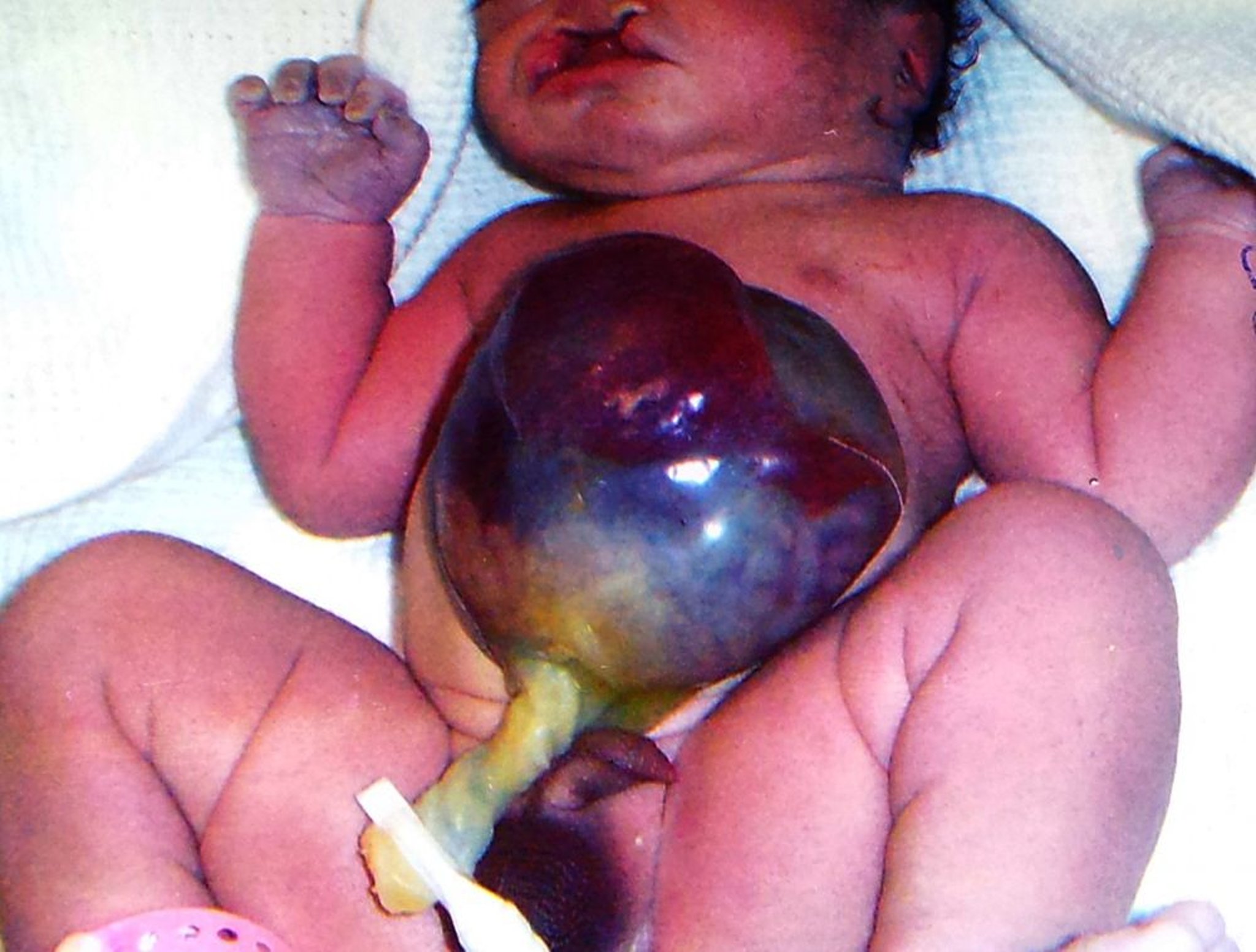
This photo shows a large omphalocele. Note the membranous covering and the umbilical cord at the base of the omphalocele. This patient also has other congenital anomalies, such as cleft lip and palate and left anophthalmia and hydrocele (not seen in this photo).
© Springer Science+Business Media
General references
1. Nembhard WN, Bergman JEH, Politis MD, et al: A multi-country study of prevalence and early childhood mortality among children with omphalocele. Birth Defects Res 112(20):1787-1801, 2020. doi:10.1002/bdr2.1822
2. Bence CM, Wagner AJ: Abdominal wall defects. Transl Pediatr 10(5):1461-1469, 2021. doi:10.21037/tp-20-94
Treatment of Omphalocele
Surgical repair
At delivery, the exposed viscera should be immediately covered with a sterile, moist, nonadherent dressing (eg, medicated petrolatum gauze that can then be covered with plastic wrap) to maintain sterility and prevent evaporation. The infant should then be given IV fluids and antibiotics (eg, a broad-spectrum regimen such as ampicillin and gentamicin) (1), and a nasogastric tube should be placed. The amount of fluids needed is typically significantly higher than that needed for a normal healthy neonate (1.5 to 2 times) because of excessive fluid loss from the exposed gut.
The infant is evaluated for associated anomalies before surgical repair of the omphalocele. Primary closure is performed when feasible. With a large omphalocele, the abdominal cavity may be too small to accommodate the viscera. In this case, the viscera are covered by a pouch or silo of polymeric silicone sheeting, which is progressively reduced in size over several days as the abdominal capacity slowly increases, until all of the viscera are enclosed within the abdominal cavity. Mortality and outcome are related to the size of the defect (2, 3).
Treatment references
1. Ravikumar C, Mitchell IC, Cantey JB. Antibiotic Utilization and Infection Among Infants with Abdominal Wall Defects. Pediatr Infect Dis J. 2020;39(12):1116-1120. doi:10.1097/INF.0000000000002867
2. Chin VHY, Hung JWS, Wong VHY, et al. Clinical characteristics and outcome of omphalocele and gastroschisis: a 20-year multicenter regional experience. Pediatr Surg Int. 2024;40(1):210. Published 2024 Jul 25. doi:10.1007/s00383-024-05783-0
3. Raymond SL, Downard CD, St Peter SD, et al. Outcomes in omphalocele correlate with size of defect. J Pediatr Surg. 2019;54(8):1546-1550. doi:10.1016/j.jpedsurg.2018.10.047
Drug Information for the Topic