Respiratory syncytial virus infection and human metapneumovirus infection cause upper and sometimes lower respiratory tract infections.
Respiratory syncytial virus is a very common cause of respiratory infections in infants and young children.
Human metapneumovirus is similar to respiratory syncytial virus but is a separate virus.
Typical symptoms include a runny nose, fever, cough, and wheezing, and a severe infection can lead to respiratory distress.
The diagnosis is based on symptoms and their occurrence at expected times of year.
Oxygen is given as needed.
Nirsevimab or clesrovimab is given to appropriate children to prevent respiratory syncytial virus infection.Nirsevimab or clesrovimab is given to appropriate children to prevent respiratory syncytial virus infection.
Respiratory syncytial virus (RSV)

Copyright © 2025 Merck & Co., Inc., Rahway, NJ, USA and its affiliates. All rights reserved.
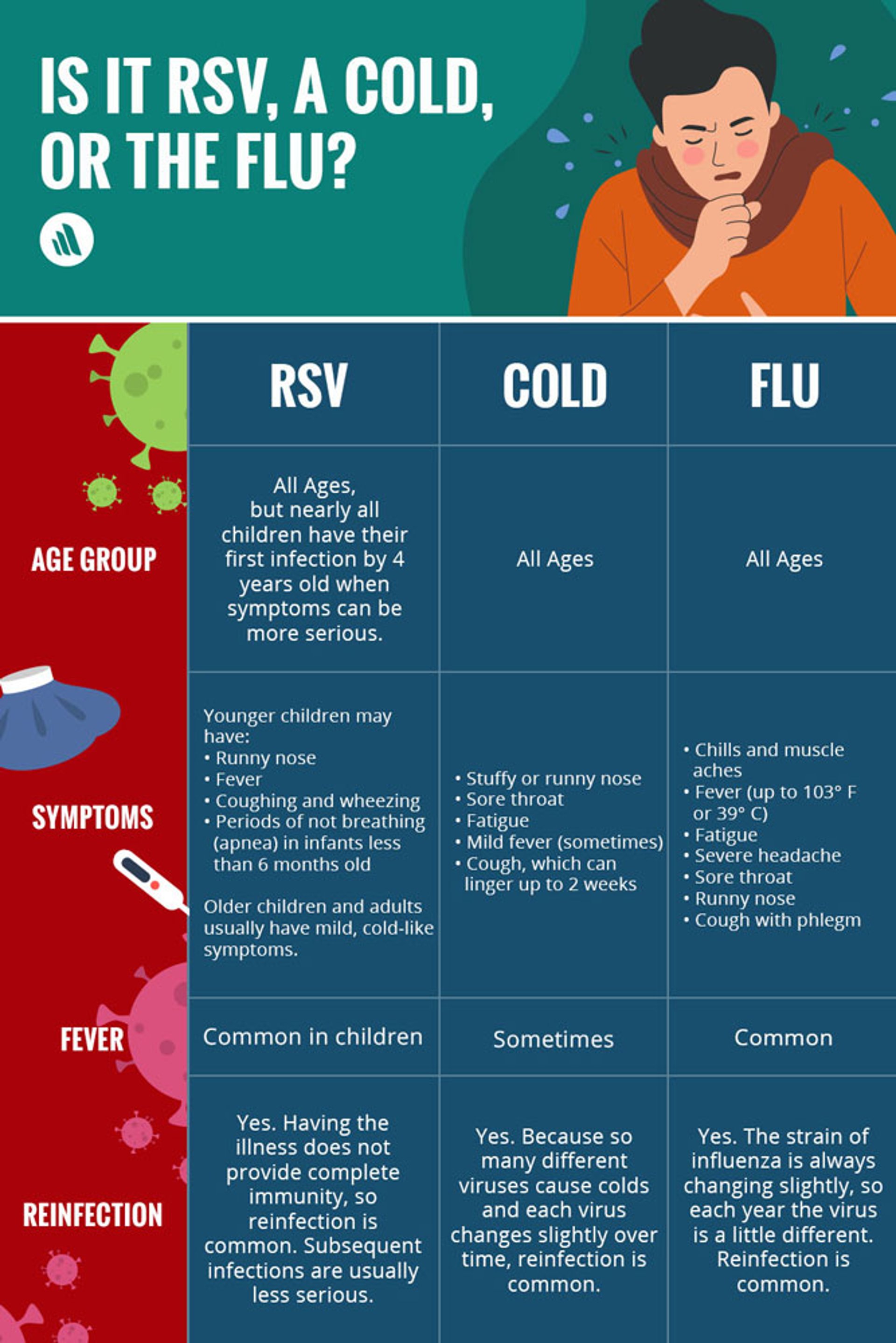
RSV is a very common cause of respiratory tract infection, particularly in children. It is the most common cause of lower respiratory tract illness in young infants. Nearly all children have been infected by age 4 years, many in the first year of life. Infection does not provide complete immunity, so reinfection is common but usually less serious.
The first RSV infection often progresses from an upper respiratory tract illness with congestion and fever to involve the lower respiratory tract, most commonly causing bronchiolitis and sometimes pneumonia with cough and difficulty breathing. Later infections usually involve only the upper respiratory tract. Children who have had bronchiolitis are more likely to be diagnosed with asthma when they are older.
Globally, RSV causes an estimated 3.6 million hospitalizations and about 100,000 deaths every year in children under the age of 5.
In the United States during the 2024 to 2025 RSV season, about 58,000 to 80,000 children under the age of 5 were hospitalized because of RSV infection. Hospitalizations in the United States have been decreasing for 3 years in a row. Outbreaks typically occur each year in fall through early spring.
Children with serious underlying disorders (such as congenital heart disease, asthma, cystic fibrosis, neuromuscular disorders, or a weakened immune system) or who were born prematurely and infants under 6 months of age are at particular risk of developing serious illness. Some children, usually young infants, develop severe trouble breathing, and a few die.
Older children and adults also can be infected with RSV, and older adults may develop pneumonia.
Human metapneumovirus (hMPV)
hMPV is a similar but separate virus.
hMPV infection occurs at the same seasonal time as RSV infection but does not infect as many children.
Symptoms of RSV and hMPV Infections

RSV and hMPV cause similar symptoms. Infection with these organisms typically begin with a runny nose, congestion, and fever 3 to 5 days after exposure. If the infection progresses, children also may develop a cough, wheezing, and shortness of breath. RSV and hMPV commonly cause bronchiolitis and rarely pneumonia.
In infants younger than 6 months old, the first symptom of RSV infection may be a period of not breathing (apnea).
In older children and healthy adults, illness is usually mild and may manifest only as a common cold with no fever.
Diagnosis of RSV and hMPV Infections
A doctor's evaluation
Sometimes testing of fluid from the nose
Doctors usually suspect RSV (and possibly hMPV) infection in young infants and children who have bronchiolitis during RSV season or during an outbreak. Tests are usually not done unless doctors are trying to identify an outbreak or if hospitalization is required.


When necessary, samples of fluid from the nose are taken and tested with a rapid antigen test, the polymerase chain reaction (PCR) technique, or sometimes a culture to help identify the virus.
Treatment of RSV and hMPV Infections
Oxygen for breathing difficulty
Children who have difficulty breathing are hospitalized. Depending on their condition, doctors may treat them with oxygen and fluids by vein (see treatment of bronchiolitis).
Most children do not need to be hospitalized. Treatment at home is mainly to provide symptom relief. For example, children may be given pain relievers and fluids to prevent dehydration. Parents should closely monitor children for signs of serious breathing difficulties or dehydration.
Ribavirin, an antiviral medication, is sometimes given to children whose immune system is severely weakened.
Prevention of RSV and hMPV Infections
Good hygiene
RSV vaccine for pregnant people
Nirsevimab or clesrovimabNirsevimab or clesrovimab
Practicing good hygiene is an important preventive measure. An ill child and the people in the household should wash their hands frequently. In general, the more intimate physical contact (such as hugging, snuggling, or bed sharing) that takes place with an ill child, the greater the risk of spreading the infection to other family members. Parents must balance this risk with the need to comfort an ill child.
The best course of action to prevent RSV infection in infants is for pregnant people to be vaccinated in the third trimester of pregnancy during seasons when RSV infection is prevalent (usually fall through early spring). For infants whose mother did not receive the RSV vaccine during pregnancy, doctors recommend they receive an injection of a long-acting antibody medication to prevent serious RSV lung infections. Nirsevimab and clesrovimab are medications that contain antibodies against RSV. These medications are available in the United States for the prevention of RSV infection in infants and young children. They are effective and safe and help reduce the number of infants who are hospitalized because of RSV infection. These medications are not needed for most infants if their mother was given an RSV vaccine during pregnancy.The best course of action to prevent RSV infection in infants is for pregnant people to be vaccinated in the third trimester of pregnancy during seasons when RSV infection is prevalent (usually fall through early spring). For infants whose mother did not receive the RSV vaccine during pregnancy, doctors recommend they receive an injection of a long-acting antibody medication to prevent serious RSV lung infections. Nirsevimab and clesrovimab are medications that contain antibodies against RSV. These medications are available in the United States for the prevention of RSV infection in infants and young children. They are effective and safe and help reduce the number of infants who are hospitalized because of RSV infection. These medications are not needed for most infants if their mother was given an RSV vaccine during pregnancy.
NirsevimabNirsevimab is recommended for the following children:
All infants younger than 8 months of age who are either born during or who are entering their first RSV season
Children 8 to 19 months of age who are at higher risk of becoming very sick if they get an RSV infection and who are entering their second RSV season
Nirsevimab should be given shortly before the start of the RSV season, which is typically October in most of the continental United States. Infants who did not receive an injection at the start of the season may be given one at any time during the season, which is typically through the end of March in most of the continental United States.
Nirsevimab may be given before a newborn leaves the hospital. It can be given at the same time as other routine childhood vaccines.
ClesrovimabClesrovimab is another medication that may be used to prevent RSV infection in infants younger than 8 months of age whose mother did not receive RSV vaccination during pregnancy.
For information on available RSV vaccines for older adults and pregnant women, see Respiratory Syncytial Virus (RSV) Vaccine.
There is no vaccine to prevent hMPV infection at the present time.
Drug Information for the Topic