A cholesteatoma is a benign growth of skinlike material in the middle ear or tissues nearby. People with a cholesteatoma may have a fever, vertigo, and/or an earache. A cholesteatoma, which destroys bone, greatly increases the likelihood of other serious complications such as infections of the inner ear, facial paralysis, and brain abscesses.
A cholesteatoma is a growth that forms in the middle ear and may extend into the mastoid bone behind the ear, or epitympanum (area in the ear canal close to the eardrum). Enzymes produced by the cholesteatoma can destroy nearby bone and soft tissue (including the eardrum). In the initial stages, people often don't have symptoms.
Advanced disease (depending on the area of local involvement) can cause pain, vertigo, facial nerve weakness, or mental status changes.
Serious complications, such as polyps, damage of the ossicles or other bones, and spread of infection, can develop.
Symptoms of Cholesteatoma
In the beginning, people often don't have symptoms.
Common symptoms in cholesteatoma include hearing loss and chronic, often foul-smelling ear discharge that does not completely respond to treatment.
Hearing loss can occur.
Advanced disease (depending on the area of local invasion) can cause pain, vertigo, facial nerve weakness, or mental status changes.

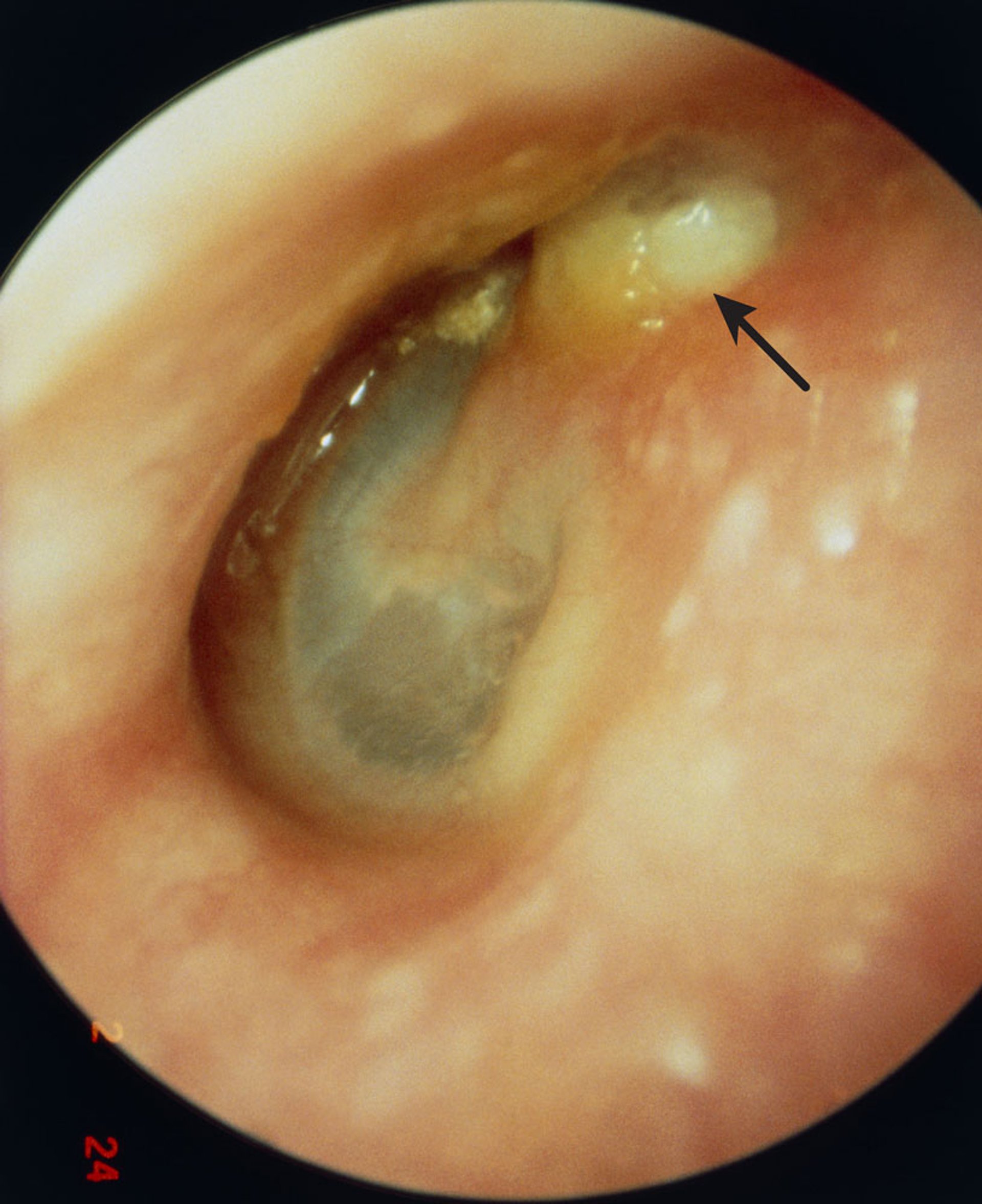
This image shows a large cholesteatoma (arrow) that caused a hole (perforation) in the eardrum (tympanic membrane).
PROFESSOR TONY WRIGHT, INSTITUTE OF LARYNGOLOGY & OTOLOGY/SCIENCE PHOTO LIBRARY
Diagnosis of Cholesteatoma
A doctor's examination
Imaging tests
A doctor examines the ear and performs hearing tests to make the diagnosis. The doctor may also do computed tomography to determine the extent of disease.
Treatment of Cholesteatoma
Surgery
Sometimes antibiotics
Cholesteatoma is treated with surgery to remove the mass and sometimes with removal of the mastoid bone behind the ear followed by reconstruction of the middle ear. Recurrence of cholesteatoma is common. Because of this, a second operation is done to check whether it has recurred before reconstruction is started
Doctors will give otic (in the ear) or oral antibiotics as needed for infectious complications. It is important to keep the ear dry, and avoid cotton swabs.
Recurrence depends upon the extent of the invasion of the cholesteatoma and the surgical technique used to treat it.
To see if cholesteatoma has recurred and to identify complications, doctors do annual follow-ups for examining the ear and hearing tests (audiogram) for at least 5 years. Sometimes doctors will do magnetic resonance imaging 12 to 18 months after surgery to identify recurrence or complications.