Pulmonary (pulmonic) stenosis is a narrowing of the pulmonary valve opening that blocks (obstructs) blood flow from the right ventricle to the pulmonary artery. It is often present at birth (congenital) and thus affects children.
(See also Overview of Heart Valve Disorders and the video .)
The pulmonary valve is in the opening between the right ventricle and the blood vessels going to the lungs (pulmonary arteries). The pulmonary valve opens as the right ventricle contracts to pump blood into the lungs. Certain disorders causes the valve opening to be narrowed (stenosis).
Pulmonary stenosis, which is rare among adults, is usually due to a birth defect. When the stenosis is severe, it is usually diagnosed during infancy or childhood, because it causes a loud heart murmur (abnormal heart sound that a doctor can hear with a stethoscope). Severe pulmonary stenosis can cause heart failure in children but may not cause symptoms until adulthood.
Symptoms include chest pain (angina), shortness of breath, and fainting.
Diagnosis of Pulmonary Stenosis
Physical examination
Echocardiography
Through a stethoscope, doctors may hear the characteristic murmur of pulmonary stenosis.
Echocardiography, which uses ultrasound waves, can produce an image of the narrowed valve opening and show the amount of blood passing through the valve, so that the severity of the stenosis can be determined. Sometimes additional testing such as cardiac catheterization or magnetic resonance imaging (MRI) of the heart can also be helpful to provide additional information about the exact location, severity, or other effects of pulmonary stenosis.
Treatment of Pulmonary Stenosis
Balloon valvuloplasty
Mild pulmonary valve stenosis in children may improve and even resolve without treatment.
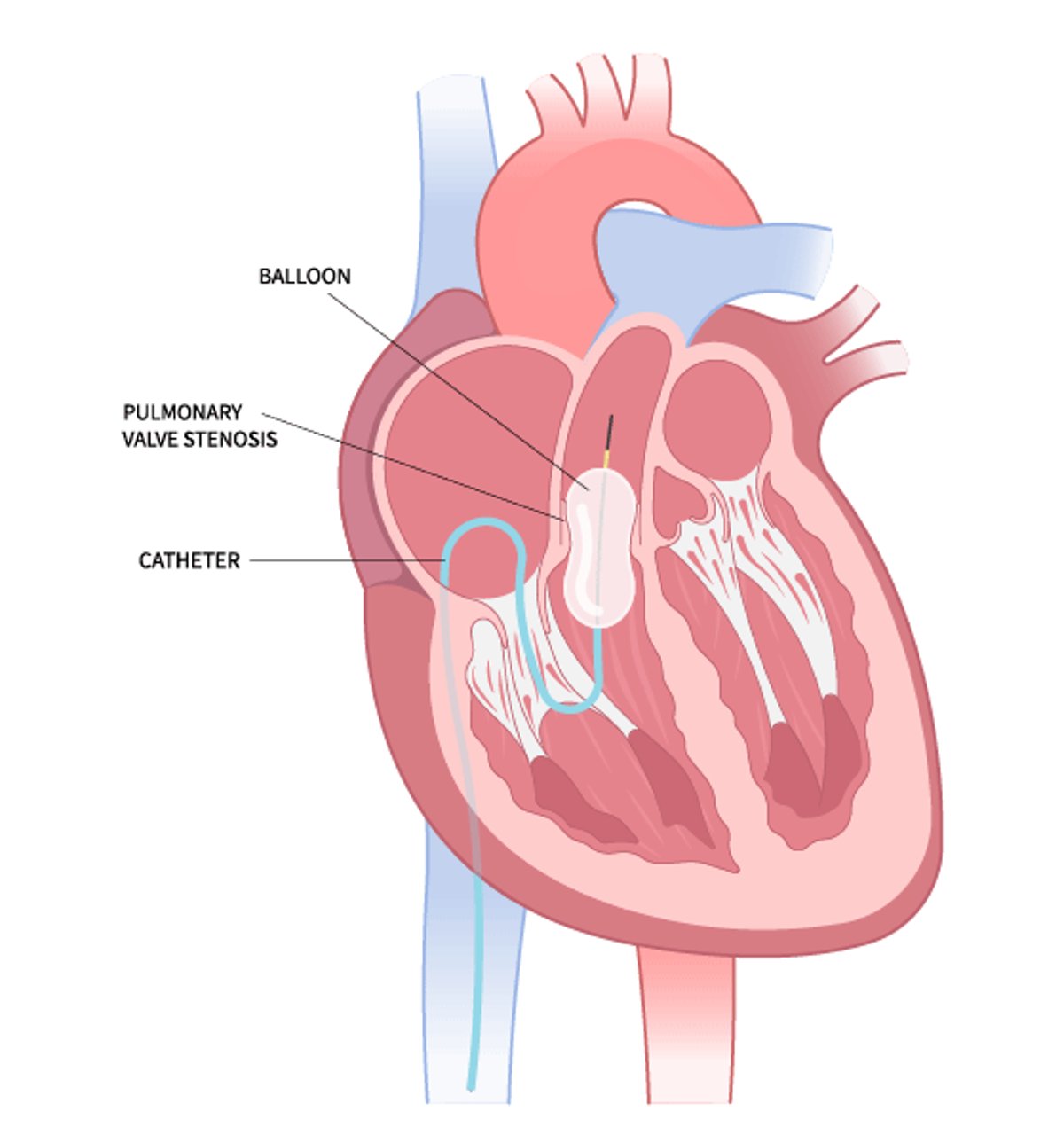
In people with symptoms and/or severe stenosis detected by echocardiography, balloon valvuloplasty may be done. In this procedure, the valve is stretched open using a catheter with a ballon on the tip, which is threaded through a vein and eventually into the heart. Once inside the valve, the balloon is inflated, separating the valve cusps and relieving the stenosis. In rare cases, the pulmonary valve is replaced with a bioprosthetic valve.
Balloon Valvuloplasty
In balloon valvuloplasty, the valve is stretched open using a catheter with a ballon on the tip, which is threaded through a vein and eventually into the heart. Once inside the valve, the balloon is inflated, separating the valve cusps and relieving the stenosis. Pepermpron/stock.adobe.com |

More Information
The following English-language resource may be useful. Please note that The Manual is not responsible for the content of this resource.
American Heart Association: Heart Valve Disease: Provides comprehensive information on diagnosis and treatment of diseases of the heart valves