Impetigo is a superficial bacterial skin infection that leads to the formation of scabby, yellow-crusted sores and, sometimes, small blisters filled with yellow fluid. Ecthyma is a form of impetigo that causes sores deeper in the skin. Both infections are caused by Staphylococcus aureus, Streptococcus pyogenes, or both.
(See also Overview of Bacterial Skin Infections.)
Impetigo is a skin infection that causes scabby, crusty sores to form on the top layer of the skin (the epidermis). It is common and mostly affects children. Impetigo can occur anywhere on the body but most commonly occurs on the face, arms, and legs.
One form of impetigo causes blisters (bullous impetigo) that vary in size and can last for days to weeks.
Impetigo often affects normal skin but may develop after an injury or a condition that causes a break in the skin, such as a fungal infection, sunburn, or an insect bite.
Impetigo is very contagious—both to other areas of the person’s own skin and to other people.
Ecthyma is a form of impetigo that causes sores (ulcers) to form in the deepest layer of the skin (the dermis). It commonly develops on the legs and may cause scarring.
Risk factors for impetigo and ecthyma include poor hygiene and a humid environment. Some people have staphylococci or streptococci bacteria living in their nose that does not cause infection. They are called nasal carriers. Carriers are people who have the bacteria but do not have any symptoms caused by the bacteria. Carriers can move the bacteria from their nose to other body parts with their hands, sometimes leading to recurring infections or to spreading infection to other people. People who have a chronic skin condition such as atopic dermatitis or dry skin are also at increased risk of impetigo.
Symptoms of Impetigo and Ecthyma
Impetigo and ecthyma are itchy and can be slightly painful. The itching often leads to extensive scratching, particularly in children, which spreads the infection.
Impetigo typically causes clusters of tiny blisters that rupture and develop a honey-colored crust over the sores (ulcers).
Bullous impetigo is similar except that the sores typically enlarge rapidly to form larger blisters. The blisters may appear as a red patch before forming larger blisters. They then burst and expose raw skin, which becomes covered with honey-colored crust.

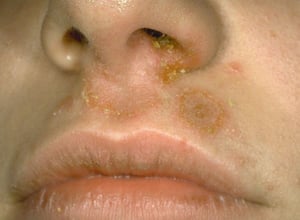
In impetigo, clusters of sores rupture and develop a honey-colored crust.
In impetigo, clusters of sores rupture and develop a honey-colored crust.
Image courtesy of Thomas Habif, MD.

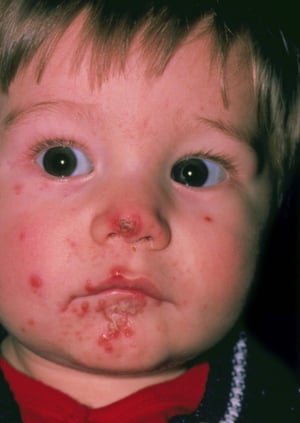
This child with impetigo has clusters of scabby, yellow-crusted sores.
This child with impetigo has clusters of scabby, yellow-crusted sores.
DR P. MARAZZI/SCIENCE PHOTO LIBRARY

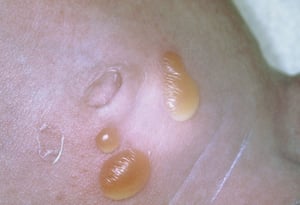
This photo shows bullous impetigo on an infant's abdomen. The infection begins as a patch, which develops into small pus-filled spots that join together, eventually forming yellow blisters (bullae) that break open and form scabs.
This photo shows bullous impetigo on an infant's abdomen. The infection begins as a patch, which develops into small pu
SCIENCE PHOTO LIBRARY
In impetigo, clusters of sores rupture and develop a honey-colored crust.
In impetigo, clusters of sores rupture and develop a honey-colored crust.
Image courtesy of Thomas Habif, MD.
This child with impetigo has clusters of scabby, yellow-crusted sores.
This child with impetigo has clusters of scabby, yellow-crusted sores.
DR P. MARAZZI/SCIENCE PHOTO LIBRARY
This photo shows bullous impetigo on an infant's abdomen. The infection begins as a patch, which develops into small pus-filled spots that join together, eventually forming yellow blisters (bullae) that break open and form scabs.
This photo shows bullous impetigo on an infant's abdomen. The infection begins as a patch, which develops into small pu
SCIENCE PHOTO LIBRARY
Ecthyma is a form of impetigo. It is characterized by small, shallow ulcers that have a punched-out appearance and sometimes contain pus. The crust that covers the ulcers is thicker than the crust caused by impetigo. It is brown-black in color. The area around the ulcers is typically red and swollen.

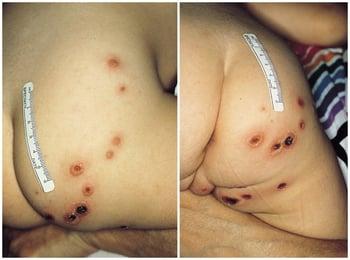
This photo shows small, pus-containing, shallow, punched-out sores (ulcers) with thick, brown-black crusts. The area around the ulcers is red and swollen.
Diagnosis of Impetigo and Ecthyma
A doctor's evaluation
Testing of a pus sample
Doctors typically diagnose impetigo and ecthyma based on the appearance of the sores and blisters.
Doctors remove and test a sample of pus to determine which bacteria is causing the infection. The results help them decide what treatment to give.
Treatment of Impetigo and Ecthyma
Antibiotic ointments or creams
Sometimes antibiotic pills
For small areas of impetigo, doctors prescribe antibiotic ointments or creams that the person can apply directly to their skin (topically). If large areas are affected, the person has a weakened immune system, or there is an outbreak, doctors prescribe an antibiotic taken by mouth (orally). Ecthyma is treated with oral antibiotics. All affected areas should be washed gently with soap and water several times a day to remove any crusts.
Doctors prescribe a topical antibiotic ointment or cream for people who are nasal carriers. People can apply the ointment of cream to their nasal passages.