Cyclosporiasis is an infection of the small intestine caused by the parasite Cyclospora cayetanensis. The main symptoms are watery diarrhea with abdominal cramping and nausea.
People can become infected with Cyclospora by consuming imported food or water contaminated with the parasite.
Cyclosporiasis symptoms may be more severe in people with a weakened immune system, such as people with human immunodeficiency virus (HIV).
Symptoms vary but include watery diarrhea, abdominal cramping, fever, and weight loss.
Doctors diagnose the infection by identifying Cyclospora in a sample of stool.
Trimethoprim/sulfamethoxazole (TMP/SMX) is used to treat cyclosporiasis.
(See also Overview of Parasitic Infections.)
Cyclosporiasis is most common in warm climates where sanitation is poor. Residents of and travelers to endemic areas are at risk.
Cyclosporiasis is increasingly documented in the United States, Canada, and Europe. In the United States, outbreaks usually occur in the summer and are associated with the consumption of fresh produce, such as raspberries, blackberries, strawberries, blueberries, basil, cilantro, snow peas, snap peas, prepared vegetables, and various lettuces.

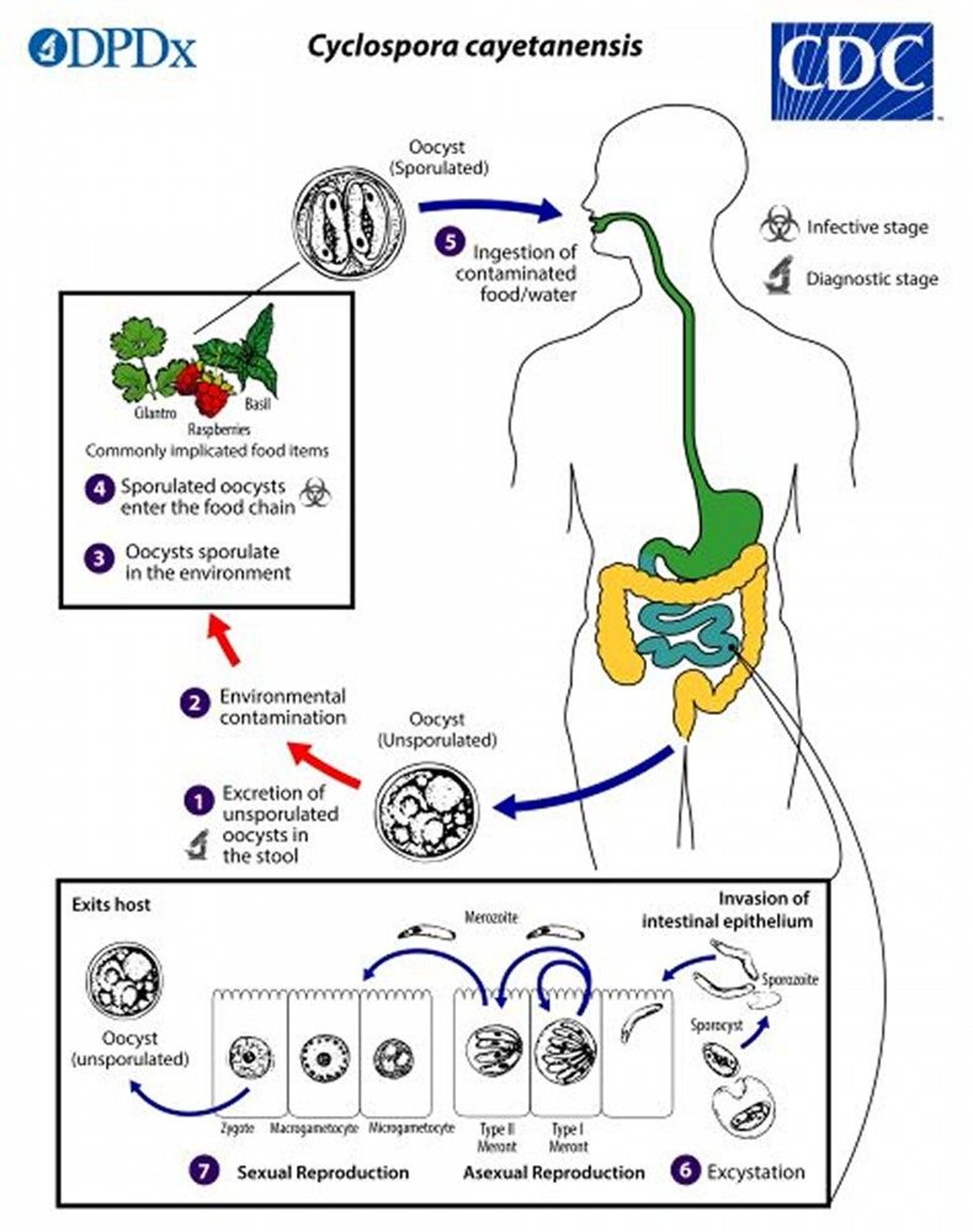
Cyclospora oocysts are not sporulated (ie, infective) when passed in stool. Thus, direct fecal-oral transmission does not occur.
1. Unsporulated oocysts are excreted from the infected host in stool.
2–3. The oocysts sporulate in the environment after 1 to 2 weeks at temperatures between 22 to 32° C.
4. The sporulated oocysts contaminate food or water. The mechanism for contamination has not been established.
5. The sporulated oocysts are ingested in contaminated food or water.
6. The oocysts excyst in the gastrointestinal tract, releasing the sporozoites, which invade the epithelial cells of the small intestine.
7. Inside the cells, they multiply asexually and develop sexually to mature into oocysts, which are shed in stool.
Image from the Centers for Disease Control and Prevention, Global Health, Division of Parasitic Diseases and Malaria.
Symptoms of Cyclosporiasis
The primary symptom of cyclosporiasis is sudden, nonbloody, watery diarrhea, and nausea. Other symptoms include fever, abdominal cramps, vomiting, fatigue, and weight loss. Symptoms in people with a normal immune system last from a few days to a month or longer. Relapses may occur.
In people with a weakened immune system, including people with end-stage HIV, cyclosporiasis may cause severe diarrhea that may persist for a long time.
Diagnosis of Cyclosporiasis
Stool tests
To diagnose cyclosporiasis, a stool sample is examined under a microscope for Cyclospora eggs. Specialized techniques can be used to increase the chances of identifying the eggs. Molecular techniques are available in some reference laboratories to identify parasite DNA.
When stool examination does not reveal a cause of persistent diarrhea, doctors may use a flexible viewing tube (endoscope) to examine the upper part of digestive tract and obtain a sample of tissue (a biopsy) to be examined under a microscope and analyzed for parasite DNA.
Treatment of Cyclosporiasis
Trimethoprim/sulfamethoxazole (TMP/SMX)
Alternatively, ciprofloxacin
Most healthy people recover without treatment. If not treated, the illness may last for a few days to a month or longer and can recur.
Treatment of choice for cyclosporiasis is double-strength TMP/SMX taken by mouth for 7 to 10 days.
In people with HIV, it is very important that the HIV infection is treated as effectively as possible with antiretroviral medications. Such treatment can strengthen the weakened immune system, which usually helps control the diarrhea and other symptoms. People with end-stage HIV may benefit from a higher dose of TMP/SMX and a longer course of treatment.
Ciprofloxacin and sometimes nitazoxanide are alternatives to TMP/SMX for cyclosporiasis.
Prevention of Cyclosporiasis
Avoiding food or water that may have been contaminated with feces is the best way to prevent cyclosporiasis.
Travelers to cyclosporiasis-endemic areas (such as tropical and subtropical regions) should be aware that treatment of water or food by routine chemical disinfection or sanitizing methods is unlikely to kill Cyclospora. (See Centers for Disease Control and Prevention [CDC]: Parasites - Cyclosporiasis: Prevention & Control). Detailed recommendations for international travelers are available in the CDC Yellow Book: Food & Water Precautions.
In endemic regions, drinking water should be boiled, unpeeled fruit should be avoided, and vegetables cooked thoroughly.
More Information
The following English-language resources may be useful. Please note that THE MANUAL is not responsible for the content of these resources.
Drug Information for the Topic