
Toxocariasis is an infection caused by the roundworms (nematodes) Toxocara canis and Toxocara cati, which are parasites that usually infect animals.
People, especially young children, can become infected when they eat soil contaminated with animal stool (feces) that contains the roundworm eggs.
The infection may cause fever, cough or wheezing, and an enlarged liver and, in some people, it may cause vision problems.
Doctors confirm the diagnosis by identifying antibodies to the roundworm in a sample of blood.
Treatment is usually unnecessary but may include medications used to treat worm infections and corticosteroids.
Regularly deworming dogs and cats and washing hands can help prevent the infection.
Helminths are parasitic worms that can infect humans and animals. There are 3 types of helminths: flukes (trematodes), tapeworms (cestodes), and roundworms (nematodes). Toxocara, Toxocara canis, and Toxocara cati are roundworms.
Toxocariasis infection occurs mainly in young children, who ingest Toxocara eggs by eating soil, dirt, or sand that is contaminated by the stool (feces) of dogs, cats, or other animals that carry the parasite. Sandboxes, where dogs and cats often defecate and children often play, pose a particular hazard for exposure to the eggs. Children frequently unknowingly transfer the eggs from their hands to their mouth and may eat the contaminated sand.
Occasionally, adults ingest eggs when they touch contaminated soil or dirt, other contaminated surfaces, or others' unwashed hands and become infected.

Zoonotic diseases are infections that can be naturally transmitted between animals and humans.
These diseases are caused by a variety of organisms, including bacteria, viruses, fungi, and parasites.
Some zoonotic diseases, such as rabies and cowpox, are transmitted directly from animals to people through contact with saliva, blood, urine, or feces. Others may spread through the air or through bites and scratches. In other diseases, transmission occurs through the bite of insects such as mosquitoes, ticks or fleas.
In Lyme disease, for example, deer ticks transmit the bacteria from infected carrier animals, such as mice, to humans or other animals. Insects that carry and transmit germs that cause diseases in people are called vectors.
Other zoonotic diseases, like Salmonella infection, are contracted by consuming food, water, or milk that has been contaminated by an infected animal, by consuming food that has been washed or grown in contaminated water, or by eating undercooked meat from an animal with Salmonella.
Zoonotic diseases make up more than half of all emerging infectious diseases (those that are rapidly increasing in incidence worldwide).
Zoonotic diseases not only cause illness and death in people, but also impact animal health, leading to illness in pets, zoo animals, wild animals and livestock, and reduced food availability. These diseases can have devastating effects on economies because of trade restrictions, health care expenditures, and negative effects on tourism.
Rabies is a viral zoonotic disease that is primarily spread through the bites or scratches of animals that are infected, called reservoirs. Common animal reservoirs for rabies include bats, skunks, raccoons, and foxes. Rabies spreads to the brain and spinal cord and can be fatal if not treated promptly.
Anthrax is a bacterial zoonotic disease commonly found in animals exposed to food, air, or water that is contaminated with anthrax spores. These spores can live in the environment and infect both people and animals when they are ingested, inhaled, or absorbed through open wounds. Humans may become infected through contact with infected animals or animal products that are contaminated with spores. Once inside the body, the spores develop into bacteria. The bacteria release toxins that can cause inflammation, bleeding, tissue death, and potentially sepsis.
Lyme disease is a bacterial zoonotic disease that is spread when a deer tick bites an infected carrier animal, such as a mouse, and ingests the bacteria that causes Lyme disease. The tick then bites animals or people, spreading the bacteria to them. Symptoms include fever, headache, fatigue, and a distinctive bull’s eye-shaped rash. If untreated, Lyme disease can affect the joints, heart, and nervous system.
The best way to prevent zoonotic disease is to limit your exposure to infected animals and vectors.
When contact with infected animals is necessary, it is important that you wear protective clothing and equipment like hats, gloves and glasses to avoid bites and scratches, and that you wash your hands thoroughly after handling animals.
To protect against insect vectors such as mosquitoes, ticks, and fleas, you can wear long pants and long-sleeve clothing, use mosquito netting, use insect repellents, and check for ticks after being outside in areas where they live.
It is also important to handle food safely and to avoid food that might be contaminated.
To protect animal health, keep healthy animals separate from infected animals and also protect them from exposure to insect vectors and contaminated food sources.
Copyright © 2026 Merck & Co., Inc., Rahway, NJ, USA and its affiliates. All rights reserved.
People who regularly eat things that are not food, such as soil, dirt, or clay (an eating disorder called pica), are at particular risk of toxocariasis.
Rarely, people are infected by eating raw or undercooked meat of other infected animals such as rabbits and ducks.
(See also Overview of Parasitic Infections.)
Transmission of Toxocariasis
After infected animals pass Toxocara eggs in their stool (feces), the eggs mature in the environment and become able to cause infection.
The infected eggs can get into peoples' mouths through contaminated dirt or unwashed hands. After people swallow the infectious eggs, larvae hatch in the intestine. The larvae penetrate the intestinal wall and spread through the bloodstream. Once in the bloodstream, the larvae travel to various tissues in the body (such as the liver, heart, lungs, brain, or eyes) causing damage and inflammation.
The larvae do not mature to adult worms in people, but they can remain alive in the body for many months. The larvae mature to adult worms when they live in dogs or cats.
Toxocara eggs may be ingested by other animals, such as rabbits, ducks, or sheep. In these animals, the eggs hatch into larvae, which penetrate the wall of the intestine and travel to various tissues where they form cysts. Rarely, people are infected by eating raw or undercooked meat from these animals and ingesting the cysts.

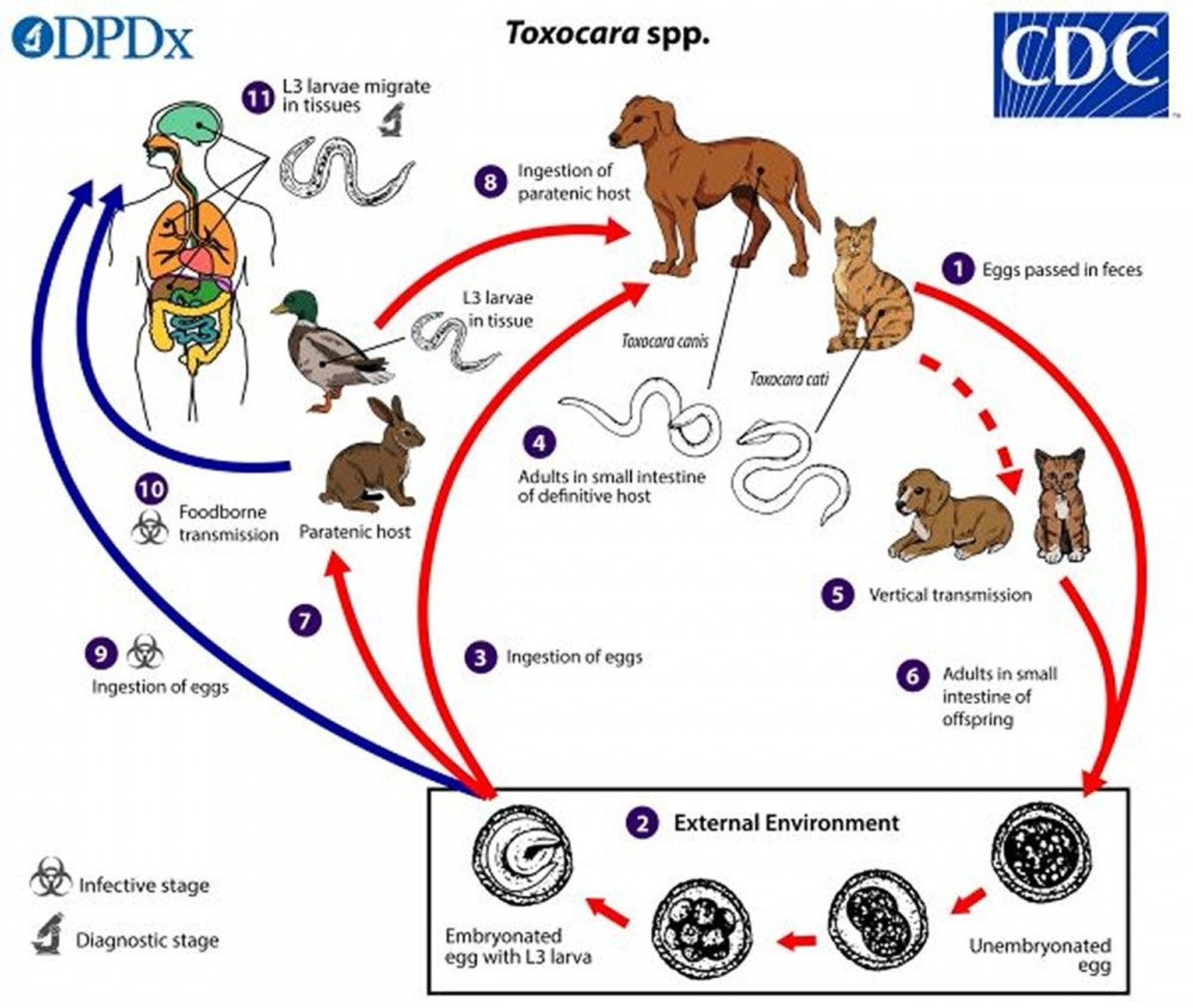
Normally, the life cycle involves dogs. People are infected only accidentally.
1. Infected animals excrete Toxocara eggs in their stool (feces).
2. After being excreted into the environment, the eggs mature and become able to cause infection.
3. A dog swallows eggs, which then hatch and release larvae.
4. The larvae penetrate the wall of the intestine. In younger dogs, the larvae travel through the lungs to the windpipe. They are coughed up, swallowed, and returned to the small intestine, where they mature into adult worms. There, adult female worms produce eggs. In older dogs, the larvae tend to form cysts in tissues.
5. If an infected dog becomes pregnant, larvae in cysts may be reactivated late in the pregnancy. The larvae can infect the puppies by crossing the placenta before birth or by entering the mother's milk to be consumed by nursing puppies.
6. Puppies are a common source of eggs in the environment.
7. Toxocara eggs may be ingested by other mammals, such as rabbits and ducks. In these mammals, the eggs hatch into larvae, which penetrate the wall of the intestine and travel to various tissues where they form cysts.
8. The life cycle is completed when dogs eat these mammals, and the larvae develop into egg-laying adult worms in the dog's small intestine.
9–10. People can be accidentally infected if they swallow eggs in contaminated soil or in undercooked meat of infected animals. After people swallow the eggs, the eggs hatch into larvae.
11. The larvae penetrate the wall of the intestine and travel to various tissues (such as the liver, heart, lungs, brain, muscle, or eyes). In people, the larvae do not develop into adult worms. However, they can damage tissues and cause inflammation.
Image from the Centers for Disease Control and Prevention, Global Health, Division of Parasitic Diseases and Malaria.
Symptoms of Toxocariasis
Toxocariasis symptoms may start within several weeks after eggs are ingested. They vary depending on the organ affected.
When larvae infect the soft internal organs (called visceral larva migrans), the most common symptoms are fever, cough or wheezing, and liver enlargement. Some people have a rash, spleen enlargement, or inflammation of the lungs. They may lose their appetite.
When larvae infect the eye (called ocular larva migrans), they typically cause no symptoms or very mild symptoms. Usually only 1 eye is affected. However, the eye may become inflamed, and vision may be impaired or lost.
Diagnosis of Toxocariasis
Blood tests to detect antibodies to the parasite
A doctor may suspect toxocariasis in a person who has an enlarged liver, inflammation of the lungs, a fever, and high levels of eosinophils (a type of white blood cell) in their blood.
The diagnosis of toxocariasis is confirmed by identifying Toxocara antibodies in the blood. (Antibodies are proteins produced by the immune system to help defend against infection, including by parasites.)
Rarely, a sample of the liver or another infected tissue is obtained and examined (biopsied) for evidence of larvae or inflammation resulting from their presence.
Treatment of Toxocariasis
If needed, medications used to eliminate worms (anthelmintics) and sometimes corticosteroids
Sometimes laser photocoagulation or other surgery when an eye is infected
In most people with toxocariasis, the infection goes away on its own, and treatment is unnecessary.
When symptoms are moderate to severe, doctors give albendazole or mebendazole. These medications are known as anthelmintics, and they are taken by mouth.
When symptoms are severe, doctors may give corticosteroids to reduce inflammation.
People who have ocular larva migrans should be treated by an eye specialist. They are given 2 types of corticosteroids: 1 that is taken by mouth and 1 that is applied directly to the infected eye. Even with appropriate care, most people have some loss of vision.
Occasionally, laser photocoagulation (in which a laser beam is aimed into the back of the eye at the retina) is used to kill larvae in the eyes. Sometimes, doctors use cold probes (cryosurgery) to freeze areas of the eye or do other types of eye surgery to fix problems caused by toxocariasis.
Prevention of Toxocariasis
Prevention involves regularly doing the following:
Treating dogs for roundworms and treating cats for roundworms (deworming)
Washing hands with soap and water after playing with pets or other animals, after disposing of pet waste, after outdoor activities, and before handling food or eating
Covering sandboxes when not in use to prevent animals from defecating in them
Telling children to not eat dirt, soil, or clay
Drug Information for the Topic