Syphilis is a sexually transmitted infection caused by the bacteria Treponema pallidum. It occurs in 3 stages of symptoms separated by periods of no symptoms.
In the first stage, syphilis begins with a painless sore at the infection site and, in the second stage, causes a rash, fever, fatigue, headache, and loss of appetite.
If untreated, the third stage of syphilis can damage the aorta, brain, spinal cord, and other organs.
Doctors usually do 2 types of blood tests to confirm that a person has syphilis.
Treatment is with penicillin, which can eliminate the infection.
Using condoms during sex can help prevent passing syphilis and other sexually transmitted infections from one person to another.
(See also Overview of Sexually Transmitted Infections.)
The number of cases of syphilis continues to increase in the United States. In 2023, more than 200,000 cases of syphilis were reported. For comparison, in 2000, about 6,000 cases were reported. The majority of cases of primary and secondary syphilis occurred in men, and one-third of these cases were in men who have sex with men. There also has been an increase in babies being born with syphilis (congenital syphilis).
Worldwide, about 70 million people have syphilis.
People with syphilis often have other sexually transmitted infections (STIs).
Transmission of Syphilis
Syphilis occurs in 3 stages:
Primary syphilis
Secondary syphilis
Tertiary syphilis
The stages are separated by long periods when no symptoms occur. These stages are called latent stages.
Syphilis is highly contagious during the primary and secondary stages. It also may be contagious at the start of a latent stage.
Infection is usually spread through sexual contact. A single sexual encounter with a person who has syphilis results in infection about 33% of the time, and this percentage is higher if the person has primary syphilis. The bacteria enter the body through mucous membranes, such as those of the vagina, penis, or mouth, or through the skin. Within hours, the bacteria reach nearby lymph nodes, then spread throughout the body through the bloodstream.
Syphilis can also be spread in other ways. It can cross the placenta and infect a fetus during pregnancy, causing birth defects and other problems.
People can sometimes get syphilis by contact with infected skin sores. However, the bacteria cannot survive long outside the human body so syphilis is not spread through contact with objects (such as toilet seats and door handles) that have been touched by a person with syphilis.
People who practice unsafe sex by having many sex partners or not using condoms correctly and regularly are at increased risk of getting and spreading syphilis.
People with HIV infection are at increased risk of getting syphilis.
Symptoms of Syphilis
Each stage of symptoms (primary, secondary, and tertiary) is progressively worse.
If not treated, syphilis can persist without symptoms for many years but may damage the aorta (the largest artery in the body) or brain, which may be fatal. Neurosyphilis affects the brain and spinal cord and can develop during any stage of syphilis.
If detected and treated early, syphilis can be cured before there is permanent damage.
Primary-stage syphilis
A painless sore called a chancre appears at the infection site. Typical sites include the following:
In men: Penis, anus, and rectum
In women: Vulva, cervix, rectum, and perineum
In both sexes: Lips and mouth
However, a chancre may appear anywhere, including the tongue, throat fingers, and other parts of the body. Usually only one chancre develops, but occasionally several develop. Symptoms usually start 3 to 4 weeks after infection but may start from 1 to 13 weeks later.
The chancre begins as a small red, raised area, which soon turns into a relatively painless, raised, firm open sore. The chancre does not bleed and is hard to the touch. The chancre may also develop a yellow or gray color over time. Nearby lymph nodes usually swell and are also painless.
About half of infected women and one-third of infected men are unaware of the chancre because it causes few symptoms. Chancres in the rectum or mouth, usually occurring in men, are often unnoticed.

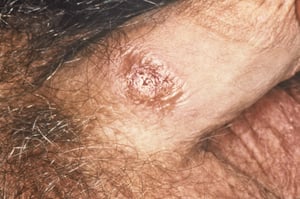
During the first (primary) stage of syphilis, a painless sore called a chancre may appear on or around the penis.
During the first (primary) stage of syphilis, a painless sore called a chancre may appear on or around the penis.
Image courtesy of Drs. Gavin Hart and N. J. Flumara via the Public Health Image Library of the Centers for Disease Control and Prevention.

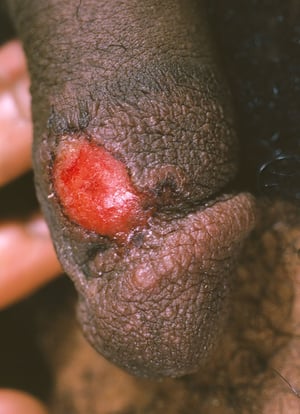
During the first (primary) stage of syphilis, a painless sore called a chancre may appear on or around the penis.
During the first (primary) stage of syphilis, a painless sore called a chancre may appear on or around the penis.
Photo courtesy of Karen McKoy, MD.

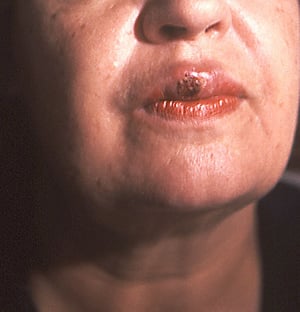
During the first (primary) stage of syphilis, a painless sore called a chancre may appear on or around the mouth.
During the first (primary) stage of syphilis, a painless sore called a chancre may appear on or around the mouth.
Image courtesy of the Public Health Image Library of the Centers for Disease Control and Prevention.
During the first (primary) stage of syphilis, a painless sore called a chancre may appear on or around the penis.
During the first (primary) stage of syphilis, a painless sore called a chancre may appear on or around the penis.
Image courtesy of Drs. Gavin Hart and N. J. Flumara via the Public Health Image Library of the Centers for Disease Control and Prevention.
During the first (primary) stage of syphilis, a painless sore called a chancre may appear on or around the penis.
During the first (primary) stage of syphilis, a painless sore called a chancre may appear on or around the penis.
Photo courtesy of Karen McKoy, MD.
During the first (primary) stage of syphilis, a painless sore called a chancre may appear on or around the mouth.
During the first (primary) stage of syphilis, a painless sore called a chancre may appear on or around the mouth.
Image courtesy of the Public Health Image Library of the Centers for Disease Control and Prevention.
The chancre usually heals in 3 to 12 weeks. Then, people appear to be completely healthy.
Secondary-stage syphilis
The bacteria spread in the bloodstream, causing a widespread sores on the mouth and skin, swollen lymph nodes, and, less commonly, symptoms in other organs. Symptoms typically appear 6 to 12 weeks after the chancre appears. Some infected people still have a chancre at this time. Secondary-stage syphilis commonly causes fever, fatigue, loss of appetite, and weight loss.
Most people develop sores and a rash, and any body surface can be affected. Even without treatment, the sores eventually go away in a few days to weeks, but they may last for months or return after healing. All sores eventually heal, usually with no scarring.
Syphilitic dermatitis is a rash caused by infection with syphilis that commonly appears on the palms and soles. The individual sores are round and scaly and may merge to form larger sores, but they typically do not itch or hurt. After the rash heals, the affected areas may be lighter or darker than normal. If syphilitic dermatitis develops on the scalp, hair may fall out in patches (alopecia areata).
Raised, flat-topped, smooth growths called condylomata lata may develop in moist areas of the skin, such as armpits, under the breasts, and around the anus. Colors vary by skin color, by where on the body the growths appear, and by how inflamed the surrounding skin is. They can be dull pink, white-gray, or tan. Condylomata lata that appear in the mouth or throat or on the penis, vulva, or rectum are usually round, raised, and often gray to white with a red border. These growths contain many syphilis bacteria and are very infectious. They are usually painless, unless they cause irritation or discomfort because of their location. They may break open and leak fluid.
Many people with secondary-stage syphilis have enlarged lymph nodes throughout the body. In some people, other organs are affected. The eyes may become inflamed. Bones and joints may ache. In a few people, infection of the liver (hepatitis) causes abdominal pain and jaundice (the skin and whites of the eyes turn yellow), and urine becomes dark. Some have headaches or problems with hearing, balance, or vision because the brain, inner ears, or eyes are infected.

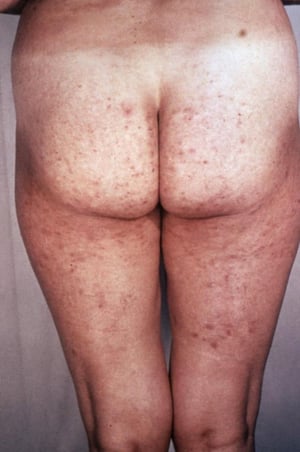
During the secondary stage of syphilis, a widespread rash may appear.
During the secondary stage of syphilis, a widespread rash may appear.
Image courtesy of the Public Health Image Library of the Centers for Disease Control and Prevention.

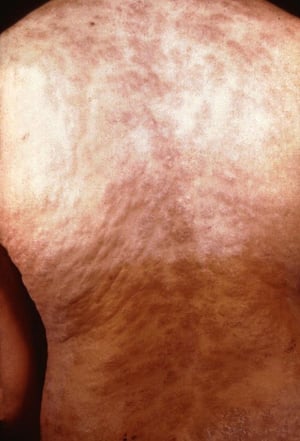
During the secondary stage of syphilis, a widespread rash may appear. The sores may be separate or may merge together, as shown here.
During the secondary stage of syphilis, a widespread rash may appear. The sores may be separate or may merge together,
Image courtesy of the Public Health Image Library of the Centers for Disease Control and Prevention.


During the secondary stage of syphilis, a rash called syphilitic dermatitis may appear. Unlike rashes caused by most other infections, syphilitic dermatitis commonly appears on the palms and soles.
During the secondary stage of syphilis, a rash called syphilitic dermatitis may appear. Unlike rashes caused by most ot
Image courtesy of the Public Health Image Library of the Centers for Disease Control and Prevention.

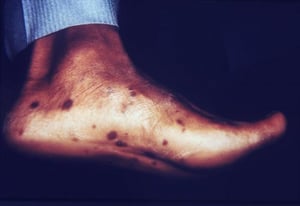
During the secondary stage of syphilis, a rash called syphilitic dermatitis may appear. Unlike rashes caused by most other infections, syphilitic dermatitis commonly appears on the palms and soles.
During the secondary stage of syphilis, a rash called syphilitic dermatitis may appear. Unlike rashes caused by most ot
Image courtesy of Susan Lindsley via the Public Health Image Library of the Centers for Disease Control and Prevention.
During the secondary stage of syphilis, a widespread rash may appear.
During the secondary stage of syphilis, a widespread rash may appear.
Image courtesy of the Public Health Image Library of the Centers for Disease Control and Prevention.
During the secondary stage of syphilis, a widespread rash may appear. The sores may be separate or may merge together, as shown here.
During the secondary stage of syphilis, a widespread rash may appear. The sores may be separate or may merge together,
Image courtesy of the Public Health Image Library of the Centers for Disease Control and Prevention.
During the secondary stage of syphilis, a rash called syphilitic dermatitis may appear. Unlike rashes caused by most other infections, syphilitic dermatitis commonly appears on the palms and soles.
During the secondary stage of syphilis, a rash called syphilitic dermatitis may appear. Unlike rashes caused by most ot
Image courtesy of the Public Health Image Library of the Centers for Disease Control and Prevention.
During the secondary stage of syphilis, a rash called syphilitic dermatitis may appear. Unlike rashes caused by most other infections, syphilitic dermatitis commonly appears on the palms and soles.
During the secondary stage of syphilis, a rash called syphilitic dermatitis may appear. Unlike rashes caused by most ot
Image courtesy of Susan Lindsley via the Public Health Image Library of the Centers for Disease Control and Prevention.
Latent-stage syphilis
A latent stage is a period when no symptoms occur and the infection is not active. The latent stage is classified as early latent if it occurs within 1 year of the initial infection or as late latent if it occurs more than 1 year after the initial infection. During this time, the bacteria are still present in the body, and tests for syphilis are positive.
The latent stage may last for years or may be permanent. People typically are not contagious during this stage, but, occasionally, sores may appear on the skin or mucous membranes in early latent syphilis. These sores are contagious, and people who come in contact with them can become infected. Latent syphilis can also be transmitted to a fetus via the placenta regardless of the presence of sores.
Tertiary (late) syphilis
Tertiary syphilis develops in about one-third of untreated people years to decades after the initial infection. Symptoms range from mild to devastating.
Tertiary syphilis has 3 main forms:
Benign tertiary syphilis
Cardiovascular syphilis
Neurosyphilis
Benign tertiary syphilis usually develops 3 to 10 years after the initial infection. Soft, rubbery growths called gummas appear on the skin, most commonly on the scalp, face, upper trunk, and legs. They also often develop in the liver or bones, but they can develop in virtually any organ. If on the skin, gummas may form an open sore. If untreated, gummas destroy the tissue around them. In bone, they usually cause deep, penetrating pain, which is usually worse at night. Gummas grow slowly, heal gradually, and leave scars.

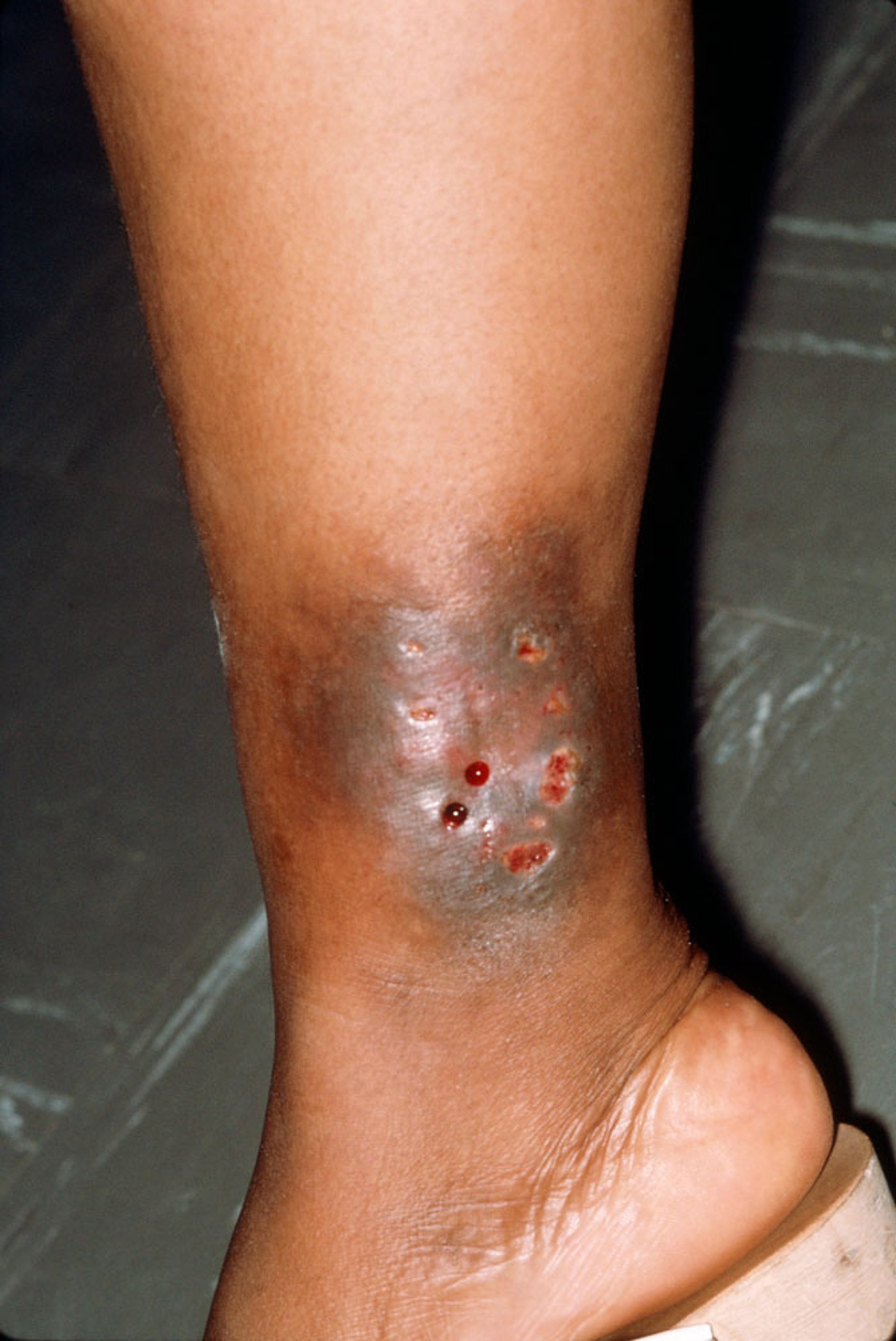
This photo shows a gumma on the leg of a person with tertiary (late) syphilis. A gumma is a mass of inflamed tissue.
BSIP, SIDEA REVUZ/SCIENCE PHOTO LIBRARY
Cardiovascular syphilis usually appears 10 to 25 years after the initial infection. The bacteria infect the blood vessels connected to the heart, including the aorta. The following may result:
The wall of the aorta may weaken, forming a bulge (aneurysm). The aneurysm may press on the windpipe or other structures in the chest, causing difficulty breathing, a cough, and hoarseness.
The valve leading from the heart to the aorta (aortic valve) may leak.
The arteries that carry blood to the heart (coronary arteries) may narrow.
These problems can cause chest pain or heart failure or may be fatal.
Neurosyphilis affects the brain and spinal cord and occurs in some people with untreated syphilis. It has the following forms:
Asymptomatic neurosyphilis: This form is a mild infection of the tissues that cover the brain and spinal cord (meninges), causing mild meningitis. Without treatment, it can cause symptoms including a headache, a stiff neck, and difficulty concentrating.
Meningovascular neurosyphilis: The arteries of the brain or spinal cord become inflamed, causing a chronic form of meningitis. Symptoms typically occur 5 to 10 years after the initial infection. At first, people may have a headache and a stiff neck. They may feel dizzy, have difficulty concentrating and remembering things, and have insomnia. Vision may be blurred. Muscles in the arms, shoulders, and eventually legs may become weak or even paralyzed. People may have difficulty controlling urination and bowel movements (incontinence). This form can also cause strokes.
Parenchymatous neurosyphilis: This form usually begins 15 to 20 years after the initial infection and does not affect people before they are in their 40s or 50s. The first symptoms are gradual changes in behavior. Symptoms may resemble those of a mental disorder or dementia. For example, people may become less careful about personal hygiene, and their moods may change frequently. They may become irritable and confused. They may have difficulty concentrating and remembering. They may have delusions of grandeur (that is, they believe that they are famous people or God or that they have magical powers). Tremors may occur in the mouth, tongue, outstretched hands, or whole body.
Tabes dorsalis: In this form, the spinal cord progressively deteriorates. It typically develops 20 to 30 years after the initial infection. Symptoms begin gradually, typically with an intense, stabbing pain in the back and legs that comes and goes irregularly. Occasionally, people have similar bouts of pain in the stomach, bladder, rectum, or throat. Walking becomes unsteady. Sensation in the feet is decreased or feels abnormal. People usually lose weight. Problems with vision may develop. Erectile dysfunction is common. Eventually, people have difficulty controlling urination (incontinence) and may become paralyzed.
Other symptoms
Syphilis can affect the eyes or ears at any stage of the infection.
Eye symptoms include watery eyes, blurred vision, eye pain, sensitivity to light, and loss of vision. If syphilis infects the eyes, the risk of developing neurosyphilis is increased.
If the ears are affected, people may have a ringing in their ears (tinnitus) or lose their hearing, or they may have vertigo and nystagmus (a rapid jerking movement of the eyes in one direction alternating with a slower drift back to the original position).
Joints may degenerate. The joints are not painful but are swollen, and movement is limited. This condition is called neurogenic arthropathy (Charcot joints).
Skin or joint damage resulting from trauma or pressure may go unnoticed because of nerve damage resulting from syphilis and leads to what are known as trophic lesions (trophic ulcers if on skin).
Diagnosis of Syphilis
Tests on a sample of blood, fluid from a chancre, or sometimes spinal fluid
Pregnant people should be screened for syphilis. Adolescents and adults who are not pregnant and do not have symptoms but who are at increased risk of infection also should be screened for syphilis.
Health care professionals suspect primary syphilis if people have a typical chancre. They suspect secondary syphilis if people have a typical rash on the palms and soles. Because syphilis can cause a wide range of symptoms during its various stages, doctors may check for syphilis when evaluating people with any of its possible symptoms, including problems with vision.
Laboratory tests are needed to confirm the diagnosis. Two types of blood tests are used:
A screening test, such as the Venereal Disease Research Laboratory (VDRL) test or the rapid plasma reagin (RPR) test, is usually done first. These tests are called nontreponemal tests because they do not directly detect the bacteria that cause syphilis (Treponema pallidum) or the antibodies produced in response to these bacteria. Screening tests are inexpensive and easy to do, but results can be negative for 3 to 6 weeks after the initial infection even though syphilis is present. Such results are called false-negative. If results of a screening test are negative but doctors think that primary syphilis is likely, the test may be repeated after 6 weeks. Screening test results are sometimes positive when syphilis is not present (false-positive) because another disorder has caused the test to be positive.
A confirmatory test must usually be done to confirm a positive screening test. These blood tests measure antibodies that are produced specifically in response to the bacteria that cause syphilis (sometimes called treponemal tests). Results of confirmatory tests may also be false-negative during the first few weeks after the initial infection and thus may need to be repeated.
Traditionally, screening tests are done first, and positive results are confirmed by a confirmatory (treponemal) test. Sometimes doctors do the treponemal test first. If results are positive, the screening rapid plasma reagin test is then done.
If test results are positive, doctors may ask the person about former sex partners, previous laboratory test results, and previous treatments to help determine whether the person currently has syphilis or has had it in the past.
Screening test results may slowly (over months to several years) become negative after successful treatment, but the confirmatory test results usually stay positive indefinitely.
In the primary or secondary stages, syphilis may also be diagnosed using darkfield microscopy. For this technique, a sample of fluid is taken from a chancre or lymph node and examined using a specially equipped light microscope. The bacteria appear bright against a dark background, making them easier to identify.
In the latent stage, the treponemal and nontreponemal test results are used to diagnose syphilis. Doctors also try to determine whether the stage is early latent syphilis or late latent syphilis based on results of their evaluation, including a thorough physical examination and review of previous test results.
In the tertiary or late stage, the diagnosis is based on symptoms and antibody test results. Depending on which symptoms are present, other tests are done. For example, a chest x-ray may be taken or another imaging test may be done to check for an aneurysm in the aorta.


If neurosyphilis is suspected, a spinal tap (lumbar puncture) is needed to obtain spinal fluid, which is tested for antibodies to the bacteria.
People with syphilis should also be tested for other STIs, including HIV infection. In people who have HIV and syphilis, the syphilis is more likely to progress faster, and neurosyphilis is more likely.
Treatment of Syphilis
Penicillin given by injection
Another antibiotic for people who are allergic to penicillin
Simultaneous treatment of sex partners
Penicillin given by injection into a muscle is the best antibiotic for all stages of syphilis.
For neurosyphilis and for infection of the eyes and inner ears, penicillin may be given by injection into a vein (intravenously) or into a muscle (intramuscularly) for 10 to 14 days (if it is given intramuscularly, it must be given with a medication called probenecid, which increases how much penicillin remains in the body). Then, another form of penicillin is given by injection into a muscle once a week for up to 3 weeks.
People who are allergic to penicillin may be given other antibiotics such as doxycycline (taken by mouth for 14 days or sometimes for 28 days). People who cannot take doxycycline may be given azithromycin (as a single dose by mouth). However, in some parts of the world, syphilis is becoming increasingly resistant to azithromycin. Pregnant people who are allergic to penicillin are hospitalized and desensitized to penicillin so that they can take penicillin.
Treatment of sex partners
Because people with primary, secondary, and even early-latent syphilis can pass the infection to others, they must avoid sexual contact until they and their sex partners have completed treatment.
If a person is diagnosed with syphilis, all of the person's sex partners are tested for syphilis. The sex partners are treated in the following circumstances:
They had sexual contact with the infected person during the 90 days before the diagnosis was made, even if their test results are negative.
They had sexual contact with the infected person more than 90 days before the diagnosis was made but only if their test results are not immediately available and their return for a follow-up visit is uncertain. If their test results are negative, no treatment is needed. If test results are positive, they are treated.
Jarisch-Herxheimer reaction
People with primary or secondary syphilis may have a reaction 6 to 12 hours after the first treatment. This reaction, called a Jarisch-Herxheimer reaction, causes fever, headache, sweating, shaking chills, and a temporary worsening of the sores caused by syphilis. Doctors sometimes mistake this reaction for an allergic reaction to medication.
Symptoms of this reaction usually subside within 24 hours and rarely cause permanent damage. However, rarely, people with neurosyphilis have seizures or a stroke.
After treatment
After treatment, examinations and blood tests are done periodically until no infection is detected.
If treatment of primary, secondary, or latent syphilis is successful, most people have no more symptoms. But treatment of tertiary syphilis cannot reverse damage done to organs, such as the brain or aorta.
People who have been cured of syphilis do not become immune to it and can be infected again.
Prevention of Syphilis
People can do the following to help reduce their risk of syphilis and other STIs:
Practice safer sex, including using a condom every time for oral, anal, or genital sex.
Reduce the number of sex partners and not have high-risk sex partners (people with many sex partners or who do not practice safer sex).
Practice mutual monogamy or abstinence.
Vaccinate (available for some STIs).
Seek prompt diagnosis and treatment to prevent spread to other people.
Identify sexual contacts if infected with an STI for the purposes of counseling and treatment.
Did You Know...
|
More Information
The following English-language resource may be useful. Please note that The Manual is not responsible for the content of this resource.
Centers for Disease Control and Prevention (CDC): About Syphilis
Drug Information for the Topic