The temporal bone (the skull bone containing part of the ear canal, the middle ear, and the inner ear) can be fractured, usually by a blow to the head.
A temporal bone fracture may cause facial paralysis, hearing loss, bruising behind the ear, and bleeding from the ear.
Doctors use computed tomography (CT) to diagnose temporal bone fractures.
Treatment, sometimes including surgery, is needed if the fracture causes problems.
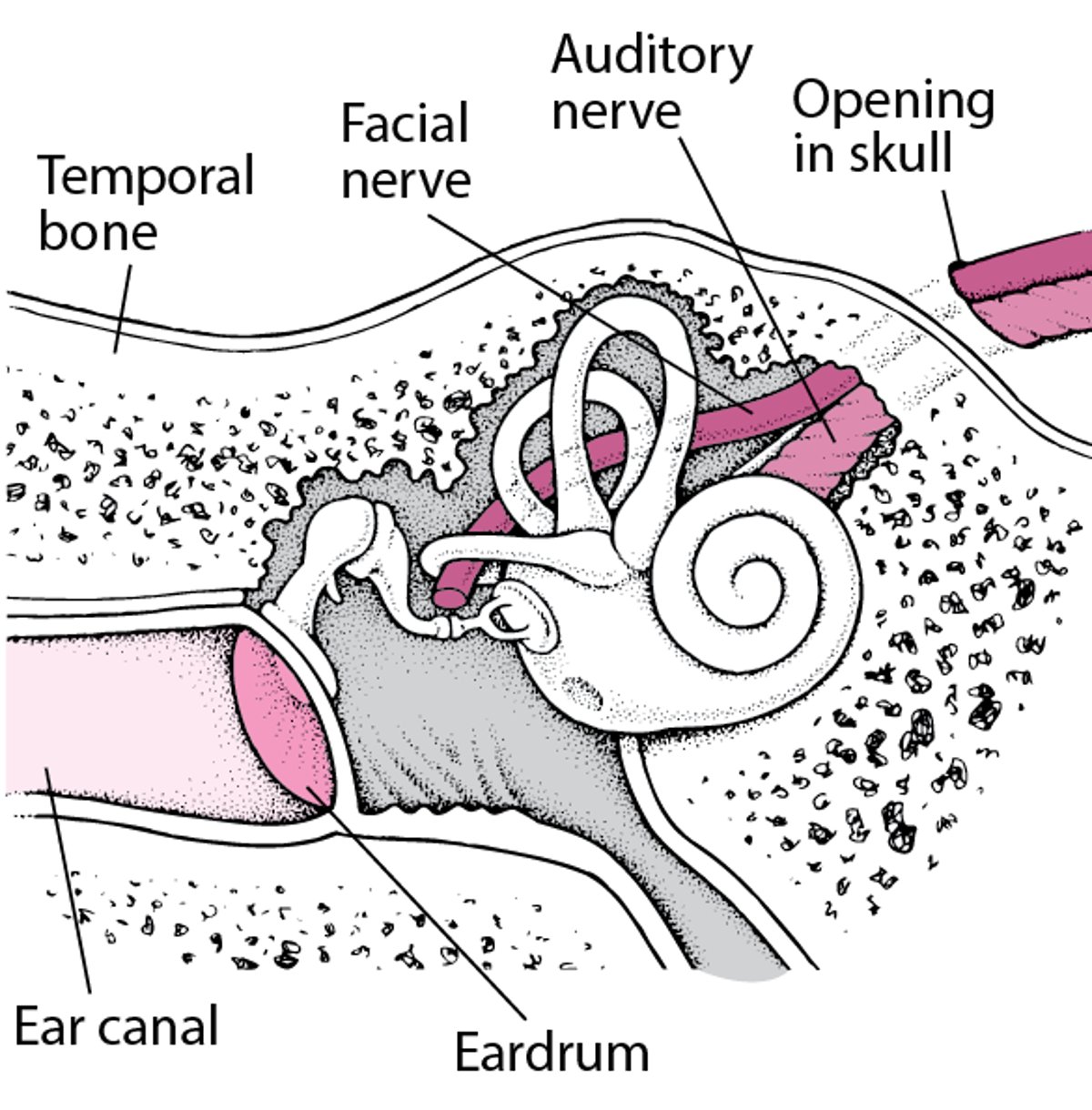
Temporal bone fractures can cause various injuries to the middle and inner ear. Injuries include rupture of the eardrum and damage to the ossicles (the chain of small bones that connects the eardrum to the inner ear), the cochlea (the organ of hearing), the vestibular apparatus (the organ of balance in the inner ear), or the nerve that controls muscles of the face (facial nerve).
Temporal Bone
The temporal bone is located on the sides and base of the skull. It surrounds and protects the ear canal, middle ear, and inner ear. |

Symptoms of Temporal Bone Fracture
People have pain and often:
Bleeding from the ear
Bleeding behind the eardrum
Bruising of the skin behind the ear
Other symptoms and complications vary depending on the exact location of the fracture.
Some people have facial paralysis on the side of the fracture. Facial paralysis can develop immediately or after some time and can be mild or severe.
Another symptom is severe hearing loss. Hearing loss may result from damage to the 3 tiny bones (called the ossicles) that connect the eardrum to the inner ear or from damage to the cochlea or the nerve that leads to the cochlea.
If the vestibular apparatus is damaged, people may feel as if they or their surroundings are spinning (vertigo) or have problems with balance.
Sometimes, fluid from around the brain and spinal cord (cerebrospinal fluid) leaks from the brain through the fracture and appears as clear fluid draining from the ear or nose. Leakage of this fluid indicates that the brain is exposed to possibly serious infection from bacteria in the ear canal.

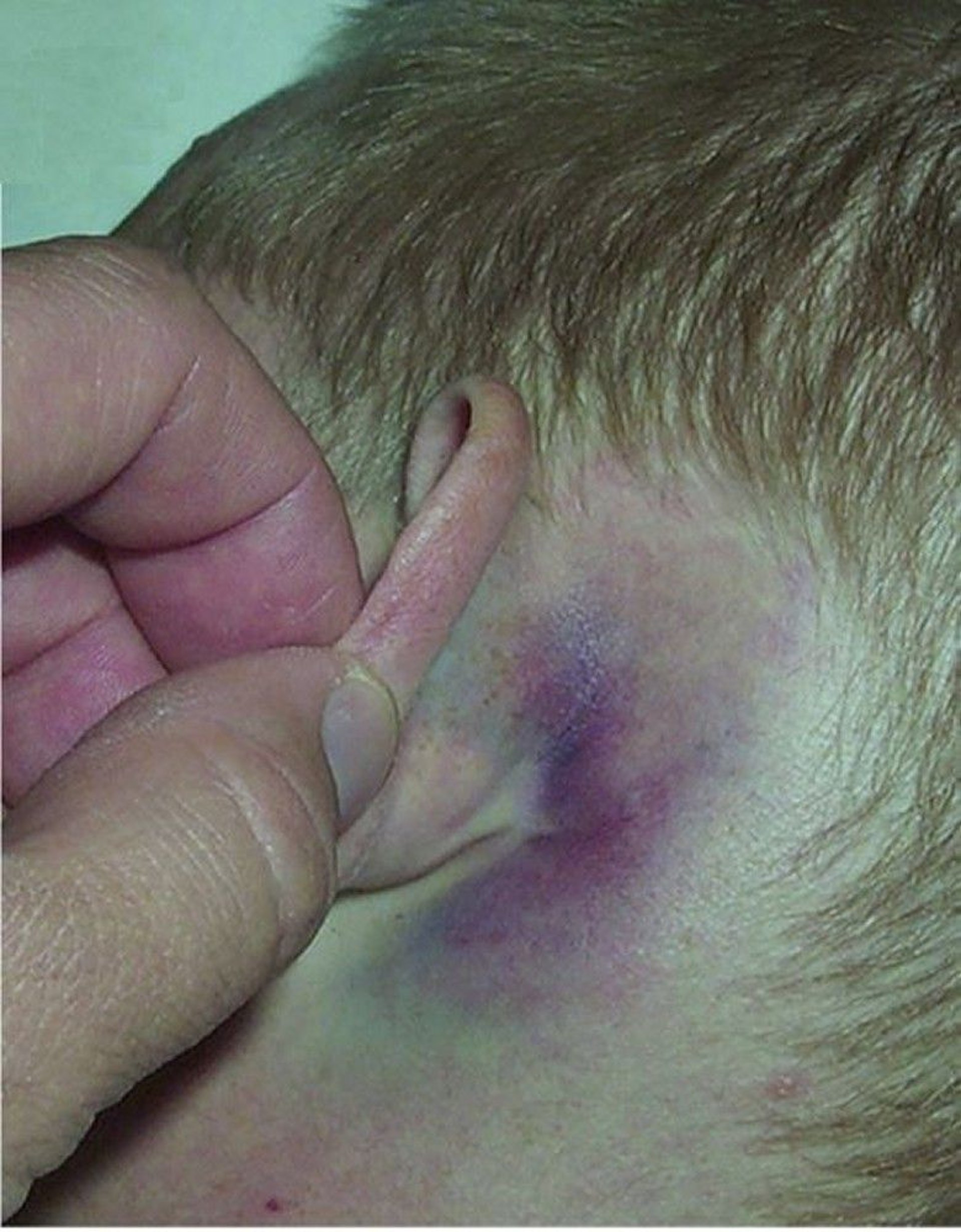
This photo shows bruising behind the ear resulting from a temporal bone fracture.
© Springer Science+Business Media
Diagnosis of Temporal Bone Fracture
Computed tomography (CT)
Testing for damage to facial nerves and hearing
Diagnosis is made with computed tomography (CT).
Doctors also may test the person's hearing and whether the face is paralyzed. If problems are found, further testing is usually done, such as detailed hearing testing by an audiologist or electrodiagnostic testing of the nerve responsible for controlling facial movement.
Treatment of Temporal Bone Fracture
Treatment of symptoms as necessary
Treatment is necessary only if the fracture causes problems.
Treatment of facial paralysis
If facial paralysis is immediate and severe, surgery may be needed. If paralysis is mild or delayed, sometimes no treatment is needed and the nerve injury resolves on its own. If it does not resolve, further treatment may be needed.
Treatment of hearing loss
Hearing loss often resolves without treatment. If hearing loss stems from damage to the ossicles, the ossicles are repaired surgically. If other types of hearing loss don't improve, hearing aids or cochlear implants may be needed.
Treatment of vertigo
Vertigo may resolve without treatment. If it does not, a specialist (such as a physical therapist) can provide exercises to help with balance.
Treatment of cerebrospinal fluid leakage
Leakage of cerebrospinal fluid may resolve without treatment. However, there is a risk of serious infection developing. Medical attention should be sought if fever, new or worsening severe headache, difficulty looking directly at a light (photophobia), severe neck stiffness, or confusion or other neurologic symptoms develop, or if the fluid leak from the ears does not resolved. If the leak does not stop on its own within a few days, surgery or insertion of a drain near the spinal cord in the lower back (lumbar drain) may be needed to prevent infection.