A spinal cord injury is damage to the bundle of cells and nerves that carry incoming and outgoing messages between the brain and the rest of the body.
Most spinal cord injuries in children younger than 12 years result from motor vehicle crashes and falls; spinal cord injuries in older children are most likely to result from motor vehicle crashes, falls, sports, or firearms.
A child with a spinal cord injury may have severe symptoms (such as paralysis), usually immediately.
A child with a spinal cord injury may only have mild symptoms (such as brief tingling or weakness or shooting pains down the spine or arms and legs), and those symptoms may be delayed up to 4 days.
Diagnosis of a spinal cord injury begins with an x-ray, but computed tomography (CT) and magnetic resonance imaging (MRI) are usually also needed.
Treatment involves mobilization and supportive care, with rehabilitation and other treatments as needed.
(See also Injuries of the Spinal Cord and Vertebrae.)
The spinal cord is a long, fragile tubelike structure that begins at the end of the brain stem and continues down to the lower part of the spine. The spinal cord consists of nerves that carry incoming and outgoing messages between the brain and the rest of the body. (See also Spinal Cord.)
Although children younger than 5 years have the lowest rate of spinal cord injuries, such injuries are not rare. Most spinal injuries in children occur in the neck area.
Spinal cord injury that occurs without visible bone abnormalities or disruption of the spinal column on x-ray or CT scan is called "spinal cord injury without radiologic abnormality" (SCIWORA). This type of injury occurs almost exclusively in children and often occurs in the neck area. (SCIWORA was originally described in the 1980s, when magnetic resonance imaging [MRI] scanners were scarcely used; currently MRI can show the source of injury in most cases of SCIWORA.)
Causes of Spinal Cord Injury in Children
Spinal cord injury can be caused by pulling or stretching of the spinal cord, pressure on the nerves or spinal cord (spinal cord impingement), spinal cord concussion (similar to a brain concussion), and injury to the blood vessels.
In children younger than 12 years, neck spinal injuries are most commonly caused by motor vehicle crashes and falls. Spinal cord injuries in older children are most likely to result from motor vehicle crashes, falls, sports, or firearms.
Compared with adults, the structures protecting the spinal cord in children (including the vertebrae) are more flexible. Because these structures are so flexible, the spinal cord itself can be more easily stretched, torn, compressed, or otherwise damaged when the neck is injured. Thus, the spinal cord can be more likely to be damaged even when the vertebrae themselves are not damaged.
Symptoms of Spinal Cord Injury in Children
Children with spinal cord injury may have symptoms such as tingling and weakness. Children may also have shooting pains down the spine or the arms or legs. Onset of symptoms, such as weakness, numbness, other nerve damage, or even complete paralysis may be delayed from 30 minutes to 4 days after injury, making it more difficult for doctors to diagnose spinal cord injury. Additionally, children may have spinal cord injuries in which nerves malfunction only temporarily and briefly and thus symptoms are temporary.
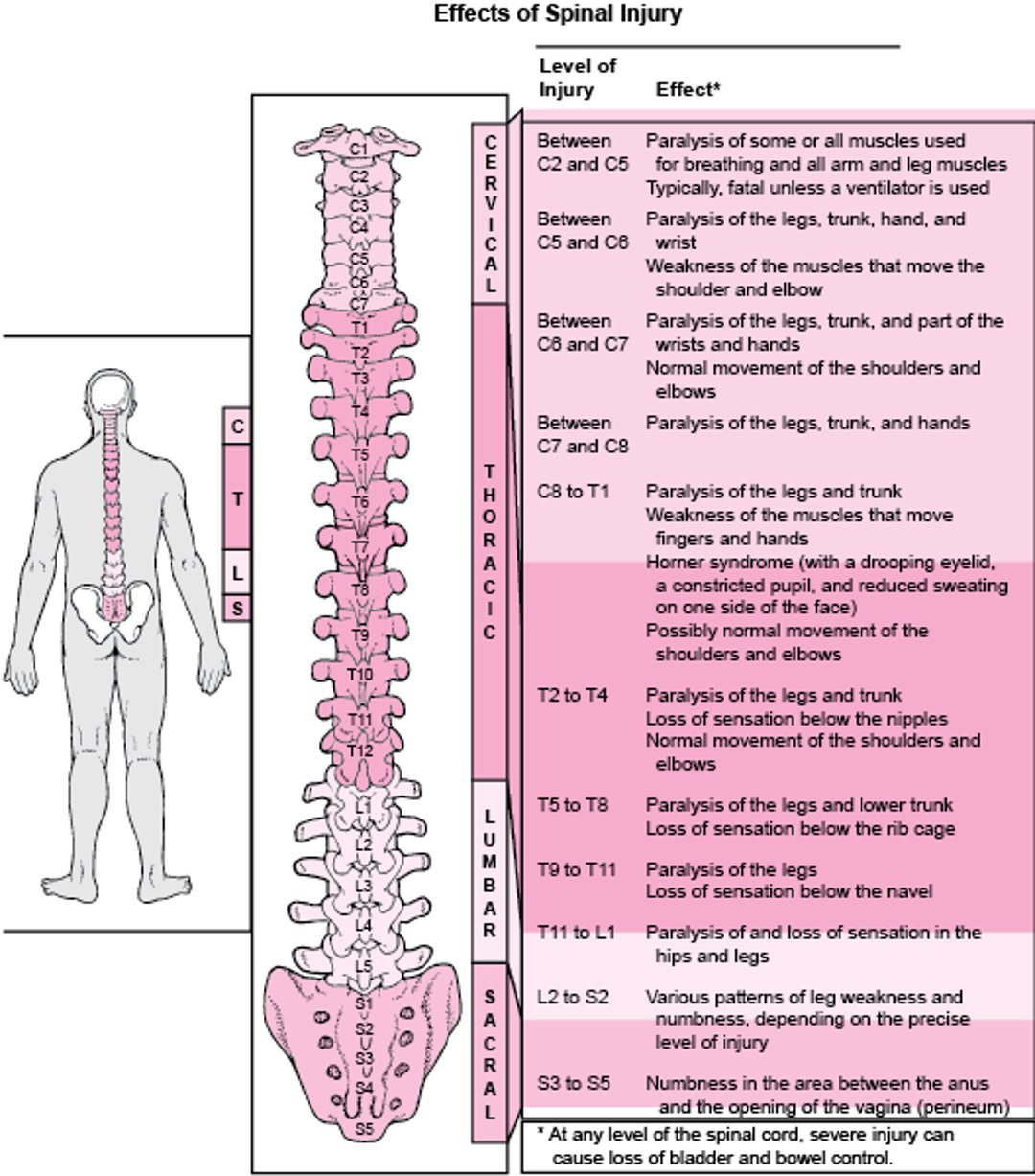
Where Is the Spinal Cord Damaged?

Diagnosis of Spinal Cord Injury in Children
X-rays
Usually computed tomography and magnetic resonance imaging
Doctors are alert for spinal cord injury in any child who has been in a motor vehicle crash, has fallen from a height greater than about 9 feet (3 meters), or has had a submersion (for example, diving) injury. Suspicion is higher in children who had any symptoms suggestive of nerve injury, such as tingling, weakness, or shooting pains.
If a fracture, dislocation, or partial dislocation is suspected based on x-ray findings or because of the way the injury occurred, computed tomography (CT) is usually done.
In children with clear or likely signs of weakness or sensory loss, magnetic resonance imaging (MRI) is usually done without first doing an x-ray or computed tomography (CT). (Unlike x-ray and CT, MRI does not expose the child to radiation.)
Treatment of Spinal Cord Injury in Children
Immobilization
Supportive care
Rehabilitation
Sometimes surgery and postsurgical rehabilitation
Children with a spinal injury should be transferred to a pediatric trauma center.
Treatment is similar to treatment of spinal cord injury in adults, including immobilization and support for breathing and circulation as needed. Surgery is less frequently needed in children than adults with spinal cord injury
Long-term rehabilitation and other treatment are needed.