People with late-stage HIV (formerly called AIDS) tend to develop certain unusual infections because their immune system is weakened. Such infections are called opportunistic infections because they take advantage of a weakened immune system. These infections can cause the bile ducts to narrow—a disorder called late-stage HIV-related cholangiopathy. Usually, the ducts eventually become inflamed and scarred.
Diagnosis is by endoscopic retrograde cholangiopancreatography (ERCP) or ultrasound.
Treatment includes antiretroviral medications, surgery, and sometimes antibiotics.
Bile is a fluid that is produced by the liver and aids in digestion. Bile is transported through small tubes (bile ducts) that carry bile through the liver and then from the liver to the gallbladder and to the small intestine. (See also Overview of Gallbladder and Bile Duct Disorders and figure .)
Before medications to treat HIV infection (antiretroviral therapy) were widely used, HIV-related cholangiopathy developed in about one-fourth of people with late-stage HIV. The most common opportunistic infection involved in this condition is Cryptosporidium parvum.
The disorder causes pain in the upper right and upper middle parts of the abdomen. If the infection affects the small intestine, people also have diarrhea. A few people have fever and jaundice (a yellowish discoloration of the skin and whites of the eyes).

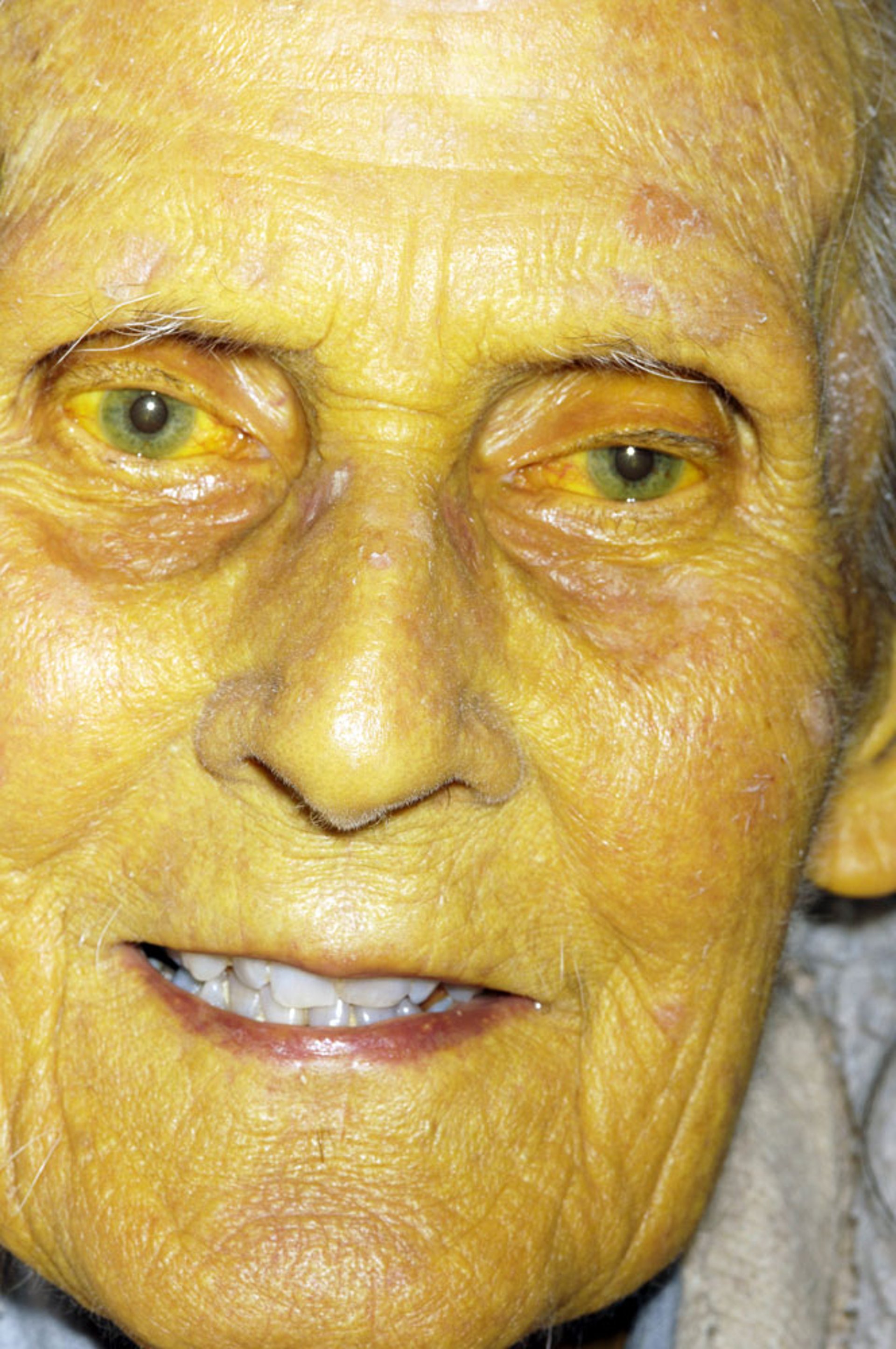
This photo shows yellowing of the eyes and skin (jaundice).
DR P. MARAZZI/SCIENCE PHOTO LIBRARY
Diagnosis of Narrowing of the Bile Ducts Due to Late-Stage HIV
Ultrasound and endoscopic retrograde cholangiopancreatography (ERCP) or magnetic resonance cholangiopancreatography (MRCP)
Blood tests
Ultrasound is typically the first step in the diagnosis. This is usually followed by a magnetic resonance cholangiopancreatography (MRCP) or endoscopic retrograde cholangiopancreatography (ERCP), both of which offer the ability to view the bile ducts more accurately than ultrasound. MRCP is noninvasive so has less risk than ERCP. Endoscopic retrograde cholangiopancreatography enables doctors to take a tissue sample and identify the organism causing the infection, and, if necessary, widen (dilate) the narrowed bile ducts and thus relieve symptoms.
For ERCP, a viewing tube (endoscope) with surgical attachments is passed through the mouth, down the esophagus, through the stomach, and into the small intestine (see figure ). A thin catheter is passed through the endoscope, through the ring-shaped muscle between the common bile and pancreatic ducts and small intestine (sphincter of Oddi), and up into the common bile duct. A radiopaque contrast agent, which is visible on x-rays, is then injected through the catheter into the bile ducts, and x-rays are taken to detect any abnormalities.
Blood tests to determine how well the liver is functioning and whether it is inflamed (liver tests) are usually also done. The results can support the diagnosis.
Treatment of Narrowing of the Bile Ducts Due to Late-Stage HIV
Antiretroviral medications
Antibiotics
Endoscopic procedures (ERCP)
Sometimes ursodeoxycholic acid
Antiretroviral medication to treat late-stage HIV can help restore the immune system to normal function. This can enable the body to fight off current infections (including the one causing gallbladder narrowing), and prevent future opportunistic infections.
During endoscopic retrograde cholangiopancreatography (ERCP), a surgical instrument is passed through the endoscope and used to cut the sphincter of Oddi—a procedure called endoscopic sphincterotomy. Cutting the sphincter of Oddi allows bile to pass into the small intestine. This procedure helps relieve pain, jaundice, and inflammation. If only one part of a duct is narrowed, a tube to keep the ducts open (stent) is inserted temporarily.
The source of infection, if it is identified, is also treated with antibiotics. The medication ursodeoxycholic acid (ursodiol) may have a role in treating abnormalities of the bile ducts within the liver, and to encourage the normal flow of bile.
More Information
The following English-language resources may be useful. Please note that The Manual is not responsible for the content of these resources.
International Foundation for Gastrointestinal Disorders (IFFGD): A resource that helps people with gastrointestinal disorders manage their health.
National Institute of Diabetes and Digestive and Kidney Diseases (NIDDK): Comprehensive information on how the digestive system works and links to related topics, such as research and treatment options.