Obsessive-compulsive disorder is characterized by obsessions, compulsions, or both. Obsessions are recurring, persistent, unwanted, anxiety-provoking, intrusive ideas, images, or urges. Compulsions (also called rituals) are certain actions or mental acts that people feel driven to perform repeatedly, to try to lessen or prevent the anxiety caused by the obsessions.
Many obsessive-compulsive thoughts and behaviors are related to concerns about harm or risk.
Doctors diagnose the disorder when a person has obsessions, compulsions, or both.
Treatment may include exposure therapy (with prevention of compulsive rituals) and certain antidepressants (selective serotonin reuptake inhibitors or clomipramine).
Obsessive-compulsive disorder (OCD) is slightly more common among women than men and affects about 1 to 3% of the population. On average, OCD begins at about age 19 to 20. (See also Obsessive-Compulsive Disorder in Children and Adolescents.) Many people with OCD have had or have a tic disorder.
OCD differs from psychotic disorders, which are characterized by loss of contact with reality, although in a very small minority of OCD cases there is no insight. OCD also differs from obsessive-compulsive personality disorder, although people with these disorders may have some of the same characteristics, such as being orderly, reliable, or perfectionistic.

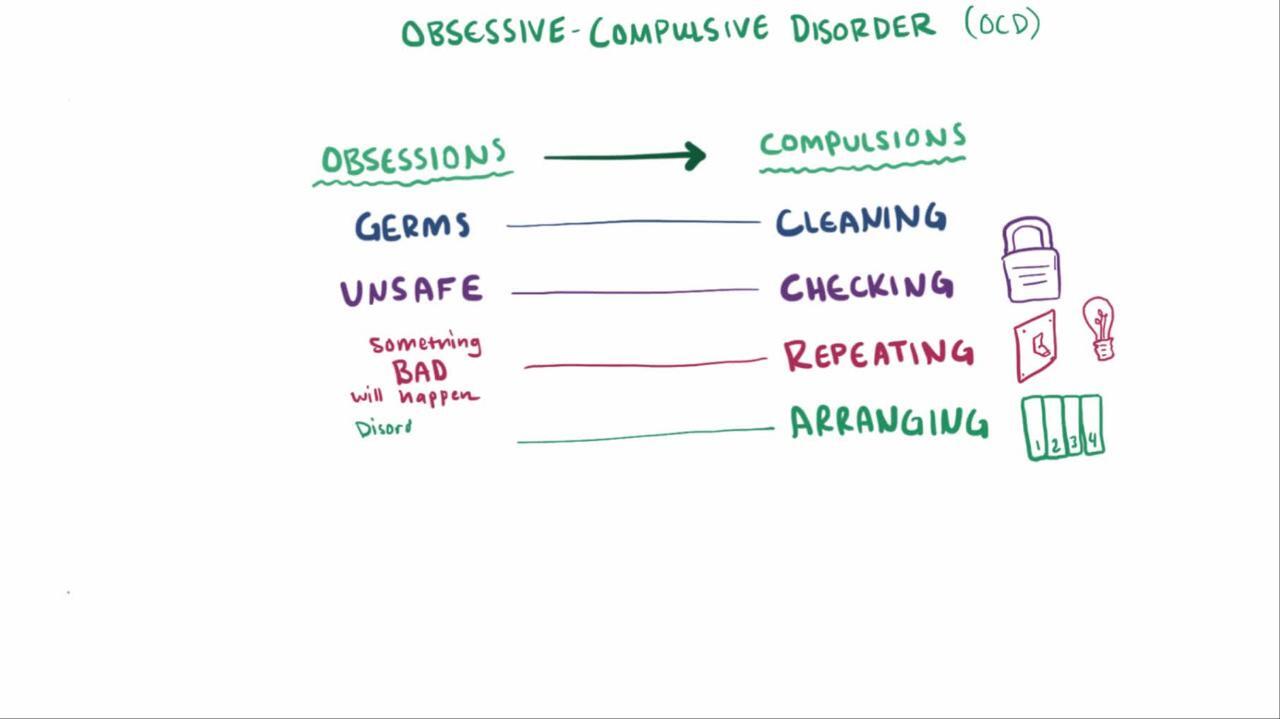
Symptoms of Obsessive-Compulsive Disorder
People with obsessive-compulsive disorder (OCD) have obsessions—thoughts, images, or urges that occur over and over even though people do not want them to. These obsessions intrude even when people are thinking about and doing other things. Also, obsessions usually cause great distress or anxiety.
Common obsessions include the following:
Concerns about contamination (for example, worrying that touching doorknobs will cause disease)
Doubts (for example, worrying that the front door was not locked)
Concern that items are not perfectly lined up or even
Forbidden or taboo thoughts (for example, aggressive or sexual obsessions)
Harm (to self or others)
Other themes may also occur. Because the obsessions are not pleasurable, people often try to ignore and/or control them.
Most people with OCD have both obsessions and compulsions. Compulsions (also called rituals) are one way people respond to their obsessions. For example, they may feel driven to do something—repetitive, purposeful, and intentional—to try to prevent or relieve the anxiety caused by their obsessions.

Common compulsions include the following:
Washing or cleaning to be rid of contamination
Checking to allay doubt (for example, checking many times to make sure a door is locked)
Counting (for example, repeating an action a certain number of times)
Ordering (for example, arranging tableware or workspace items in a specific pattern)
Most rituals, such as excessive handwashing or repeated checking to make sure a door has been locked, can be observed. Other rituals, such as repetitive counting in one's mind, cannot be observed.
Rituals may have to be done in a precise way according to rigid rules. The rituals may or may not be logically connected to the obsession. When compulsions are logically connected to the obsession (for example, showering to avoid being dirty or checking the stove to prevent fire), they are clearly excessive compared with normal behavior. For example, people may shower for hours each day or always check the stove 30 times before they leave the house. For OCD to be diagnosed, the obsessions and rituals must be time-consuming (that is to say, they must last for at least an hour in total each day). People may spend many hours each day on them. These compulsions and obsessions may cause so much distress or interfere with functioning so much that people become incapacitated.
Most people with OCD are at least somewhat aware that their obsessive thoughts do not reflect actual risks or reality and that their compulsive behaviors are excessive. However, a few people are convinced that their obsessions are well-founded and that their compulsions are reasonable.
Most people with OCD are also aware that their compulsive behaviors are excessive. Thus, they may perform their rituals secretly, even though the rituals may occupy several hours each day.
As a result of OCD symptoms, relationships may deteriorate, and people with OCD may do less well in school, at work, or in other aspects of daily functioning.
Many people with OCD also have other mental health disorders. Fifty-one (51) to 76% of people with OCD also have a lifetime diagnosis of an anxiety disorder, about 41% have a lifetime diagnosis of major depression and 23 to 32% have obsessive-compulsive personality disorder.
Up to 50% of people with OCD have suicidal thoughts at some point, and about 15% attempt suicide. The risk of a suicide attempt is higher if people also have major depression (see Suicidal Behavior).
Diagnosis of Obsessive-Compulsive Disorder
A doctor's evaluation based on specific psychiatric diagnostic criteria
A physical examination and medical tests are sometimes needed to evaluate for physical disorders
Doctors diagnose obsessive-compulsive disorder based on symptoms: the presence of obsessions, compulsions, or both. The obsessions or compulsions must be at least 1 of the following:
Time-consuming
Cause significant distress or interfere with the person's ability to function
The diagnosis may also include the following:
To what extent the person is aware that the belief(s) underlying their obsessive thoughts (for example, that they will get cancer if they touch an ashtray) is inaccurate (level of "insight").
If the person also has or had a tic disorder
Treatment of Obsessive-Compulsive Disorder
Cognitive-behavioral therapy (CBT) that includes exposure and response (ritual) prevention
Certain antidepressants
Either CBT or medication is often tried first. These treatments may be combined if the person responds poorly to either initial therapy. Many experts believe that a combination of exposure and response prevention therapy along with medication is the best treatment, especially for more severe symptoms.
CBT is often effective in treating obsessive-compulsive disorder: exposure and ritual (response) prevention therapy, a type of CBT, is often effective. Exposure therapy involves gradually and repeatedly exposing people to whatever situations or people trigger obsessions, rituals, or discomfort while asking them not to perform the compulsive ritual (ritual prevention therapy). Discomfort or anxiety gradually diminishes during repeated exposure as people learn that rituals are unnecessary for decreasing discomfort. The improvement usually persists for years, perhaps because people who have mastered this approach are able to continue to practice it after formal treatment has ended. Cognitive therapy techniques, which help a person to identify and change unhelpful thought patterns, are often added to exposure and ritual prevention therapy.
Certain antidepressant medications are often effective: selective serotonin reuptake inhibitors (SSRIs) (for example, fluoxetine) and clomipramine (an older type of antidepressant that also works on the brain chemical serotonin) are often effective. An SSRI is usually tried before clomipramine because the SSRIs tend to have fewer potential side effects, and higher doses than are commonly used for the treatment of depression may be needed. People who do not respond to these medications may be given other types of medications that work differently.
Psychodynamic psychotherapy (which emphasizes the identification of unconscious patterns in current thoughts, feelings, and behaviors) and psychoanalysis have generally not been effective for people with obsessive-compulsive disorder.
Drug Information for the Topic