Doctors can identify many skin disorders by examining the skin. A full skin examination includes the scalp, nails, and mucous membranes of the eyes and mouth. Sometimes doctors use a hand-held lens or a dermatoscope (which includes a magnifying lens and a built-in light) to better see the areas of concern.
Doctors make note of the size, shape, color, and location of the mark, rash, or growth and determine whether other symptoms are present or missing. Doctors then check other areas of the skin to determine whether and where the problem has spread, even though the person may have noticed the problem on only a small area of skin.

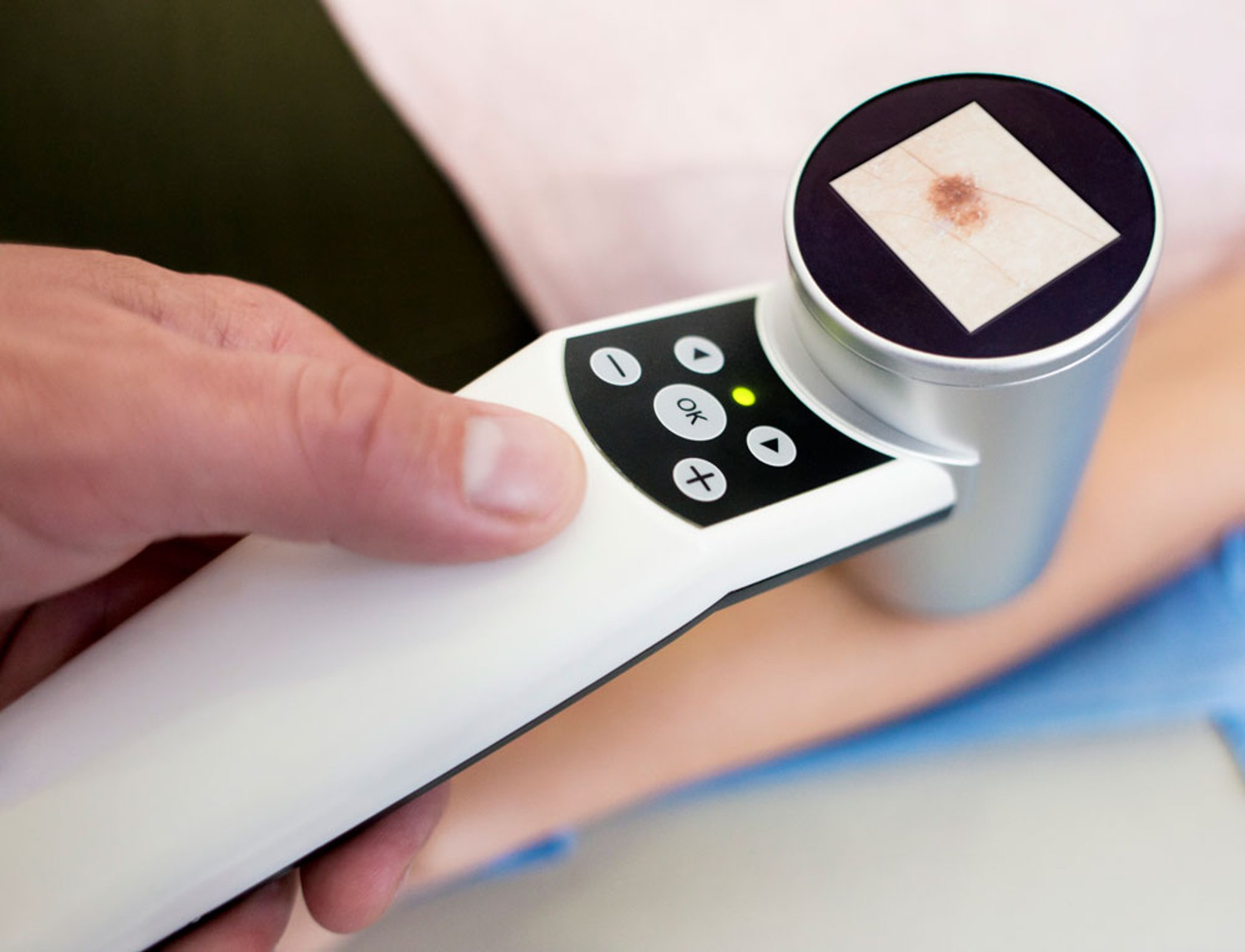
This photo shows a digital dermatoscope. This device is being used to examine a mole on a person's arm.
SCIENCE PHOTO LIBRARY
If the skin examination does not reveal a diagnosis, doctors may do other tests to gather more information.
(See also Structure and Function of the Skin.)
Skin Biopsy
Sometimes a skin biopsy, in which a small piece of skin is removed for examination under a microscope, must be done.
For this simple procedure, the doctor generally numbs a small area of skin with a local anesthetic and, using a small knife (scalpel), scissors, razor blade (called a shave biopsy), or round cutter (called a punch biopsy), removes a piece of growth. The size of the piece is determined by the type of abnormal growth that is suspected, its location, and the type of tests to be done.


Sometimes the doctor can both diagnose and treat a small growth by removing the entire growth along with a small border of normal skin around it (sometimes called an excisional biopsy). The growth is sent to a laboratory for examination under a microscope.
Skin Scrapings
Culture
If an infection is suspected, a doctor removes a sample of material (such as a skin cells or fluids) and sends it to a laboratory, where the sample is placed in a culture medium (a substance that allows microorganisms to grow). If the sample contains bacteria, fungi, parasites, or viruses, they will often grow in the culture and can then be identified.
Wood Light (Black Light)
Doctors do a Wood light examination when they suspect certain skin disorders. The skin is illuminated with an ultraviolet light (also known as a black light) in a dark room. The ultraviolet light makes some fungi or bacteria glow brightly. The light also accentuates the skin's pigment (melanin), making pigmentation abnormalities, such as vitiligo, more visible.

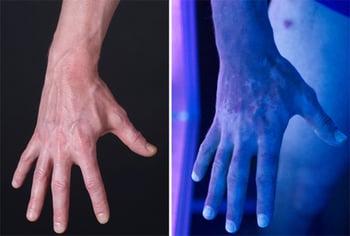
Vitiligo is viewed more easily under a Wood light (right).
Tzanck Testing
A Tzanck test is done to help a doctor diagnose certain diseases caused by viruses, such as herpes simplex and herpes zoster. When these diseases are active, they produce small blisters (vesicles).
During a Tzanck test, a doctor removes the top of a blister with a sharp blade and then scrapes the blister with a scalpel to obtain fluid. The specimens are examined under a microscope after special stains are applied.
Diascopy
Diascopy is done so that a doctor can observe color changes that occur when pressure is applied to the skin.
During this test, a doctor presses a microscope slide against a growth to see whether it blanches (becomes less red) or otherwise changes color. Certain kinds of growths become less red, whereas others do not. Some skin growths (such as those caused by sarcoidosis) turn a yellowish brown color when this test is done.
Skin Tests
Skin tests, including a use test, a patch test, a prick (puncture) test, and an intradermal test, may be done if a doctor suspects an allergic reaction is the cause of a rash.
In the use test, a suspected reaction-causing substance, known as an allergen, is applied far from the original area where the rash is (usually on the forearm). This test is useful when perfumes, shampoos, or other substances found in the home may be the cause of a rash. If redness, blistering, itching, or sometimes pain occurs in (and sometimes around) the area where the allergen is applied, the test is considered positive.
In the patch test, many small samples of common and suspected allergens are contained in patches that doctors tape to the skin (typically on the upper back). The patches are left on for 48 hours and then removed. Doctors evaluate the skin under the patches at removal and then again 72 or 96 hours later. It often takes the skin several days to produce a visible reaction. If an allergen produces a characteristic, usually itchy reaction, the person is probably allergic to it. In people who have light skin, the color of the reaction is usually red. In people who have dark skin, the color of the reaction may have less contrast with surrounding skin and thus be more subtle. Sometimes the allergens produce an irritating reaction that is not a true allergic reaction.
In the prick test, doctors place a drop of an allergen on the skin. Then, the drop is pricked with a needle to introduce a very tiny amount of the allergen into the skin. The skin is then observed for hives, which usually occur within 15 to 20 minutes. Redness (or other color changes) can help support a positive test. (See also Skin testing.)


This illustration shows the skin prick method of allergy testing. Drops of solutions that contain different allergens, such as pollen and animal dander, are placed on a skin prick device. The skin pricks are then placed on the person's forearm where they lightly prick the skin surface to allow the allergen to enter the body. If the person is allergic to any of the allergens, a hive appears at the site of application, as shown in magnified view (top).
MAURIZIO DE ANGELIS/SCIENCE PHOTO LIBRARY
In the intradermal test, tiny amounts of a diluted allergen are injected under the skin. Doctors then watch the area for the extent and firmness of swelling, which indicate an allergic reaction. Redness (or other color changes) can help support a positive test. (See also Skin testing.)


This photo shows an intradermal allergy test. For this test, a small amount of test solution is injected into the person’s skin through a needle.
EDWIGE/SCIENCE PHOTO LIBRARY
Although rare, prick and intradermal tests can cause a severe allergic reaction, known as anaphylaxis, which can be life threatening. Therefore, these types of tests should be done only by a trained health care professional.
Blood Tests
See allergen-specific serum IgE tests for more information about blood testing for allergies.
Provocative Tests
See provocative testing for more information about these tests for allergies.