Fingernails and toenails can be damaged by injuries.
Even a minor injury to the finger or toe may cause changes in the nail.
Severe damage to the nail bed (the soft tissue underneath the nail plate that attaches the nail to the finger), particularly from a crush injury, often results in permanent nail deformity. To reduce the risk of a permanent nail deformity, the injury should be repaired immediately, which requires removal of the nail.
(See also Overview of Nail Disorders.)
Nail injuries are common. Disorders that result from these injuries can include
Activity-related toenail injury
Acute toenail injuries are common among athletes and are typically caused by repetitive striking of the nail plate against footwear. Such injuries can lead to fungal infections and nail plate deformities, including retronychia.
Nail-biting
Nail-biting (onychophagia) usually does not cause any lasting or serious problems unless the nail bed is damaged. Still, there are some possible complications:
Changes in nail texture, shape, or both (dystrophies)
Infections (bacterial, fungal, and/or viral), typically resulting from small areas of nail trauma and damage
Dental problems
Dystrophies can develop if chronic nail-biting disrupts the nail unit, which often inflames the nail matrix. The nails can develop horizontal ridging, depressions, and raised areas, and long-term biting can lead to a permanently shortened nail. The cuticles are almost always damaged, disrupting nails' waterproof "seal," causing nails to thin and peel, and increasing the risk of infection. Eventually, scarring can affect the cuticles and matrix, making dystrophy irreversible.
Bacterial infections are often caused by staphylococcal and streptococcal bacteria but may be caused by Pseudomonas aeruginosa. Pockets of pus (abscesses) can develop around the nail (as in paronychia) or in the fingertip (called a felon). They can lead to permanent nail loss without timely surgical drainage. Permanent nail changes may develop even with surgical drainage.
Fungal infections are very common. Fungal nail infections involving the fingernails are more common in patients who also have a toenail fungal infection. Because fingernails and toenails are often involved these infections are usually treated with oral medication.
Viral infections commonly include human papillomavirus, which causes warts. Small areas of injury all around the nail are how viruses can enter the nails. These infections are difficult to eradicate and spread easily between fingers and from the fingers to the mouth and lips. Warts can be unsightly and distressing.
Dental complications may include disfigurement of the teeth or shifts in position. The risks of gum disease and infection are also increased.
For many people, nail-biting is mild, and simply receiving counseling from a doctor about the possible complications (which people often do not know) may encourage them to try to stop. Some people are ashamed of nail-biting. Habit-breaking techniques may include applying over-the-counter nail polish that is foul-tasting or a long-wearing manicure that blocks a person's ability to bite the nail, such as a dip-powder manicure. Rarely, severe or obsessive nail-biting can be a sign of a mental health or anxiety problem, and people should be evaluated by a mental health professional.
Onychogryphosis
Onychogryphosis is a dystrophy in which the nail, most often on the big toe, becomes thickened and takes on an extremely curved, hooked appearance ("ram’s horn nail"). The curved hooked nail may injure an adjoining toe and is caused by one side of the nail growing faster than the other. This disorder involves damage to the nail bed, which is most often caused by repetitive injury (such as by ill-fitting shoes) but may also occur in disorders such as psoriasis. Onychogryphosis is common among older adults.
The nails should be kept trimmed, and injury to nearby toes can be prevented by placing lamb’s wool between the toes. Footwear or stockings that gather at the toes should be avoided.

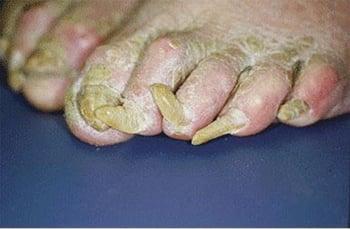
Onychogryphosis is extreme thickening and curving of the nails.
Onychotillomania
People with this disorder pick at and tear their nails. The most common manifestation is the habit-tic deformity, in which the person frequently picks at or rubs the central cuticle (the skin at the base of the nail) with a neighboring finger. This manifestation is most often seen on the thumbnail and leads to a washboard-like appearance in the center of the nail plate. Onychotillomania can also cause bleeding beneath the nails (subungual hemorrhage), infection in the nail unit, and even complete loss of the nail plate.
Subungual hematoma
Blood often collects under the nail (subungual hematoma) immediately after an injury (usually a direct blow, such as with a hammer). The blood appears as a purple-black spot beneath part or all of the nail and causes a great deal of throbbing pain.
The doctor can release the blood and relieve the pain by making a small hole in the nail plate (the hard part of the nail). Usually the doctor uses a needle or heated wire (electrocautery device) to make the hole. This procedure is relatively painless and takes only a few seconds. It is only effective if performed within the first 24 hours.

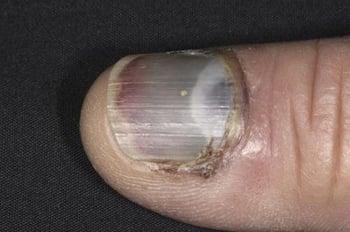
This photo shows bleeding under the fingernail.
Because the blood has separated the nail from its bed, the nail usually falls off after several weeks, unless the hematoma is small. A new nail grows below the existing nail and replaces it when fully grown in.
A tumor beneath the nail can cause a similar purple-black spot. However, such a spot appears slowly and not within minutes of an injury and does not grow outward with the nail over time (tumors remain in the same spot under the nail). However, any small hematomas should be watched to make sure that they grow out with the nail.
White spots
A nail may develop a small spot of white discoloration that usually results from a minor injury to the nail. The spot starts at the injured location and grows out with the nail. White spots on the fingernails typically are nothing to be concerned about.

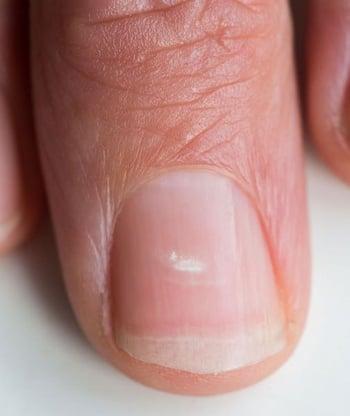
This image shows a white spot resulting from a minor injury.
Red and blue discolorations
Red discoloration in a fingernail or toenail can be a sign of various conditions, ranging from benign nail growths and infections to more serious issues like nail cancer or genetic disorders (eg, Darier disease).
Blue nail discolorations can affect one or multiple nails. A single blue nail might indicate a specific type of benign or cancerous nail tumor, while multiple blue nails could be a side effect of certain medications or exposure to toxins like silver or related to other systemic medical conditions.