Recurrent aphthous stomatitis (RAS) is a common condition in which round or ovoid painful ulcers recur on the oral mucosa. Etiology is unclear. Diagnosis is clinical. Treatment is symptomatic and most often includes topical glucocorticoids.
(See also Stomatitis and Evaluation of the Dental Patient.)
Recurrent aphthous stomatitis affects approximately 20 % of adults and a greater percentage of children at some time in their life (1).
General reference
1. Akintoye SO, Greenberg MS. Recurrent aphthous stomatitis. Dent Clin North Am. 58(2):281-297, 2014. doi: 10.1016/j.cden.2013.12.002
Etiology of Recurrent Aphthous Stomatitis
Etiology is unclear, but RAS tends to run in families. The damage is predominately T-cell–mediated. Cytokines, such as IL-2, IL-10, and particularly TNF-alpha, play a role.
Predisposing factors include
Oral trauma
Stress (1)
Some patients with food allergies may also have RAS and certain foods may exacerbate symptoms (eg, chocolate, peanuts, eggs). However, there are no studies directly implicating food allergy as the cause of RAS.
Etiology reference
1. Huling LB, Baccaglini L, Choquette L, Feinn RS, Lalla RV. Effect of stressful life events on the onset and duration of recurrent aphthous stomatitis. J Oral Pathol Med. 2012 Feb;41(2):149-52. doi: 10.1111/j.1600-0714.2011.01102.x
Symptoms and Signs of Recurrent Aphthous Stomatitis
Symptoms and signs usually begin in childhood (most patients are < 30 years) and decrease in frequency and severity with aging. Symptoms may involve as few as one ulcer 2 to 4 times a year or almost continuous disease, with new ulcers forming as old ones heal. A prodrome of pain or burning for 1 to 2 days precedes ulcers, but there are no antecedent vesicles or bullae. Severe pain, disproportionate to the size of the lesion, can last from 4 to 7 days.
Aphthous ulcers are well-demarcated, shallow, ovoid, or round and have a necrotic center with a yellow-gray pseudomembrane, a red halo, and slightly raised red margins.
Minor aphthous ulcers (canker sores) account for 85% of cases (1). They occur on the floor of the mouth, lateral and ventral tongue, buccal mucosa, and pharynx; are < 8 mm (typically 2 to 3 mm); and heal in 10 days without scarring.

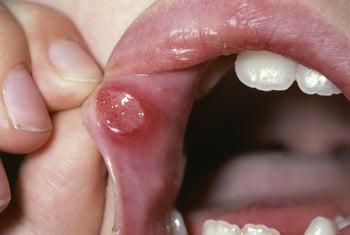
This photo shows a minor aphthous ulcer (canker sore) on the inside of the lip. The ulcer depicted is larger than a typical minor aphthous ulcer.
Major aphthous ulcers (Sutton disease, periadenitis mucosa necrotica recurrens) constitute 10% of cases (2). Appearing after puberty, the prodrome is more intense and the ulcers are deeper, larger (> 1 cm), and longer lasting (weeks to months) than minor aphthae. They appear on the lips, soft palate, and throat. Fever, dysphagia, malaise, and scarring may occur.

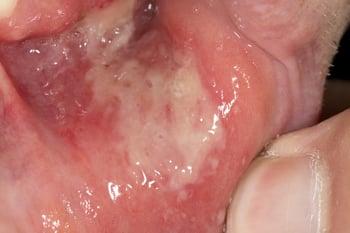
This photo shows a major aphthous ulcer (whitish area) inside the lip.
Herpetiform aphthous ulcers (morphologically resembling but unrelated to herpesvirus) account for about 5% of cases. They begin as multiple (up to 100) < 1 cm small, painful clusters of ulcers on an erythematous base. They coalesce to form larger ulcers that last 2 weeks. They tend to occur in women and at a later age of onset than do other forms of recurrent aphthous stomatitis (1).
Symptoms and signs references
1. Akintoye SO, Greenberg MS. Recurrent aphthous stomatitis. Dent Clin North Am. 58(2):281-297, 2014. doi: 10.1016/j.cden.2013.12.002
2. Shashy RG, Ridley MB. Aphthous ulcers: a difficult clinical entity. Am J Otolaryngol. 2000;21(6):389-393. doi:10.1053/ajot.2000.18872
Diagnosis of Recurrent Aphthous Stomatitis
Primarily history and physical examination
Evaluation proceeds as described for stomatitis. Diagnosis is based on appearance and on exclusion because there are no definitive histologic features or laboratory tests.
Primary oral herpes simplex may mimic RAS but usually occurs in younger children, always involves the gingiva, may affect any keratinized mucosa (hard palate, attached gingiva, dorsum of tongue), and is associated with systemic symptoms. Viral culture can be done to identify herpes simplex. Recurrent herpetic lesions are usually unilateral.
Similar recurrent episodes, often with multiple ulcers, can occur with Behçet disease, inflammatory bowel disease, celiac disease, HIV infection, PFAPA (periodic fevers with aphthous stomatitis, pharyngitis, and adenitis) syndrome, and nutritional deficiencies; these conditions generally have systemic symptoms and signs. Isolated recurrent oral ulcers can occur with herpes infection, HIV, and, rarely, nutritional deficiency (eg, zinc, iron, various B vitamins). Viral testing and serum tests can identify these conditions.
Drug reactions may mimic RAS but are usually temporally related to ingestion. However, reactions to foods or dental products may be difficult to identify; sequential elimination may be necessary.
Treatment of Recurrent Aphthous Stomatitis
Topical chlorhexidine and glucocorticoids
General treatments for stomatitis may help patients with RAS.
Topical glucocorticoids, the mainstay of therapy (1), should be used during the prodrome, if possible. Triamcinolone dental paste, hydrocortisone cream, and fluocinonide cream are common topical agents that can be applied several times a day for approximately 2 weeks. Patients using these glucocorticoids should be monitored for oral candidiasis. If topical glucocorticoids are ineffective, oral prednisone (eg, 40 mg orally once a day) may be needed for ≤ 5 days.
Antimicrobial mouthwashes (eg, chlorhexidine) are sometimes used to reduce frequency of recurrent episodes but are not primary treatment (2).
Symptomatic treatment with topical anesthetics (eg, benzocaine with instructions to avoid toxicity) and/or surface protectants (eg, sucralfate) are effective in relieving discomfort, but these medications simply provide pain relief and/or a protective coating for tissue and are not therapeutic.
Continuous or particularly severe RAS is best treated by a specialist in oral medicine. Treatment may require prolonged use of systemic glucocorticoids, azathioprine or other immunosuppressants, pentoxifylline, or thalidomide (3). Intralesional injections can be done with betamethasone, dexamethasone, or triamcinolone. Supplemental B1, B2, B6, B12, folate, or iron lessens RAS in some patients.
Treatment references
1. Scully C. Clinical practice. Aphthous ulceration. N Engl J Med. 2006;355(2):165-172. doi:10.1056/NEJMcp054630
2. Hunter L, Addy M. Chlorhexidine gluconate mouthwash in the management of minor aphthous ulceration. A double-blind, placebo-controlled cross-over trial. Br Dent J. 1987;162(3):106-110. doi:10.1038/sj.bdj.4806042
3. Stoopler ET, Villa A, Bindakhil M, Díaz DLO, Sollecito TP. Common Oral Conditions: A Review. JAMA. 2024;331(12):1045-1054. doi:10.1001/jama.2024.0953
Drug Information for the Topic