An ingrown toenail is incurvation or impingement of a nail border into its adjacent nail fold, causing pain.
(See also Overview of Nail Disorders.)
The causes of ingrown toenail include tight shoes, abnormal gait (eg, toe-walking), bulbous toe shape, excessive trimming of the nail plate, or congenital variations in nail contour (eg, congenital pincer nail deformity) (1). Sometimes an underlying osteochondroma is responsible, especially in young patients. In older adults, peripheral edema is a risk factor. Eventually, infection can occur along the nail margin (paronychia).
General reference
1. Geizhals S, Lipner SR. Review of onychocryptosis: epidemiology, pathogenesis, risk factors, diagnosis and treatment. Dermatol Online J. 2019;25(9):13030/qt9985w2n0. Published 2019 Sep 15.
Symptoms and Signs of Ingrown Toenail
Pain occurs at the corner of the nail fold or, less commonly, along its entire lateral margin. Initially only mild discomfort may be present, especially when wearing certain shoes. In chronic cases, granulation tissue becomes visible, more often in young patients.

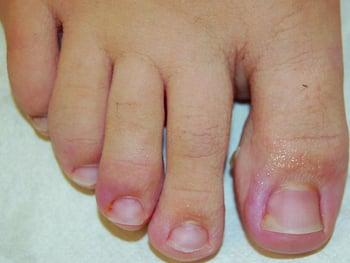
This photo shows ingrown toenails with redness and swelling affecting the 1st and 3rd toes.

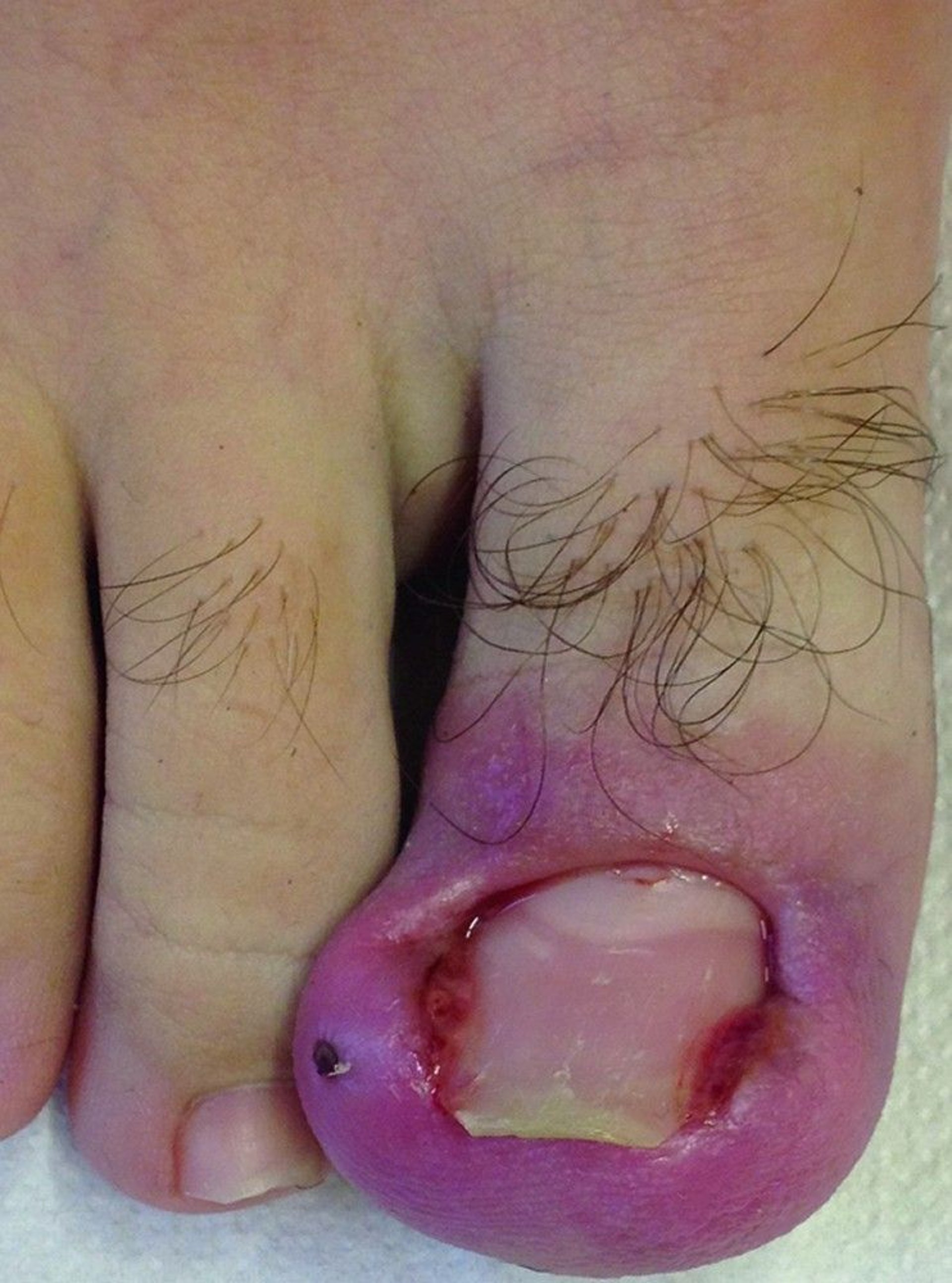
This photo shows an ingrown toenail with extensive inflammation around the nail and granulomatous tissue.
© Springer Science+Business Media
Diagnosis of Ingrown Toenail
Primarily physical examination
Rarely biopsy (to exclude other causes)
The diagnosis is primarily clinical. Redness, swelling, and pain may also suggest concurrent paronychia. In young patients (eg, < 20 years) with recurrent ingrown toenails, radiographs should be considered to exclude underlying osteochondroma. In the absence of an ingrown toenail, apparent granulation tissue around the toe may indicate the need for a biopsy to exclude the rare possibility of amelanotic melanoma.
Treatment of Ingrown Toenail
Conservative approaches (eg, using athletic tape, inserting wads of cotton, avoidance of tight footwear)
Rarely, surgical removal
A conservative approach can be attempted first. If ineffective, surgery may be required. In mild cases, taping the skin away from the nail using athletic tape can be attempted (1). Inserting wads of cotton between the ingrown nail plate and painful fold (using a thin toothpick) may provide immediate relief and, if continued, correct the problem. If the shoes being worn are too tight, alternatives with a larger toe box are indicated.
In most cases, however, particularly with paronychia, excision of part or occasionally all of the ingrown toenail after injecting a local anesthetic is the only effective treatment. After excision, a flexible tube can be used to separate the nail plate and painful fold and allow healing.
If ingrown toenails recur, sodium hydroxide or phenol is applied to permanently destroy the nearby lateral nail matrix. Phenol should not be used if there is arterial insufficiency. (See also How To Treat an Ingrown Toenail.)
Treatment reference
1. Geizhals S, Lipner SR. Clinical pearl: kinesiology tape for onychocryptosis. Cutis. 2019;103(4):197.
Drug Information for the Topic