



Scabies is an infestation of the skin with the mite Sarcoptes scabiei. Scabies causes intensely pruritic lesions with erythematous papules and burrows in web spaces, wrists, waistline, and genitals. Diagnosis is based on examination and scrapings. Treatment is with topical scabicides or sometimes oral ivermectin.
Etiology of Scabies

Scabies is an ectoparasitic skin infestation caused by the mite Sarcoptes scabiei var. hominis, an obligate human parasite that lives in burrowed tunnels in the stratum corneum (see figure ). Scabies is easily transmitted from person to person through physical contact; animal and fomite transmission probably also occurs. The primary risk factor is interpersonal contact in crowded conditions (as in schools, shelters, barracks, and some households), and caregiving when provided in close contact. Shared bedding and sexual contact may contribute to transmission (1); there is no clear association with poor hygiene.
Crusted scabies, also called Norwegian scabies, usually causes a more severe but often less pruritic rash than common scabies (1). For unknown reasons, crusted scabies is more common among patients who are immunosuppressed (eg, those with HIV infection, hematologic cancer, chronic glucocorticoid or other immunosuppressant use), patients with severe physical disabilities or intellectual disability, and patients with Australian Aboriginal ethnicity. Infestations occur worldwide with exceptionally wide regional variation (2), with countries in the Pacific region including islands (eg, Samoa, Fiji) and Latin America having the highest prevalence. Children are substantially more affected than adolescents and adults. Patients in warm climates develop small erythematous papules with few burrows. The severity of clinical presentation is usually related to the patient’s immune status, not geography.

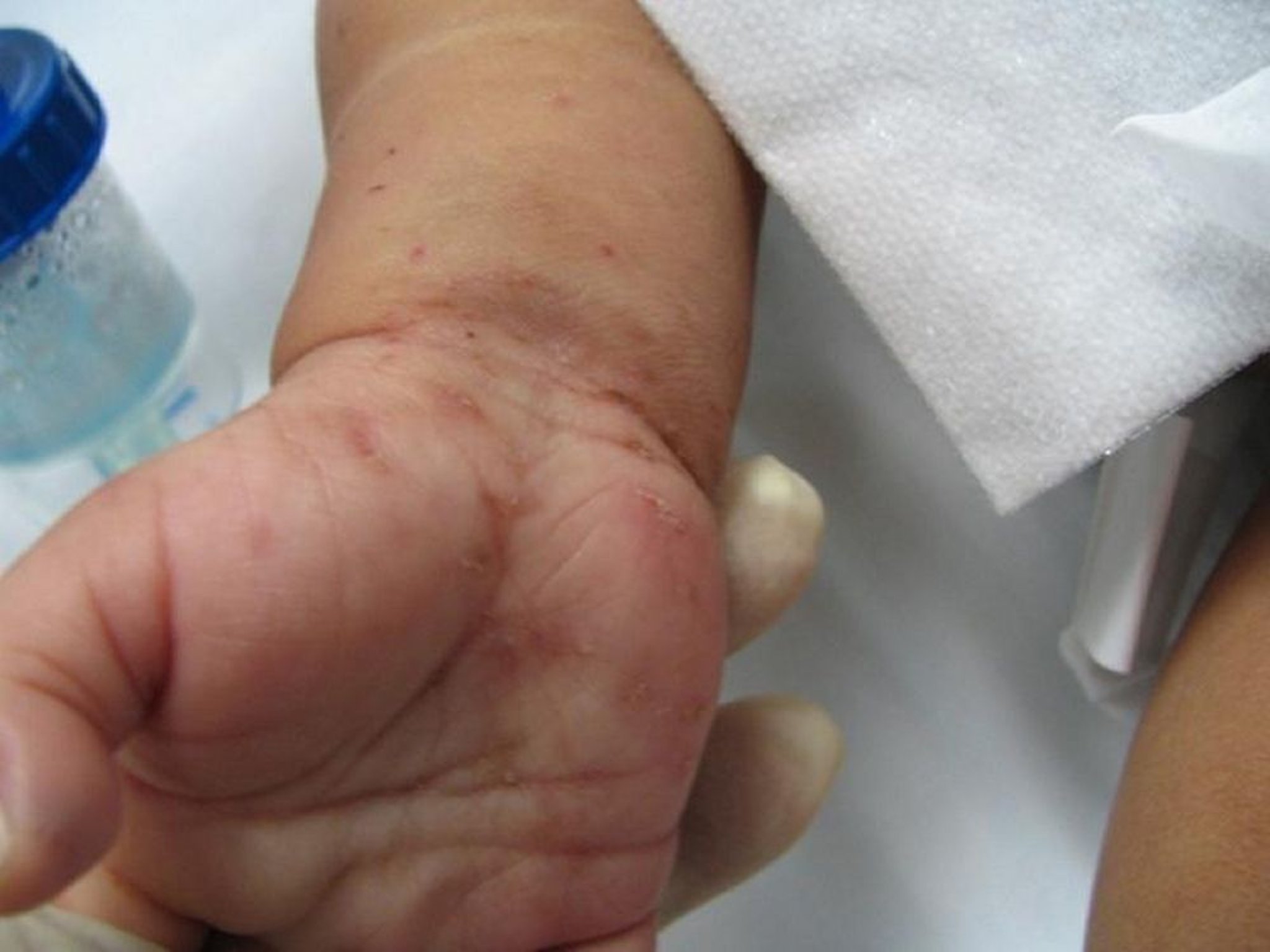
The child in this photo has excoriations and crusted lesions clustered around the flexor crease of the wrist. These findings are typical of scabies. Burrows are present as 3- to 4-mm crusted lesions in the wrist creases and elsewhere.
Photo courtesy of Karen McKoy, MD.
Etiology references
1. Roberts K. What Is Scabies?. JAMA. Published online September 11, 2025. doi:10.1001/jama.2025.13679
2. Romani L, Steer AC, Whitfeld MJ, et al. Prevalence of scabies and impetigo worldwide: a systematic review. Lancet Infect Dis15(8):960-967, 2015. doi: 10.1016/S1473-3099(15)00132-2
Symptoms and Signs of Scabies
Clinical features of scabies first begin to appear approximately 4 to 6 weeks after initial exposure (1). The primary symptom of scabies is intense pruritus, classically worse at night, although that timing is not specific to scabies. Pruritus represents the formation of delayed hypersensitivity to scabies mite antigens (2).
Classic scabies
Erythematous papules initially appear in finger web spaces, flexor surfaces of the wrist and elbow, axillary folds, along the belt line, or on the lower buttocks. Papules can affect any area of the body, including the breasts and penis. The face usually remains uninvolved in adults. Burrows, usually on the wrists, hands, or feet, are pathognomonic for disease, manifesting as fine, wavy, and slightly scaly lines several millimeters to 1 cm long. A tiny erythematous and pruritic papule—the mite—may be visible at one end and is often the first classic sign of a scabies infestation. In some cases where the mite has burrowed further into the skin, further inflammation and the formation of a fluid-filled vesicle may be noted. Such vesicular lesions may be subject to erosion or secondary infection, especially if scratched. In classic scabies, people usually have only 10 to 12 mites.


A pruritic, pustular rash in the webbing between fingers is the hallmark of classic scabies.
Signs of classic scabies may be atypical. In Black people and other people with dark skin, scabies can manifest as granulomatous nodules. In infants, the palms, soles, face, and scalp may be involved, especially in the posterior auricular folds. In older adults, scabies can cause intense pruritus but otherwise subtle skin findings, making it a challenge to diagnose. In patients who are immunosuppressed, there may be widespread nonpruritic scaling (particularly on the palms and soles in adults and on the scalp in children).

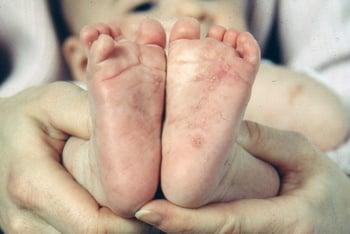
In infantile scabies, pustules on the soles and palms are common.
Other forms
Crusted scabies (Norwegian scabies) is due to an impaired host immune response, allowing mites to proliferate and number in the millions; scaling erythematous patches often involve the hands, feet, and scalp and can become widespread.

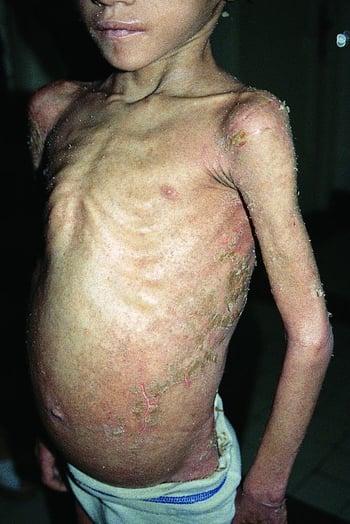
This photo shows diffuse scaling and hyperkeratotic plaques in a patient with HIV infection and crusted scabies.
Nodular scabies occurs in approximately 7 to 10% of cases, is more common among infants and young children, and may be due to hypersensitivity to retained organisms. Nodules are usually erythematous; measure 5 to 20 mm; and involve the groin, genitals, axillary folds, and buttocks (3). Nodules represent foci of delayed hypersensitivity reactions and may persist for months after eradication of mites.

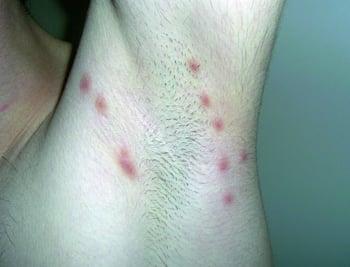
Nodular scabies are shown in this photo as multiple brownish red papules on the axilla.
Bullous scabies occurs more commonly among children. When it occurs in older adults, it can mimic bullous pemphigoid, resulting in a delay in diagnosis.
Scalp scabies occurs in infants and immunocompromised people and can mimic dermatitis, particularly atopic dermatitis or seborrheic dermatitis.
Scabies incognito looks like a widespread eczema and occurs in patients who use topical glucocorticoids.
Symptoms and signs references
1. Roberts K. What Is Scabies?. JAMA. Published online September 11, 2025. doi:10.1001/jama.2025.13679
2. Thomas C, Castillo Valladares H, Berger TG, et al. Scabies, Bedbug, and Body Lice Infestations: A Review. JAMA. Published online September 9, 2024. doi:10.1001/jama.2024.13896
3. Zhao YK, Lu JF, Liu JH, et al. Recalcitrant nodular scabies showing excellent response to tofacitinib: five case reports. Ther Adv Chronic Dis. 2023;14:20406223231195632. Published 2023 Aug 29. doi:10.1177/20406223231195632
Diagnosis of Scabies
Primarily history and physical examination
Burrow scrapings
The diagnosis of scabies is suspected by physical findings, especially burrows and itching that is out of proportion to physical findings, along with the presence of similar symptoms among household contacts. The 2020 International Alliance for the Control of Scabies criteria define 3 diagnostic certainty levels (1):
Confirmed (when there is concrete microscopic or dermoscopic evidence)
Clinical (when there are typical lesions plus history)
Suspected (where clinical findings are less typical but the history is supportive)
Confirmation is by finding mites, ova, or fecal pellets on microscopic examination of burrow scrapings; failure to find mites is common and does not exclude scabies. Scrapings should be obtained by placing glycerol, mineral oil, or immersion oil over a burrow or papule (to prevent dispersion of mites and material during scraping), which is then unroofed with the edge of a scalpel. The material is then placed on a slide and covered with a coverslip; potassium hydroxide should be avoided because it dissolves fecal pellets.
Imaging and magnification of the skin using a hand-held instrument (dermoscopy) or confocal microscopy can be performed to help identify scabies. The presence of a delta-wing jet sign (ie, visualizing dense scabies head parts in a triangular shape and the burrow itself may appear as an S-shaped whitish line trailing behind) on dermoscopy is characteristic (2).
Patients with crusted scabies may have extremely high levels of IgE and elevated eosinophils (3).
Diagnosis references
1. Engelman D, Yoshizumi J, Hay RJ, et al. The 2020 International Alliance for the Control of Scabies Consensus Criteria for the Diagnosis of Scabies. Br J Dermatol. 2020;183(5):808-820. doi:10.1111/bjd.18943
2. Fox G. Diagnosis of scabies by dermoscopy. BMJ Case Rep. 2009;2009:bcr06.2008.0279. doi:10.1136/bcr.06.2008.0279
3. Roberts LJ, Huffam SE, Walton SF, Currie BJ. Crusted scabies: clinical and immunological findings in seventy-eight patients and a review of the literature. J Infect. 2005;50(5):375-381. doi:10.1016/j.jinf.2004.08.033
Treatment of Scabies
Topical permethrin, or other topical scabicides
Sometimes oral ivermectin
Symptomatic management of pruritus (oral antihistamines)
Primary treatment of scabies involves topical or oral scabicides (1) (see table Treatment Options for Scabies). Permethrin is the first-line topical medication (2).
Topical therapy is primarily with permethrin. Older children and adults should apply permethrin to the entire body from the neck down and wash it off after 8 to 14 hours. Treatments should be repeated in 7 days.
For infants and young children, permethrin should be applied to the head and neck, avoiding periorbital and perioral regions. Special attention should be given to intertriginous areas, fingernails, toenails, and the umbilicus. Reapplications on the hands and feet may be necessary (3). Mittens on infants can keep permethrin out of the mouth.
For adults and children 4 years of age and older, spinosad 0.9% topical suspension should be applied to the entire cutaneous surface from the neck down, including the soles and feet (4). In patients who are bald, the suspension should be applied to the scalp, forehead, hairline, and temples. The suspension should be allowed to dry for 10 minutes before getting dressed and then left on the skin for 6 hours before showering or bathing. Treatment should be repeated in 1 week.
Precipitated sulfur 6 to 10% in petrolatum is an alternative therapy typically reserved for infants < 2 months of age or pregnant individuals. It is applied for 24 hours for 3 consecutive days, and is safe and effective. Lindane is no longer recommended because it can be neurotoxic (5).
Oral therapy is with ivermectin, which is indicated for patients who do not respond to topical treatment, are unable to adhere to topical regimens, or are immunocompromised with Norwegian scabies. Ivermectin has been used with success in epidemics involving close contacts, such as in nursing homes.
Symptomatic management of pruritus is usually with oral antihistamines (eg, hydroxyzine 25 mg orally up to 4 times a day). Secondary infection should be considered in patients with weeping, yellow-crusted lesions (ie, impetigo) and treated with the appropriate systemic or topical antistaphylococcal or antistreptococcal antibiotic. After eradication of mites, pruritus can also be treated symptomatically with topical glucocorticoids.
Symptoms and lesions take up to 3 weeks to resolve despite killing of the mites, making failed treatment due to resistance, poor penetration, incompletely applied therapy, reinfection, or nodular scabies difficult to recognize. Skin scrapings can be performed periodically to check for persistent scabies.
Treatment Options for Scabies
Therapy | Instructions | Comments |
|---|---|---|
Permethrin* 5% (60 g) cream | Apply to whole body; wash off after 8–14 hours Repeat in 1 week | 1st-line treatment Can cause stinging and itching |
Ivermectin tablets | 200 mcg/kg orally for 1 dose Repeat in 7–10 days | Indicated as a 2nd-line treatment to permethrin For use in institutional epidemics and immunocompromised patients, or those unable to adhere to topical regimens Caution required when given to older patients with hepatic, renal, or cardiac disorders Not recommended for pregnant or lactating women; unproven safety in children < 15 kg or < 5 years May cause tachycardia |
Crotamiton 10% cream/lotion | Apply after bath to whole body, apply 2nd dose after 24 hours, and bathe 48 hours after 2nd dose Repeat both doses in 7–10 days | — |
Spinosad 0.9% topical suspension | Apply to skin from the neck to the toes including the soles and feet; in patients who are bald, apply to forehead, hairline, scalp, and temples Wait 10 minutes before getting dressed; leave on skin for 6 hours before showering or bathing Repeat in 1 week | For use in patients ≥ 4 years of age May cause eyelid redness and swelling and dry skin; avoid contact with eyes Contains benzyl alcohol and derivatives; avoid in neonates and those younger than 6 months of age because of potential toxicity and in patients with sensitivity to benzyl alcohol |
Sulfur ointment 6–10% | Apply to whole body at bedtime for 3 nights and leave each application on for 24 hours | Very effective and safe May be limited by its unpleasant odor |
* Pyrethrins are natural components of chrysanthemum flowers, with strong insecticidal activity; pyrethroids are synthetic and natural relatives of pyrethrin; and permethrin is a commonly used synthetic pyrethroid. Pyrethrins are combined with a piperic acid derivative (piperonyl butoxide) to enhance efficacy. | ||
Treatment references
1. Al-Dabbagh J, Younis R, Ismail N. The current available diagnostic tools and treatments of scabies and scabies variants: An updated narrative review. Medicine 102(21): p e33805. doi: 10.1097/MD.0000000000033805
2. U.S. Centers for Disease Control and Prevention (CDC). Clinical Care of Scabies. December 18, 2023. Accessed on October 16, 2025.
3. Riebenbauer K, Weber PB, Haitel A, et al. Comparison of Permethrin-Based Treatment Strategies against Scabies in Infants and Young Children. J Pediatr. 2022;245:184-189. doi:10.1016/j.jpeds.2022.02.016
4. Seiler JC, Keech RC, Aker JL, et al. Spinosad at 0.9% in the treatment of scabies: Efficacy results from 2 multicenter, randomized, double-blind, vehicle-controlled studies. Am Acad Dermatol Aug 12:S0190-9622(21)02290-8, 2021. doi: 10.1016/j.jaad.2021.07.074
5. Nolan K, Kamrath J, Levitt J. Lindane toxicity: A comprehensive review of the medical literature. Pediatr Dermatol 29(2):141-146, 2012. doi: 10.1111/j.1525-1470.2011.01519.x
Prevention
Recommended strategies for the prevention of scabies focus on prompt identification and treatment of cases and their close contacts, environmental decontamination, and, in high-prevalence settings, community-level interventions (1). Avoidance of direct contact with infested individuals and their personal items, especially in institutional or crowded settings is important. Public-health strategies include establishing surveillance programs for early detection, regionally appropriate protocols for treatment and prevention, and procedures for notification, all of which can further streamline preventive efforts (2).
Key prevention measures include empiric treatment of all close contacts (eg, household members, those with direct skin-to-skin contact) even if they are asymptomatic. Asymptomatic carriers can transmit the infestation; clinical symptoms may be delayed or not manifest at all.
Decontamination measures are also recommended; clothing, bedding, and linens should be washed in hot water (≥ 50 to 54° C [≥ 122 to 130° F]) and dried on a high-heat cycle for 10 minutes, or contaminated items should be isolated in a sealed plastic bag for up to 1 week (3). Only items in contact with the patient in the previous 2 to 3 days require cleaning.
Mass medication administration with oral ivermectin or topical permethrin has been shown to be particularly effective in outbreak settings, and substantially reduces scabies transmission in endemic communities (4, 5).
Prevention references
1. U.S. Centers for Disease Control and Prevention (CDC). Preventing Scabies. December 18, 2023. Accessed October 16, 2025.
2. U.S. Centers for Disease Control and Prevention (CDC). Public Health Strategies for Scabies Outbreaks in Institutional Settings. December 18, 2023. Accessed October 16, 2025.
3. World Health Organization (WHO). Scabies. May 31, 2023. Accessed October 16, 2025.
4. Hardy M, Samuela J, Kama M, et al. Community control strategies for scabies: A cluster randomised noninferiority trial. PLoS Med. 2021;18(11):e1003849. Published 2021 Nov 10. doi:10.1371/journal.pmed.1003849
5. Romani L, Whitfeld MJ, Koroivueta J, et al. Mass Drug Administration for Scabies Control in a Population with Endemic Disease. N Engl J Med. 2015;373(24):2305-2313. doi:10.1056/NEJMoa1500987
Key Points
Risk factors for scabies include crowded living conditions and immunosuppression; poor hygiene is not a risk factor.
Suggestive findings include burrows in characteristic locations, intense itching (particularly at night), and clustering of cases among household contacts.
Confirm scabies when possible by finding mites, ova, or fecal pellets.
Treat scabies usually with topical permethrin or, when necessary, oral ivermectin.
Drug Information for the Topic







