Meniere disease is an inner ear disorder that causes vertigo, nausea, fluctuating sensorineural hearing loss, aural fullness, and tinnitus. There is no confirmatory diagnostic test, but audiograms and MRI can help support the diagnosis by excluding other causes. Vertigo and nausea are treated symptomatically with anticholinergics or benzodiazepines during acute attacks. Diuretics and a low-salt diet, the first line of treatment, often decrease the frequency and severity of episodes. For severe or refractory cases, the vestibular system can be ablated with topical gentamicin or surgery.
Meniere disease is a chronic inner ear disorder that affects balance and hearing; it is characterized by episodes of vertigo, tinnitus, hearing loss, and a feeling of aural fullness or pressure in the affected ear. In Meniere disease, pressure and volume changes in the labyrinthine endolymph affect inner ear function. Data from a large claims database in the United States reported a prevalence of Meniere disease of 190 per 100,000 adults (1). The peak incidence is between ages 40 and 60, and prevalence increases with age. There is a female predominance.
Endolymphatic hydrops, an abnormal accumulation of endolymphatic fluid within the membranous labyrinth of the inner ear, is a pathologic process observed in all patients with Meniere disease. However, not all patients with endolymphatic hydrops have symptoms of Meniere disease, and it can be associated with other conditions such as preexisting autoimmune inner ear disease, allergies, trauma to the head or ear causing temporal bone fractures, and more rarely, hypothyroidism and otosyphilis.

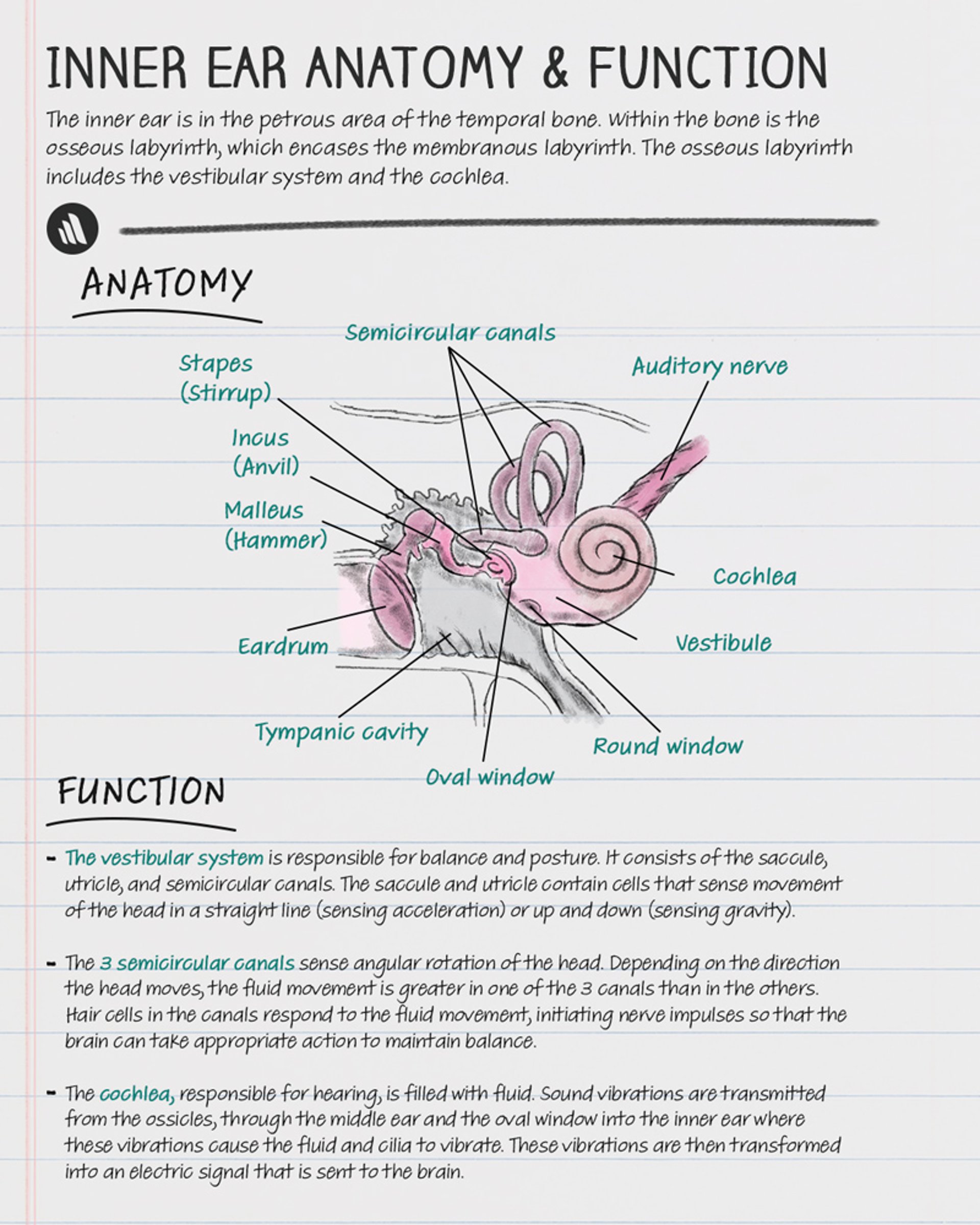
Copyright © 2023 Merck & Co., Inc., Rahway, NJ, USA and its affiliates. All rights reserved.
Meniere disease refers to the presence of characteristic symptoms without a known cause, whereas Meniere syndrome refers to the same constellation of symptoms, but due to a known cause (eg, congenital anomalies, head trauma, infection).
Reference
1. Harris JP, Alexander TH. Current-day prevalence of Ménière's syndrome. Audiol Neurootol. 2010;15(5):318-322. doi:10.1159/000286213
Symptoms and Signs of Meniere Disease
Patients with Meniere disease have sudden attacks of vertigo that usually last for 20 minutes to 12 hours; rarely, the attacks can last up to 24 hours. Usually, nausea and vomiting are also present. Other symptoms include diaphoresis, diarrhea, and gait unsteadiness.
Tinnitus in the affected ear may be constant or intermittent buzzing, ringing, roaring, whistling, or hissing; it is not related to position or motion.
Hearing impairment, typically affecting low frequencies, may follow the attacks. Before and during an episode, most patients sense fullness or pressure and hyperacusis (sensitivity to loud sounds) in the affected ear. In most patients, only one ear is affected.
During the early stages, symptoms tend to remit between episodes; symptom-free periods may last > 1 year. As the disease progresses, however, hearing impairment fluctuates but eventually persists and gradually worsens, and tinnitus may be constant, even between attacks.
Diagnosis of Meniere Disease
Primarily history and physical examination
Audiogram and gadolinium-enhanced MRI to rule out other causes
The diagnosis of Meniere disease is usually made clinically (1). The concurrence of fluctuating low-frequency sensorineural hearing loss, episodic vertigo, ipsilateral fluctuating aural fullness (in the affected ear), and tinnitus is characteristic and should raise clinical suspicion for the condition. Similar symptoms can result from vestibular migraine, vestibular neuronitis, viral labyrinthitis, a cerebellopontine angle tumor (eg, vestibular schwannoma), or a brain stem stroke. Although bilateral Meniere disease can occur, bilateral symptoms increase the likelihood of an alternate diagnosis (eg, vestibular migraine). Vestibular migraine (also known as migrainous vertigo) is characterized by episodes of vertigo in patients who have a history of migraines or with other features of migraines, such as headache, photophobia and phonophobia, or visual aura; there is no loss of hearing.
Between attacks, the examination may be entirely normal. But during an acute attack, the patient has nystagmus and can fall toward the affected side. Also, in long-standing or refractory cases with associated labyrinthine hypofunction, the Fukuda stepping test (marching in place with eyes closed, also known as the Unterberger test) causes the patient to turn toward the affected ear, consistent with a unilateral labyrinthine lesion.
The Halmagyi head thrust maneuver, or head impulse test, is another technique that is used to check for unilateral labyrinthine dysfunction. In the Halmagyi maneuver, the examiner has the patient visually fixate on a target straight ahead (eg, the examiner's nose). Then while observing the patient's eyes, the examiner rapidly rotates the patient's head 15 to 30° to one side.
When the head is rotated to one side, vestibular function on that side is normal if the patient's eyes remain fixated on the target. When vestibular function is impaired, the vestibulo-ocular reflex (a reflex that coordinates eye movements with head movements, ensuring stable vision during head motion) is absent. The patient's eyes do not remain fixated on the target but instead transiently follow the head rotation, and then quickly and voluntarily return back to the target (called delayed catch-up saccades).
Patients with symptoms suggesting Meniere disease should have an and an MRI (with gadolinium enhancement) of the central nervous system with attention to the internal auditory canals to exclude other causes. The audiogram typically shows a low-frequency sensorineural hearing loss in the affected ear that fluctuates between tests. The Rinne test and the Weber test may indicate sensorineural hearing loss.
Diagnosis reference
1. Basura GJ, Adams ME, Monfared A, et al. Clinical Practice Guideline: Ménière's Disease Executive Summary. Otolaryngol Head Neck Surg. 2020;162(4):415-434. doi:10.1177/0194599820909439
Treatment of Meniere Disease
Symptom relief with antiemetics, antihistamines, or benzodiazepines
Diet and lifestyle modifications (eg, low-salt diet and avoidance of caffeine and alcohol)
Pharmacotherapy (eg, diuretics) for maintenance therapy
Rarely, endolymphatic sac decompression, or vestibular ablation by medications or surgery
Meniere disease tends to be self-limited. Treatment of an acute attack is aimed at symptom relief and usually initiated in a staged fashion; the least invasive measures are performed first, and then if the measures are ineffective, ablative procedures are sometimes performed.
For the treatment of acute episodes, anticholinergic antiemetics (eg, prochlorperazine or promethazine, both administered rectally or orally every 6 to 8 hours) can minimize vagal-mediated gastrointestinal symptoms (1). Ondansetron is a second-line antiemetic. Antihistamines (eg, diphenhydramine, meclizine, or cyclizine, orally every 6 hours) or benzodiazepines (eg, diazepam orally every 6 to 8 hours) are used to sedate the vestibular system. Neither antihistamines nor benzodiazepines are effective as prophylactic treatment. Some physicians also use a short courses of high-dose oral glucocorticoids (eg, prednisone 60 mg orally once a day for 1 week, tapered over another week), but this is typically reserved for patients with severe or refractory symptoms.
Prophylactic lifestyle measures such as a low-salt (< 1.5 g/day) diet, avoidance of alcohol, and limiting caffeine intake are generally recommended to prevent fluid retention; however, high-quality data supporting their efficacy are lacking (2).
Diuretics (eg, hydrochlorothiazide/triamterene 25 mg/37.5 mg orally once a day or acetazolamide 250 mg orally 2 times a day) may also help prevent or reduce the incidence of vertigo attacks and are commonly used as maintenance therapy. Betahistine, another agent that may be used as maintenance therapy, is thought to reduce vertigo frequency by increasing blood flow in the inner ear; it may be used with or without diuretics (1). There are no well-designed studies that clearly prove the efficacy of these measures for Meniere disease; however, some studies have shown benefit and they are generally well-tolerated.
Because there is strong overlap between Meniere disease and migraine disorders, a trial of traditional migraine preventive medications (eg, nortriptyline, venlafaxine) may also be considered for refractory or recurrent episodes. Traditional migraine preventive medications (eg, tricyclic antidepressants, serotonin-norepinephrine reuptake inhibitors [SNRIs]) are also beneficial in some patients with Meniere disease.
Although more invasive, endolymphatic sac decompression relieves vertigo in most patients, spares vestibular function, and poses minimal risk of hearing loss. Thus, this procedure is still classified as a vestibular-sparing treatment.
Serial intratympanic injections of glucocorticoids (eg, dexamethasone) may also be helpful in some patients and avoids the systemic side effects of oral glucocorticoids (3). Intratympanic gentamicin (chemical labyrinthectomy) injection may also be used but carries a high risk of hearing loss. Follow-up with serial audiometry is recommended after intratympanic injections to monitor for hearing loss.
Ablative surgery is rarely used and reserved for patients with frequent, severely debilitating episodes who are unresponsive to less invasive modalities (ie, intratympanic gentamycin injection). Vestibular neurectomy (an intracranial procedure) relieves vertigo in about 95% of patients and usually preserves hearing. A surgical labyrinthectomy is performed only if preexisting hearing loss is profound.
Unfortunately, there is no known way to prevent the natural progression of hearing loss. Most patients may sustain moderate to severe sensorineural hearing loss in the affected ear within 10 to 15 years.
Treatment references
1. Basura GJ, Adams ME, Monfared A, et al. Clinical Practice Guideline: Ménière's Disease Executive Summary. Otolaryngol Head Neck Surg. 2020;162(4):415-434. doi:10.1177/0194599820909439
2. Hussain K, Murdin L, Schilder AG. Restriction of salt, caffeine and alcohol intake for the treatment of Ménière's disease or syndrome. Cochrane Database Syst Rev. 2018;12(12):CD012173. Published 2018 Dec 31. doi:10.1002/14651858.CD012173.pub2
3. Ahmadzai N, Cheng W, Kilty S, et al. Pharmacologic and surgical therapies for patients with Meniere's disease: A systematic review and network meta-analysis. PLoS One. 2020;15(9):e0237523. Published 2020 Sep 1. doi:10.1371/journal.pone.0237523
Key Points
Meniere disease typically causes vertigo with nausea and vomiting, ipsilateral aural fullness, unilateral tinnitus, and chronic, progressive hearing loss.
Diagnosis is primarily based on history and physical examination; assessment of hearing with audiogram is done and MRI may be performed to exclude other disorders.
Antiemetics and antihistamines can help relieve symptoms; some clinicians also use oral or transtympanic glucocorticoids or migraine-preventive medications (eg, tricyclic antidepressants or SNRIs).
Lifestyle modifications such as a low-salt diet and avoidance of alcohol and caffeine can help prevent attacks.
Pharmacotherapy with diuretics or betahistine are used for maintenance therapy.
More invasive treatments for refractory cases include endolymphatic sac decompression, intratympanic gentamicin, and vestibular neurectomy.
Drug Information for the Topic