Meckel diverticulum is a true diverticulum and is the most common congenital anomaly of the gastrointestinal tract, occurring in < 1 to 3% of people. It is caused by incomplete obliteration of the vitelline duct and consists of a congenital sacculation of the antimesenteric border of the ileum. It is usually located within 200 cm of the ileocecal valve and often contains heterotopic gastric tissue, pancreatic tissue, or both. Symptoms are uncommon but include bleeding, bowel obstruction, and inflammation (diverticulitis). Diagnosis is difficult and often involves radionuclide scanning and sometimes other imaging studies. Treatment is usually surgical resection.
A diverticulum is a saclike pouch that protrudes through a tubular structure; if it contains all layers of the structure, it is considered a true diverticulum (see also Definition of Diverticular Disease).
Pathophysiology of Meckel Diverticulum
In early fetal life, the vitelline or omphalomesenteric duct that connects the midgut to the yolk sac is normally obliterated by the sixth week. If the portion connecting to the ileum fails to atrophy, a Meckel diverticulum results. This congenital diverticulum arises from the antimesenteric margin of the intestine and contains all layers of the normal bowel and is thus a true diverticulum. In many patients, a Meckel diverticulum also contains heterotopic tissue of the stomach (up to 71%) (and thus contains parietal cells that secrete hydrochloric acid), pancreas (up to 12%), or both.
A Meckel diverticulum occurs in < 1 to approximately 3% of the population (1). Approximately 4 to 9% of people with a Meckel diverticulum develop symptoms (2). Meckel diverticula are more common among males. Complications of Meckel diverticulum include:
Bleeding is common among children (< 11 years) (1). Bleeding occurs when acid secreted from ectopic gastric mucosa in the diverticulum ulcerates the adjacent ileum. Obstruction is also more common among children (especially < 4 years). Obstruction is most likely caused by intussusception of the diverticulum, but may also result from adhesions, volvulus, retained foreign bodies, tumors, or incarceration in a hernia (Littre hernia).
Acute Meckel diverticulitis may be more common in adults (1).
Perforation causes peritonitis.
Tumors, including gastrointestinal and pancreatic neuroendocrine tumors, are rare and occur mainly in adults (3, 4).
Pathophysiology references
1. Hansen CC, Søreide K. Systematic review of epidemiology, presentation, and management of Meckel's diverticulum in the 21st century. Medicine (Baltimore). 2018;97(35):e12154. doi:10.1097/MD.0000000000012154
2. Martin JP, Connor PD, Charles K. Meckel's diverticulum. Am Fam Physician. 2000;61(4):1037-1044.
3. Thirunavukarasu P, Sathaiah M, Sukumar S, et al. Meckel's diverticulum--a high-risk region for malignancy in the ileum. Insights from a population-based epidemiological study and implications in surgical management. Ann Surg. 2011;253(2):223-230. doi:10.1097/SLA.0b013e3181ef488d
4. van Malderen K, Vijayvargiya P, Camilleri M, et al. Malignancy and Meckel's diverticulum: A systematic literature review and 14-year experience at a tertiary referral center. United European Gastroenterol J. 2018;6(5):739-747. doi:10.1177/2050640617752771
Symptoms and Signs of Meckel Diverticulum
In all ages, intestinal obstruction is manifested by cramping abdominal pain, nausea, and vomiting. Acute Meckel diverticulitis is characterized by abdominal pain and tenderness typically localized below or adjacent to the umbilicus; it is often accompanied by vomiting and is similar to that of appendicitis.
Children present classically with repeated episodes of painless, bright red rectal bleeding, which is usually not severe enough to cause shock. Adults may also bleed, typically resulting in melena rather than frank blood.
Diagnosis of Meckel Diverticulum
Based on symptoms
For bleeding: Radionuclide scan, wireless capsule endoscopy, and enteroscopy
For pain: CT or ultrasound
Diagnosis of Meckel diverticulum is often difficult, and tests are chosen based on presenting symptoms.
If rectal bleeding is suspected to originate from a Meckel diverticulum, a Tc-99m pertechnetate scan (Meckel scan) may identify ectopic gastric mucosa and thus the diverticulum in 85 to 97% of bleeding children (1). Diverticula without heterotopic gastric mucosa are not detectable on a Meckel scan. Wireless capsule endoscopy and enteroscopy can visually identify the diverticulum as the source of bleeding. Angiography may also identify a Meckel diverticulum by visualizing a persistent vitelline artery.
Patients presenting with abdominal pain and focal tenderness may undergo ultrasound, CT with oral contrast, or other imaging. The finding of a normal appendix on imaging may lead to the diagnosis of a Meckel diverticulum (1). If vomiting and colicky abdominal pain predominate, flat and upright radiographs of the abdomen may be performed to evaluate for obstruction.
Definitive diagnosis is occasionally made only during surgical exploration for presumed appendicitis; whenever a normal appendix is found during exploration for suspected appendicitis, a Meckel diverticulum should be sought.

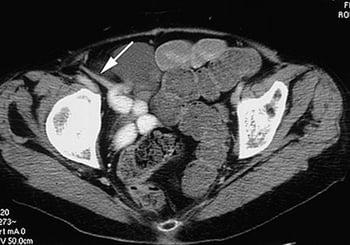
This axial image shows a Meckel diverticulum (arrow) containing oral contrast arising from the distal ileum.
Diagnosis reference
1. Hansen CC, Søreide K. Systematic review of epidemiology, presentation, and management of Meckel's diverticulum in the 21st century. Medicine (Baltimore). 2018;97(35):e12154. doi:10.1097/MD.0000000000012154
Treatment of Meckel Diverticulum
Surgery
Patients with intestinal obstruction caused by a Meckel diverticulum require early surgery. Detailed treatment of intestinal obstruction is discussed elsewhere.
A bleeding diverticulum with an indurated area in the adjacent ileum requires resection of the indurated bowel along with the diverticulum. A bleeding diverticulum without ileal induration requires resection of only the diverticulum.
Meckel diverticulitis also usually requires resection.
Small, asymptomatic diverticula encountered incidentally at laparotomy do not need to be removed. Controversy exists regarding the management of a Meckel diverticulum found incidentally during surgery (1, 2, 3). Some surgeons prefer to resect the diverticulum in children and young adults even when it is asymptomatic, in part because the presence of heterotopic tissue cannot be predicted prior to excision.
Treatment references
1. Tartaglia D, Cremonini C, Strambi S, et al. Incidentally discovered Meckel's diverticulum: should I stay or should I go?. ANZ J Surg. 2020;90(9):1694-1699. doi:10.1111/ans.16189
2. Zani A, Eaton S, Rees CM, Pierro A. Incidentally detected Meckel diverticulum: to resect or not to resect?. Ann Surg. 2008;247(2):276-281. doi:10.1097/SLA.0b013e31815aaaf8
3. Park JJ, Wolff BG, Tollefson MK, et al. Meckel diverticulum: the Mayo Clinic experience with 1476 patients (1950-2002). Ann Surg. 2005;241(3):529-533. doi:10.1097/01.sla.0000154270.14308.5f
Key Points
Meckel diverticulum is a common congenital (ie, retains all layers of the intestinal wall) sacculation of the antimesenteric border of the ileum that occasionally bleeds, becomes inflamed, or causes obstruction.
Up to 60 to 80% of diverticula of patients who present with complications such as painless lower gastrointestinal bleeding contain heterotopic gastric tissue that secretes hydrochloric acid, which can cause ulcers of the adjacent ileal mucosa and bleeding.
Patients with Meckel diverticulitis may have pain similar to that of appendicitis.
Select tests based on presenting symptoms.
A Meckel scan has high sensitivity for detection of Meckel diverticulum in children with rectal bleeding.
Remove symptomatic diverticula surgically.