Folliculitis is inflammation of hair follicles that is most commonly due to infection. Diagnosis is clinical. Treatment for most cases of bacterial folliculitis is with topical antimicrobials.
(See also Overview of Bacterial Skin Infections.)
The etiology of folliculitis is not well characterized, but perspiration, trauma, friction, and occlusion of the skin are known to potentiate infection.
The pathogen may be bacterial, fungal, viral, or parasitic.
Bacterial folliculitis is usually caused by Staphylococcus aureus, but occasionally Pseudomonas aeruginosa (hot tub folliculitis) or other organisms have been reported. Hot tub folliculitis occurs because of inadequate chemical treatment of water. It begins anytime from 6 hours to 5 days after exposure. Areas of skin covered by a bathing suit, such as the torso and buttocks, are the most common sites.
Fungal folliculitis is caused by dermatophyte, Malassezia furfur (risk factors include diabetes, glucocorticoids, and neutropenia), or Candida (seen in infants or in patients with prolonged antibiotic or corticosteroid use) infections.
Viral folliculitis is most commonly caused by herpesviruses.
Ectoparasitic infestation with Demodex mites can also lead to folliculitis.
Acne is a noninfectious form of folliculitis. Growth of stiff hairs into the skin may cause chronic low-grade irritation or inflammation that may mimic infectious folliculitis (pseudofolliculitis barbae).
Symptoms and Signs of Folliculitis
Symptoms of folliculitis include mild pain, pruritus, and irritation.
A sign of folliculitis is a superficial pustule or inflammatory nodule surrounding a hair follicle. Hairs in infected follicles fall out easily or may be removed by the patient, but new pustules tend to develop.

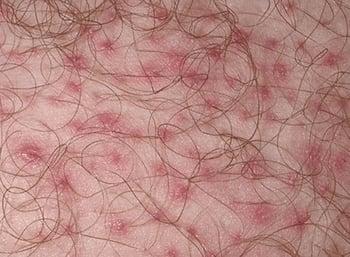
Folliculitis manifests as superficial pustules or inflammatory nodules surrounding hair follicles.
Diagnosis of Folliculitis
Primarily history and physical examination
The diagnosis of folliculitis is based on clinical evaluation; the primary skin finding suggesting folliculitis is a pustule with perifollicular inflammation. Patients with viral folliculitis may develop erythematous vesicles (in herpesvirus folliculitis) or pearly papules with a central umbilication (in molluscum).
Microbiologic testing is not routinely indicated, and treatment is usually initiated empirically. If empiric therapy does not result in a cure, or folliculitis recurs, pustules are Gram-stained and cultured to evaluate for gram-negative or methicillin-resistant S. aureus (MRSA) etiology, and nares are cultured to evaluate for nasal staphylococcal carriage. Potassium hydroxide (KOH) wet mount should be done on a plucked hair if there is clinical suspicion of fungal folliculitis.
Treatment of Folliculitis
Topical antimicrobials
Sometimes systemic antimicrobials
Because most bacterial folliculitis is caused by S. aureus, treatment with topical mupirocin or topical clindamycin is generally effective (1, 2). Alternatively, benzoyl peroxide 5% wash may be used for 5 to 7 days when showering. Extensive cutaneous involvement may warrant systemic therapy (eg, cephalexin for 5 to 10 days).
Hot tub folliculitis usually resolves without treatment. However, adequate chlorination of the hot tub is necessary to prevent recurrences and to protect others from infection.
Data on management of fungal, viral, or parasitic etiologies of folliculitis are limited, and treatment is usually directed towards the suspected or isolated organism (3).
Treatment references
1. Ramakrishnan K, Salinas RC, Agudelo Higuita NI. Skin and Soft Tissue Infections. Am Fam Physician. 2015;92(6):474-483.
2. Lopez FA, Lartchenko S. Skin and soft tissue infections. Infect Dis Clin North Am. 2006;20(4):759-vi. doi:10.1016/j.idc.2006.09.006
3. In Mandell, Douglas, and Bennett's Principles and Practice of Infectious Diseases (Tenth Edition). Philadelphia, Elsevier, 2026.
Key Points
Folliculitis can be caused by various pathogens and tends to be potentiated by perspiration, trauma, friction, and occlusion of the skin.
Bacterial folliculitis is usually caused by Staphylococcus aureus but occasionally Pseudomonas aeruginosa (hot tub folliculitis).
Treat most staphylococcal folliculitis with topical mupirocin or topical clindamycin.
Drug Information for the Topic